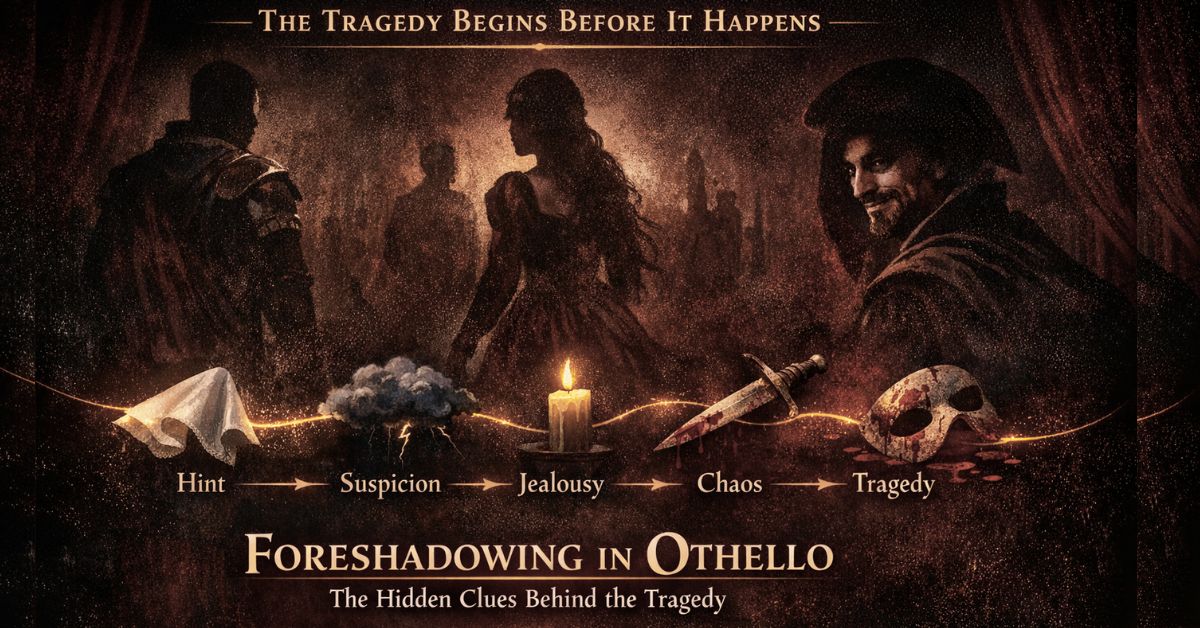
Foreshadowing in Othello is Shakespeare’s technique of planting early hints- through dialogue, symbols, and tone- that predict the tragic downfall of Othello and Desdemona.
I still remember walking into class, holding a piece of chalk like it was evidence in a crime scene, and asking my students, “What if I told you the tragedy begins long before the murder?” They looked puzzled. Good. That’s where learning begins.
In Othello, nothing happens suddenly. Shakespeare is too clever for that. He plants quiet clues, like seeds in dark soil, and lets them grow into catastrophe. A line here, a warning there, a symbol passed from hand to hand… and before we realize it, the ending has already been whispered in Act 1.
I always tell my students: if you listen carefully, the play tells you its secrets early. The tragedy doesn’t surprise us. It slowly traps us.
What Is Foreshadowing in Othello?
Foreshadowing in Othello simply means giving subtle hints about what will happen later in the story. But let me put it the way I explain it in class: it’s like Shakespeare leaving breadcrumbs- except these breadcrumbs lead us straight into tragedy.
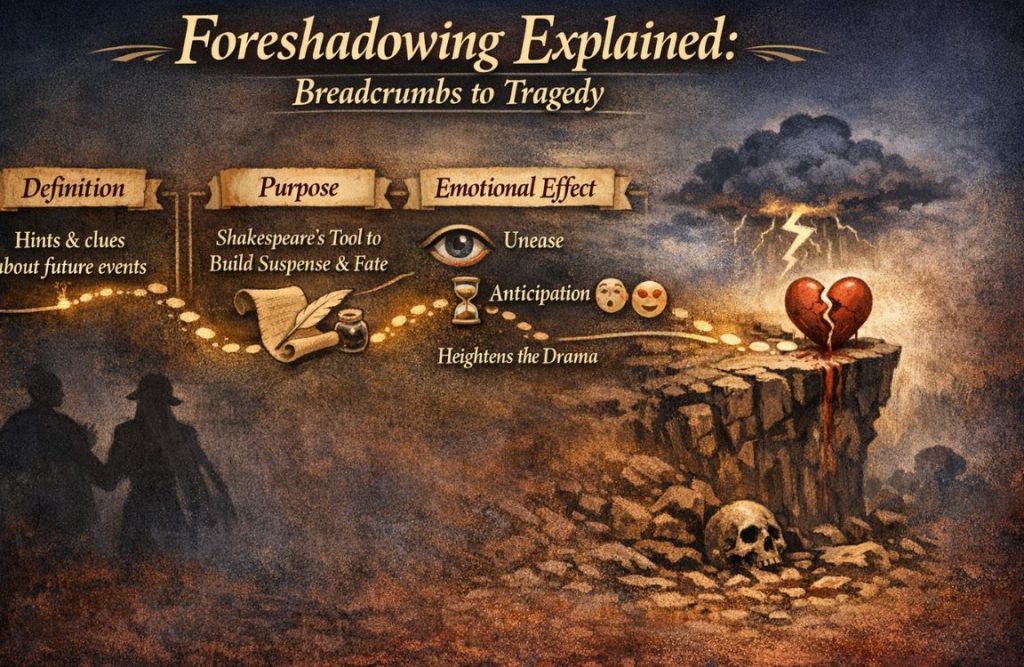
In a tragic play, events don’t just unfold. They feel psychological inevitability. That’s exactly what foreshadowing does. It prepares us, quietly, almost invisibly, for the emotional storm ahead.
Why does Shakespeare use it? Because he wants us to see the danger before the characters do. We become uneasy witnesses, watching choices being made, already sensing their consequences.
Take a simple moment: when a character speaks with absolute confidence about love or trust, I pause and ask my students, “Should we believe this, or fear it?” In tragedy, certainty often hides collapse.
So, foreshadowing is not just a technique. It’s a subtle hint system. And in Othello, the alarm starts ringing much earlier than we expect.
How Is Foreshadowing Used in Othello?
Foreshadowing in Othello works through dialogue, imagery, and Iago’s calculated hints, creating dramatic irony where the audience foresees tragedy long before Othello does.
Now, this is where I lean forward and tell my students: William Shakespeare plants clues in plain sight, but also sharpens them with precise examples.
First, dialogue carries hidden weight: Othello’s “Chaos” speech quietly predicts emotional collapse, while Iago’s early vows to turn virtue into “pitch” forecast ruin.
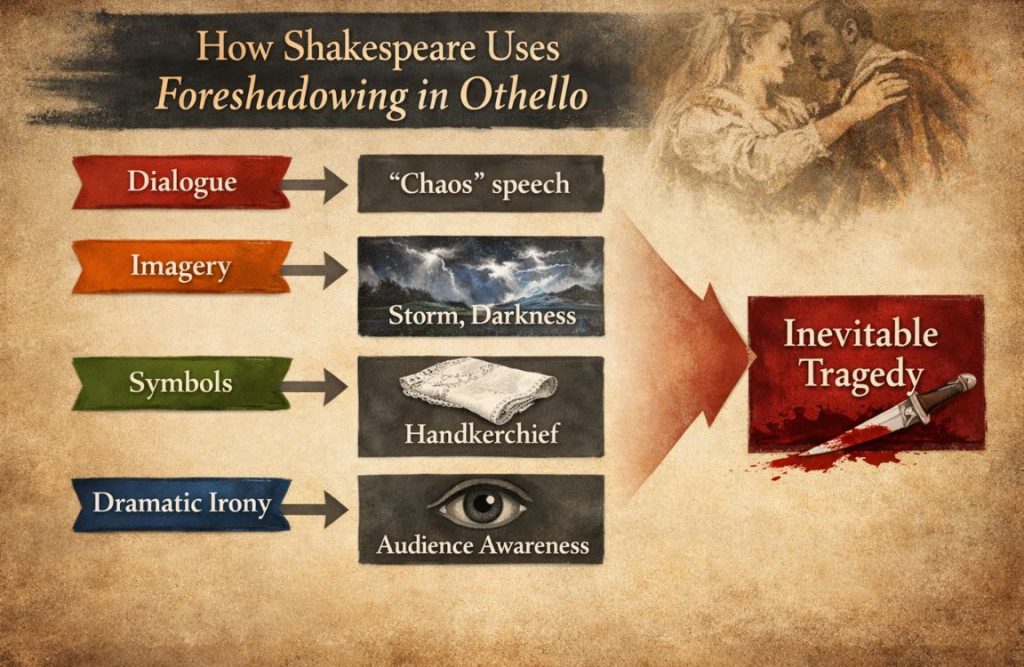
Then imagery. Storms, darkness, and turbulent language signal a mind losing control, culminating in the haunting Willow Song, where Desdemona unknowingly rehearses her fate.
Even objects speak: the handkerchief becomes a seed of suspicion long before it destroys trust.
But the real mastery lies in dramatic irony in Othello. Through Iago’s soliloquies, we see the trap forming step by step, while Othello walks toward it, unaware.
That helpless awareness is the engine of tragedy: we recognize every ominous clue, yet cannot stop the fall. Crucially, Shakespeare layers these hints so subtly that inevitability feels both shocking and unavoidable.
Foreshadowing as Control, Not Just Clue
Foreshadowing in Othello is not just a hint system; it is structural control, where Iago shapes events and perception, turning prediction into manipulation and tragedy into design.
I tell my students, “Don’t just ask what happens. Ask who controls when it happens.” And suddenly, everything points to Iago.
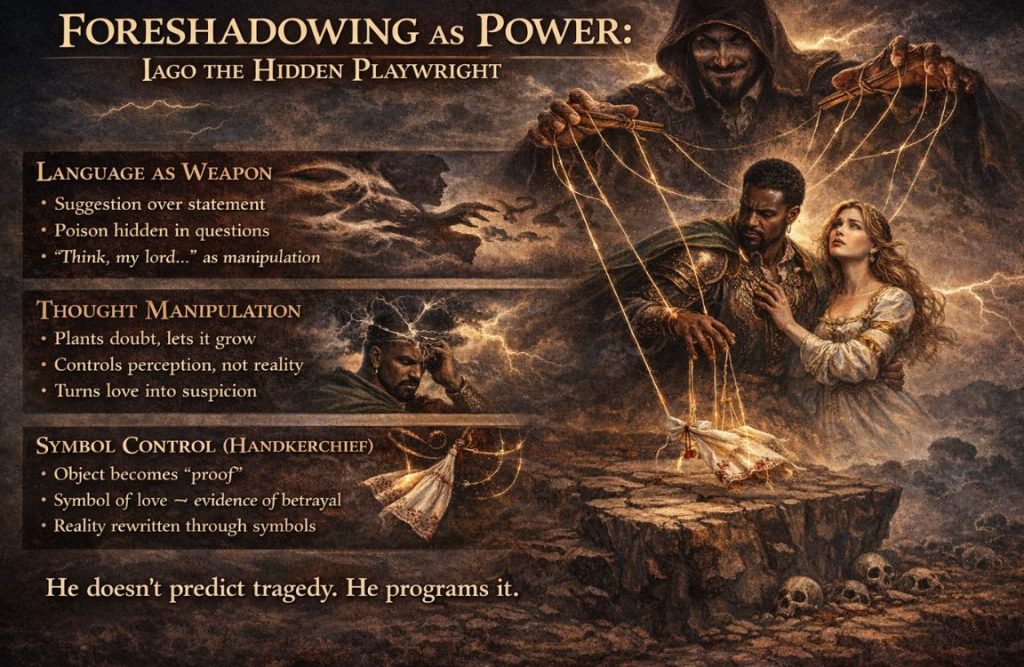
Here’s the twist: he doesn’t just exist inside the play. He directs it. Like a hidden playwright, he scripts reactions, times revelations, and feeds thoughts into Othello’s mind. When he warns of jealousy, he isn’t cautioning. He’s programming him.
Even Othello joins this control, staking his life on love, unknowingly scripting his fall. The handkerchief turns suspicion into “proof,” sealing perception.
So, foreshadowing is not passive. It is power- engineered, controlled, and devastating.
Examples of Foreshadowing in Othello
If you really want to see foreshadowing at work, don’t look for big moments; look for quiet lines that feel slightly uncomfortable. These foreshadowing quotes in Othello are like cracks in a wall; small at first, but they eventually bring everything down.
i) Iago’s Early Warnings (Foreshadowing Quotes in Othello)
I still remember writing on the board: “I am not what I am.” Then I turned to my students and asked, “Would you trust someone who tells you this?” Silence. Exactly.
Iago doesn’t hide. He reveals, but only to us. This line is one of the most powerful foreshadowing examples in Othello because it openly declares his duplicity. It’s almost as if he hands us the script of the tragedy in advance.
But he goes further. When he urges Othello to “observe” his wife, he plants suspicion like a seed. I tell my students, “The danger isn’t that Iago lies. It’s that others believe him when he finally does.” That contradiction drives everything.
ii) Othello’s Tragic Hints (Foreshadowing Examples in Othello)
Then comes Othello, and this is where I slow the class. He says, “My life upon her faith!”- a line glowing with certainty.
But certainty, in tragedy, is fragile. Later, he admits, “When I love thee not, chaos is come again.” That word, chaos, foreshadows his mental collapse.
I ask, “What happens when your whole world rests on one idea?” His absolute love predicts absolute ruin. Like a tower built too high, the fall becomes inevitable.
iii) Desdemona & Innocence (Subtle Foreshadowing Examples)
With Desdemona, foreshadowing softens but deepens. Her Willow Song quietly mirrors a betrayed woman’s fate, echoing her own end.
Even small details matter. The lost handkerchief becomes a symbol of broken trust, while her request to lay out wedding sheets eerily anticipates her deathbed. Emilia’s warning that jealousy is a “monster / Begot upon itself” sharpens the danger.
I often tell my students, “In tragedy, innocence doesn’t protect; it exposes.” These subtle foreshadowing lines whisper what is coming, and somehow, that makes the tragedy even harder to bear.
Foreshadowing in Othello Act by Act
If my students ever feel lost in the play, I tell them, “Track the foreshadowing act by act. It’s like following footprints toward the crime scene.” Each act doesn’t just move the plot forward. It quietly prepares the tragedy, step by step.
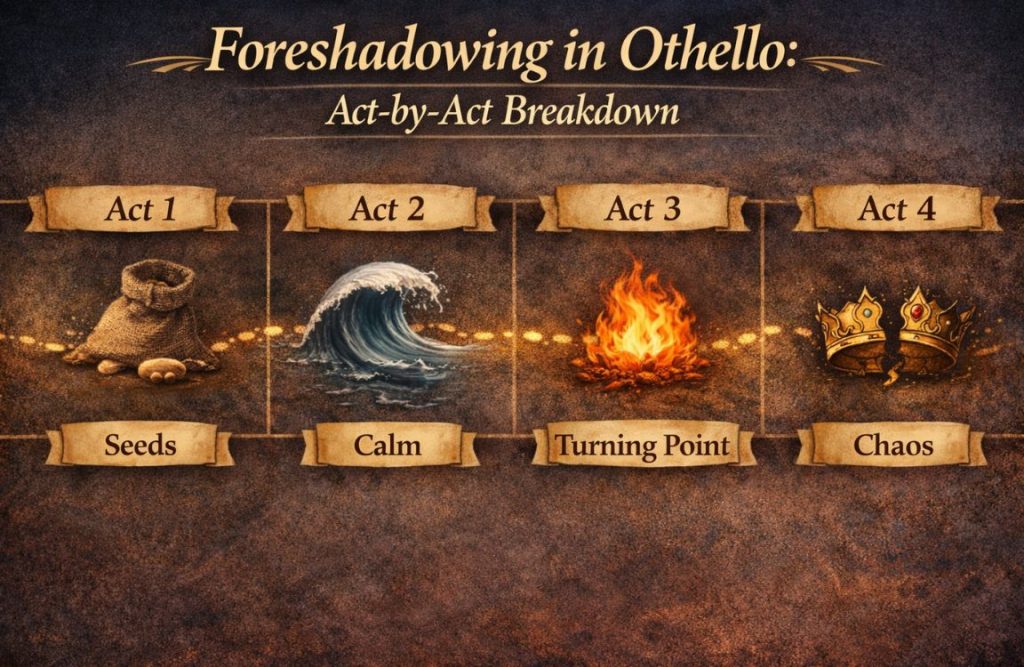
i) Foreshadowing in Othello Act 1 (Seeds of Tragedy)
Foreshadowing in Act 1 of Othello plants early signals through Iago’s deception, Brabantio’s caution, and racial tension, quietly signaling jealousy, mistrust, and the tragic downfall ahead.
I always begin here with a question: “What if the tragedy has already begun before Othello even appears?”
Iago sets everything in motion. His chilling line, “I am not what I am,” feels less like a confession and more like a promise. He isn’t reacting. He’s planning.
Then comes Brabantio’s warning: Desdemona deceived her father and may deceive her husband. I always emphasize to my students, “That single doubt is enough.”
Layer in racial imagery, and the danger deepens. Act 1 doesn’t explode. It whispers the future.
ii) Foreshadowing in Othello Act 2 (Calm Before the Storm)
Foreshadowing in Act 2 of Othello appears through deceptive calm, storm imagery, and Iago’s planning, quietly signaling emotional chaos, manipulation, and the tragic breakdown of trust ahead.
By Act 2, the surface feels peaceful. Cyprus looks like a fresh start. And that’s when I usually point out to my students, “In tragedy, calm is never innocent.”
The storm that destroys the Turkish fleet mirrors the chaos to come. Even Othello’s hopeful line about calm after the tempest feels dangerously ironic.
Meanwhile, Iago begins weaving his web, using small moments, like Cassio taking Desdemona’s hand, to set his trap. Nothing explodes yet, but everything is ready to.
iii) Foreshadowing in Othello Act 3 (The Turning Point)
Foreshadowing in Act 3 of Othello turns hints into action through the handkerchief, jealousy imagery, and shifting language, signaling the collapse of trust and the inevitability of tragedy.
This is where I slow down and tell my students, “Now, watch carefully. Prediction becomes reality.”
The handkerchief is no longer a small object. It becomes “proof,” carrying the weight of suspicion. I remind them, “In Shakespeare, objects speak louder than words.”
At the same time, Iago introduces the “green-eyed monster,” and Othello echoes “chaos,” unknowingly predicting his fall.
What once whispered now sharpens into certainty. The tragedy is no longer coming. It has already begun.
iv) Foreshadowing in Othello Act 4 (Descent into Chaos)
Foreshadowing in Act 4 of Othello reaches its peak through psychological collapse, symbolic songs, and violent behavior, clearly signaling Desdemona’s death and Othello’s irreversible descent into chaos.
By Act 4, I pause and ask, “Do you still recognize him?” Silence follows.
Othello unravels- his speech breaks, his mind distorts. Even his language shifts, echoing Iago’s influence.
Meanwhile, Desdemona’s Willow Song and her request for wedding sheets quietly predict her death.
I tell my students, “This is not just action. It’s transformation fulfilled.” The tragedy is no longer coming. It is already here.
How Foreshadowing Reveals Iago’s Character in Othello
Foreshadowing in Othello reveals Iago as a master manipulator whose words predict and control the tragedy, exposing his duplicity, psychological insight, and delight in destruction.
When I teach this, I advise my students, “Don’t just watch the tragedy. Watch who is writing it.” And all eyes turn to Iago.
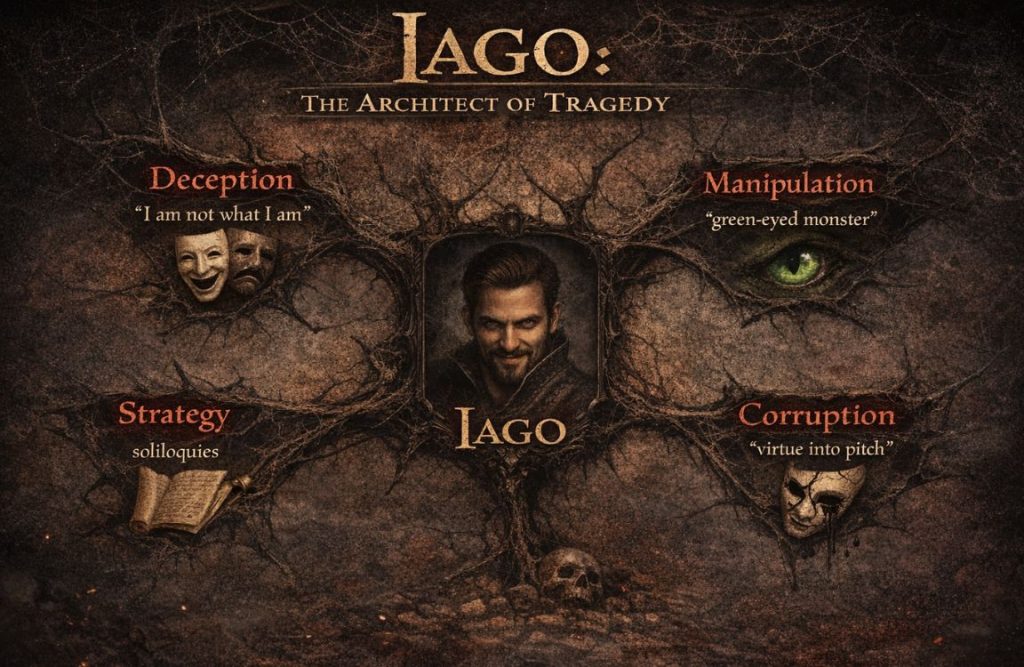
He doesn’t simply act. He orchestrates. His chilling line, “I am not what I am,” feels like a confession disguised as a forewarning. Through soliloquies, he outlines his plans, treating people like pieces in a game he already knows how to win.
What fascinates me is his method. He never commands. He suggests. He plants jealousy with phrases like the “green-eyed monster,” then steps back and watches it grow. He even plans to turn Desdemona’s virtue into “pitch,” corrupting goodness itself.
So, in any strong analysis of foreshadowing in Othello, I remind my students: Iago’s real power is not deception alone. It’s anticipation. He knows what will happen because he quietly sets it in motion.
Importance of Foreshadowing in Othello
Foreshadowing in Othello builds suspense, emotional tension, and inevitability, making the tragedy in Othello feel unavoidable while deepening audience awareness of betrayal, manipulation, and downfall.
If I had to explain this in one line, I’d say, “Foreshadowing makes the tragedy hurt before it happens.”
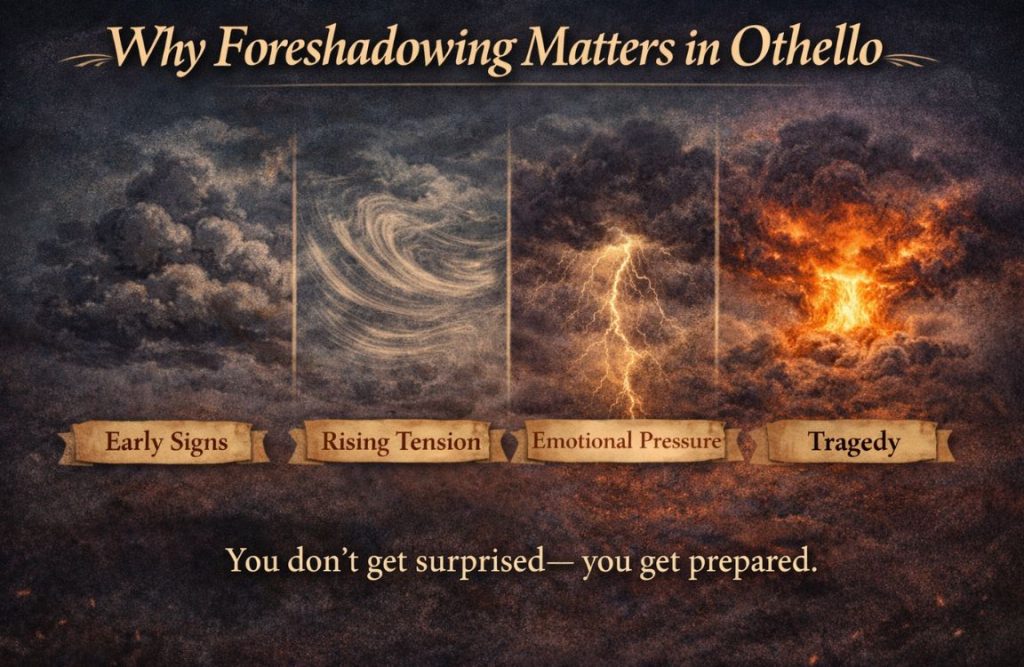
Tragic foreshadowing in Othello works like gathering storm clouds. We sense danger early, through Iago’s hints, ironic dialogue, and symbols like the handkerchief. That knowledge doesn’t protect us. It intensifies dread.
I often remind my students, “You’re not surprised. You’re prepared.” And that’s the brilliance. Each ominous sign, each uneasy line, builds pressure.
By the time events unfold, the ending of Othello feels inevitable. This is what transforms tragedy in Othello from a simple story into a haunting experience.
Summary of Foreshadowing in Othello
Foreshadowing in Othello shapes the tragedy through early hints, symbolism, and Iago’s manipulation, preparing the audience for the unavoidable downfall while the characters remain unaware.
Foreshadowing here is not just a technique. It is the silent architect of tragedy. Subtle lines, symbolic moments like the handkerchief, and echoes of “chaos” quietly predict destruction.
As I say to my students, “Nothing happens without warning. You just have to notice it.”
This Othello foreshadowing summary comes down to one idea: the tragedy is not sudden. It is carefully predicted. Shakespeare invites us to see the future unfolding, even as the characters remain unaware.
And perhaps that is the most unsettling lesson of all. We watch the fall coming, yet we cannot stop it.
FAQs:
How does foreshadowing affect the audience’s emotions in Othello?
Foreshadowing creates a sense of tension and emotional unease. As I like to tell my students, we don’t just watch events. We anticipate them. This anticipation makes the tragedy more painful because we sense the outcome long before it actually unfolds.
Why is Iago central to foreshadowing in the play?
Iago drives foreshadowing through his calculated hints and strategic language. I often say in class, “He doesn’t just act in the tragedy. He designs it.” His words quietly shape the future before others even realize what’s happening.
Is foreshadowing the same as dramatic irony in Othello?
Not exactly. Foreshadowing hints at future events, while dramatic irony occurs when the audience knows more than the characters. In Othello, they work together, making us aware of dangers that the characters fail to see.
Which act contains the strongest foreshadowing in Othello?
I often tell my students it begins in Act 1, but Act 3 is where it becomes most powerful. That’s where earlier hints start turning into visible consequences, making the tragedy feel immediate and unavoidable.
How can students identify foreshadowing in exams?
Look for unusual or heavy lines, repeated symbols, and moments of extreme certainty. I advise my students: “If a line feels too confident or too dark, pause; Shakespeare is probably hinting at something deeper.”
Conclusion:
Foreshadowing in Othello reminds us of one powerful truth: tragedy is never sudden. It is carefully prepared. As I reflect with my students, Shakespeare doesn’t shock us with the ending. He guides us toward it, step by step, clue by clue.
What makes his craft remarkable is not just what happens, but how early he lets us feel it coming. That quiet tension, that slow realization- that’s where the real tragedy lives.
And here’s what I always tell my class, with a knowing smile: “Once you see foreshadowing, you can never unsee it.”
So go back, re-read Act 1. Spot the hidden clues. And more importantly, use these insights in your exam answers. Because understanding foreshadowing doesn’t just make you a better reader. It makes you a sharper thinker.