I still remember the moment I paused in class, looked at my students, and asked: “Does Iago get punished… or does he somehow escape?” The room went quiet. After all, in Othello, we expect justice: swift, dramatic, and satisfying. But Shakespeare, ever the trickster, doesn’t give us that comfort.
If you’re wondering what happens to Iago at the end of Othello, or even asking, does Iago die in Othello, the answer is unsettling.
Because the truth is, the explanation of Othello’s ending reveals something far more disturbing than a simple death. Iago’s fate isn’t just punishment. It’s a lingering shadow. While others fall dramatically, Iago remains. Silent. Defiant.
And that silence? It might just be the most chilling ending of all.
What Happens to Iago at the End of Othello?
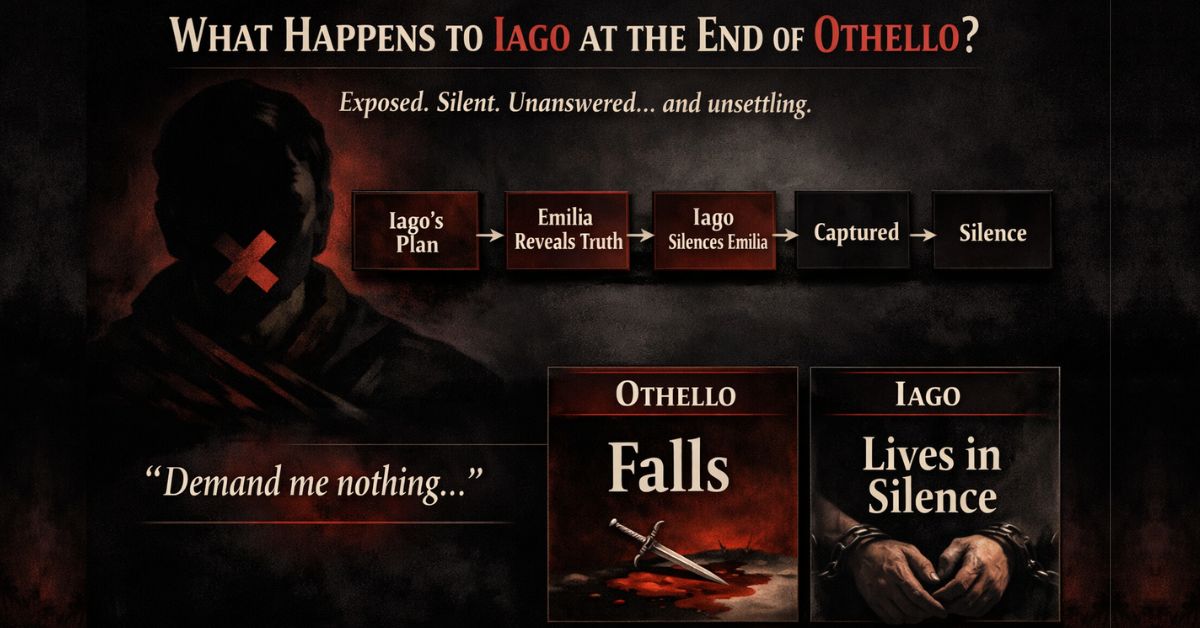
At the end of Othello, Iago is exposed, wounded but not killed, arrested, and taken away to face torture and execution. He refuses to explain his motives, choosing silence instead.
Now, let me walk you through this carefully as I would in a live class.
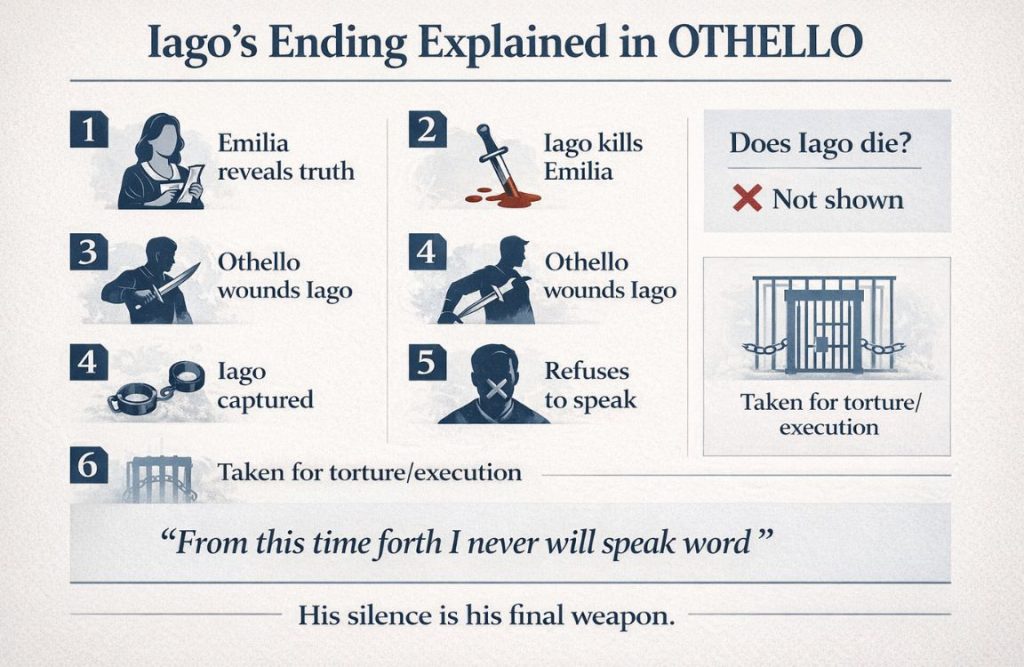
By the final act, Iago’s web of lies collapses when Emilia reveals the truth about the handkerchief. In a desperate move, Iago kills her, his last attempt to control the narrative. Othello, enraged, wounds him, but Iago chillingly replies, “I bleed, sir, but not kill’d.”
Captured and disgraced, Iago faces justice under Cassio’s authority. Yet here’s the twist I always emphasize: he refuses to speak.
“Demand me nothing… From this time forth I never will speak word.”
And just like that, he chooses silence, not as surrender, but as control.
Finally, Iago is taken away to be tortured and eventually executed, but Shakespeare doesn’t show us his death. Instead, he leaves Iago alive at the end, broken, yet eerily in control of his own story.
Here’s the contrast I always highlight: Othello dies seeking redemption. Iago lives, denying it.
In fact, some critics call him “motiveless malignity”, evil without reason. But what if his silence is the real answer?
Table of Contents
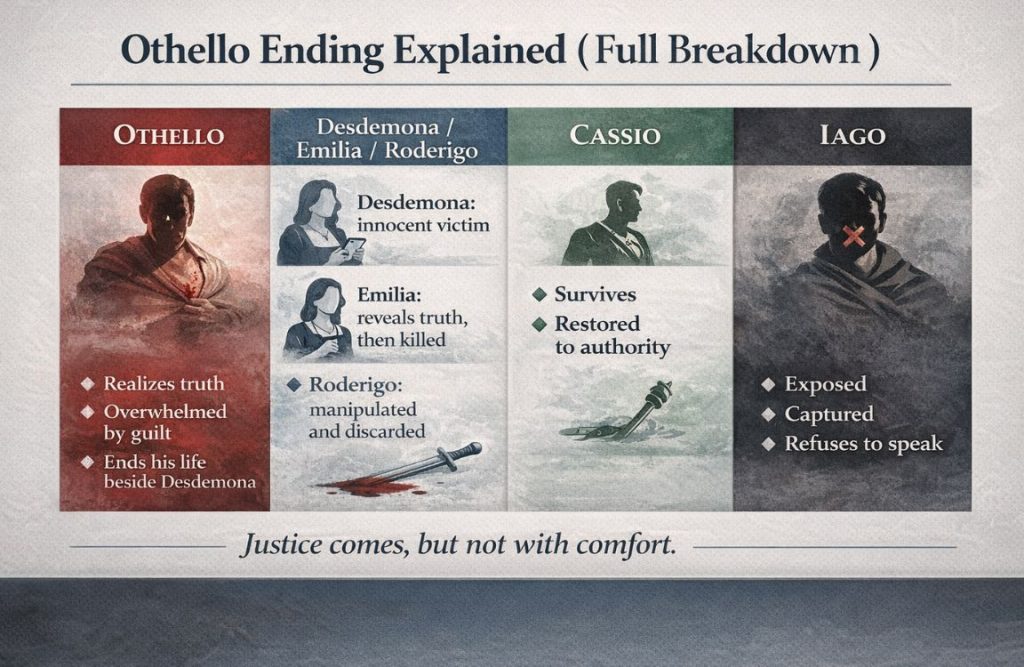
Othello Ending Explained (Full Breakdown)
In this final unraveling, we witness truth, guilt, justice, and tragic loss. Let’s break down what happens to each major character, and why Shakespeare’s ending still unsettles readers today.
i) What Happens to Othello at the End
At the end of Othello, Othello realizes Desdemona’s innocence, is overwhelmed by guilt, and kills himself beside her.
Ah, Othello, the tragic hero. When Emilia exposes Iago’s lies, truth shatters him. If you’re asking why Othello kills himself, it is because he cannot live with the guilt of murdering Desdemona. He delivers a final speech, then stabs himself.
So, how does Othello die? Othello dies by suicide, an act of punishment and a loss of honor. He dies beside Desdemona, kissing her.
I always tell my students: Othello does not just die from guilt, but from a shattered identity and love.
ii) What Happens to Desdemona, Emilia, and Roderigo
Let’s pause here, because this is where the tragedy deepens.
If you’re wondering who dies in Othello, the list is painfully long.
Desdemona, innocent and loving, is suffocated by Othello in a heartbreaking scene. That answers how Desdemona dies, not by fate, but by misplaced trust.
Emilia, however, becomes the moral voice of the play. She exposes Iago’s villainy, an act of courage I deeply admire. But it costs her life. If you ask what happens to Emilia in Othello, the answer is simple yet tragic: she is murdered by her own husband.
And Roderigo? Used, manipulated, and ultimately discarded. He, too, is killed by Iago to keep the truth hidden.
iii) What Happens to Cassio at the End of Othello
Cassio in Othello survives Iago’s plot, though wounded, and becomes the governor of Cyprus.
Now, here’s a rare glimmer of stability. If you’re asking, does Cassio die? The answer is a big NO. He lives. Attacked by Roderigo and injured, he survives as Iago’s treachery is exposed.
By the end, Cassio is restored and given authority, even overseeing Iago’s punishment. But I always tell my students: his survival is not victory. It’s the burden of restoring order after tragedy.
Why Iago Does Not Die at the End of Othello
Iago in Othello does not die on stage. Instead, he is arrested to face torture and execution, making Iago’s punishment psychological and unresolved rather than immediate death.
Let me take you into a real classroom moment. I lean in and ask, “Does Iago die in Othello?” Then I pause, because Shakespeare quietly denies us that satisfaction. Iago does not die on stage.
Death would end the story. But Iago’s punishment is far more unsettling.
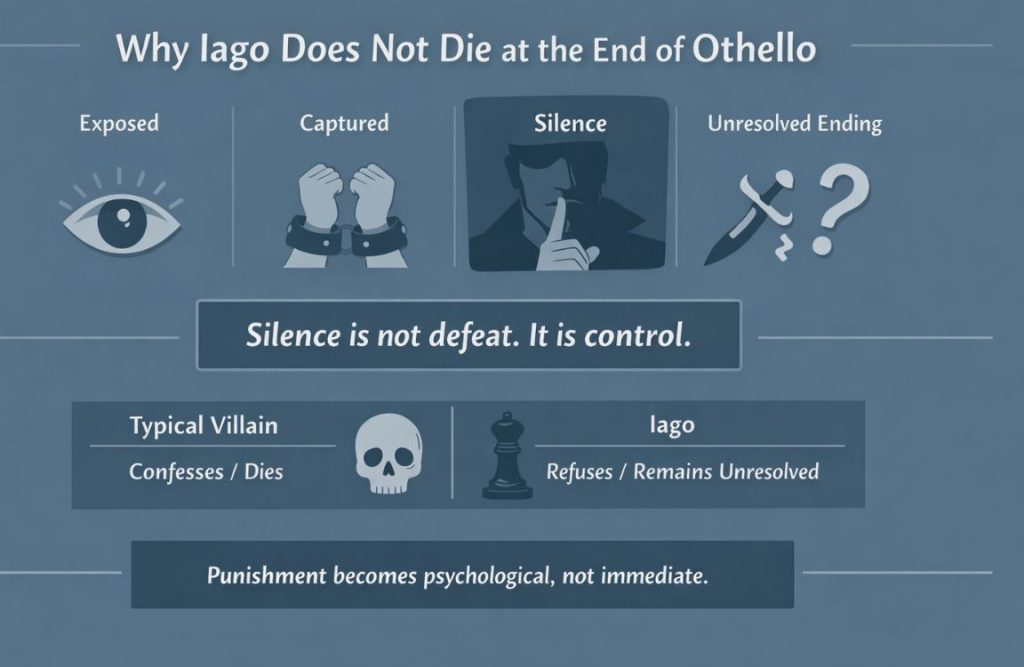
Exposed and stripped of power, he chooses silence: “Demand me nothing… I never will speak word.” This is not defeat. It’s defiance. He refuses explanation, keeping control even in capture.
And here’s the deeper truth I often share with my students: Iago represents a kind of evil that cannot be neatly explained or erased. His survival shifts justice from personal revenge to the state, where he faces torture and likely execution.
Unlike other villains, he does not repent or resolve.
That is why Iago’s punishment lingers. He lives, quiet and unknowable.
And honestly, that feels far worse than death.
Iago’s Punishment and Final Fate Explained
In this section, I’ll walk you through Iago’s final fate, whether he is executed, what punishment he faces, and why his haunting silence becomes the most powerful and unsettling moment in the play.
i) Is Iago Executed in Othello?
Now, let’s address the question directly, the one examiners love: what happens to Iago’s fate?
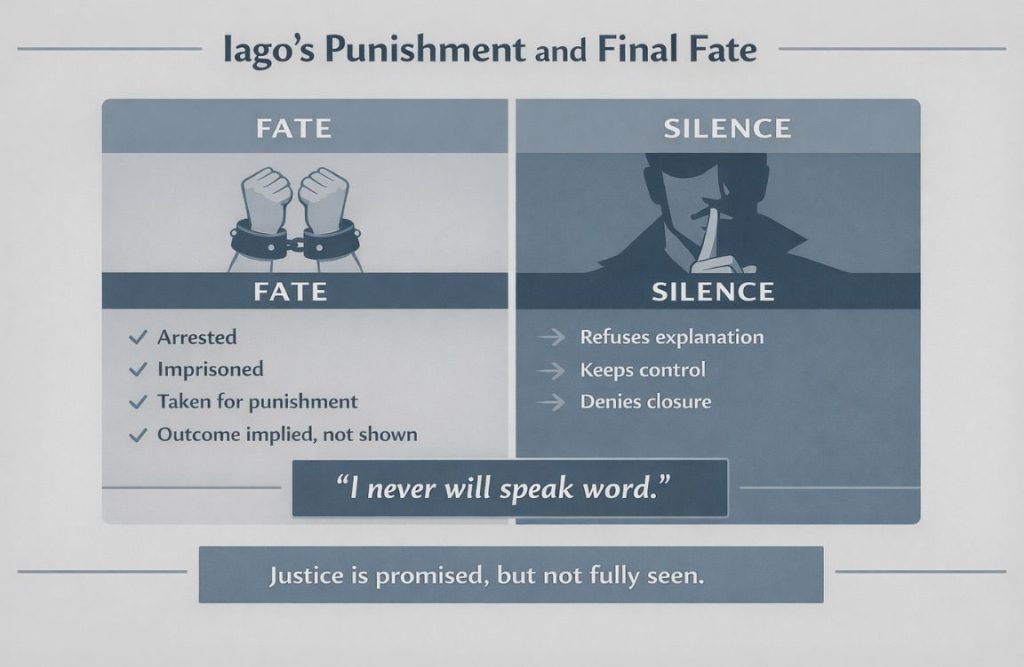
At the end of Othello, Lodovico takes control of the situation. Justice, at last, begins to take shape. He orders that Iago be taken away, imprisoned, and punished.
Is Iago executed? The play strongly implies it, but does not show it.
And here’s where I always nudge my students to think critically. Shakespeare doesn’t stage Iago’s death. Instead, Lodovico declares that Iago will be tortured before facing execution. This suggests prolonged suffering rather than immediate justice.
So, while we can reasonably assume execution awaits him, the focus is not on when he dies, but on how he suffers before it happens.
That lingering uncertainty keeps the audience uneasy. Justice is promised, but not neatly delivered.
ii) Why Iago Refuses to Speak at the End of Othello?
Ah, this is my favorite teaching moment.
When Iago says, “I never will speak word,” it becomes his final, and perhaps greatest, manipulation. If you’re exploring the Iago final speech or the meaning of Iago’s silence, this is where the real depth lies.
You see, throughout Othello, Iago controls everything through language. He twists words, plants ideas, and engineers destruction. So what happens when he chooses silence?
He takes back control.
By refusing to explain himself, he denies both the characters and us the satisfaction of understanding him. It’s a brilliant, almost cruel move. Even in defeat, he controls the narrative.
After being arrested, Iago is powerless physically, but psychologically, he remains untouchable.
His silence becomes his final weapon. And perhaps, his darkest legacy.
Iago’s Ending vs Othello’s Ending (Key Contrast)
Now, let’s place these two side by side, because this contrast is the heart of the tragedy.
In Othello, Othello and Iago meet very different ends, and I often sum it up for my students with a metaphor:
Othello burns fast. Iago rots slowly.
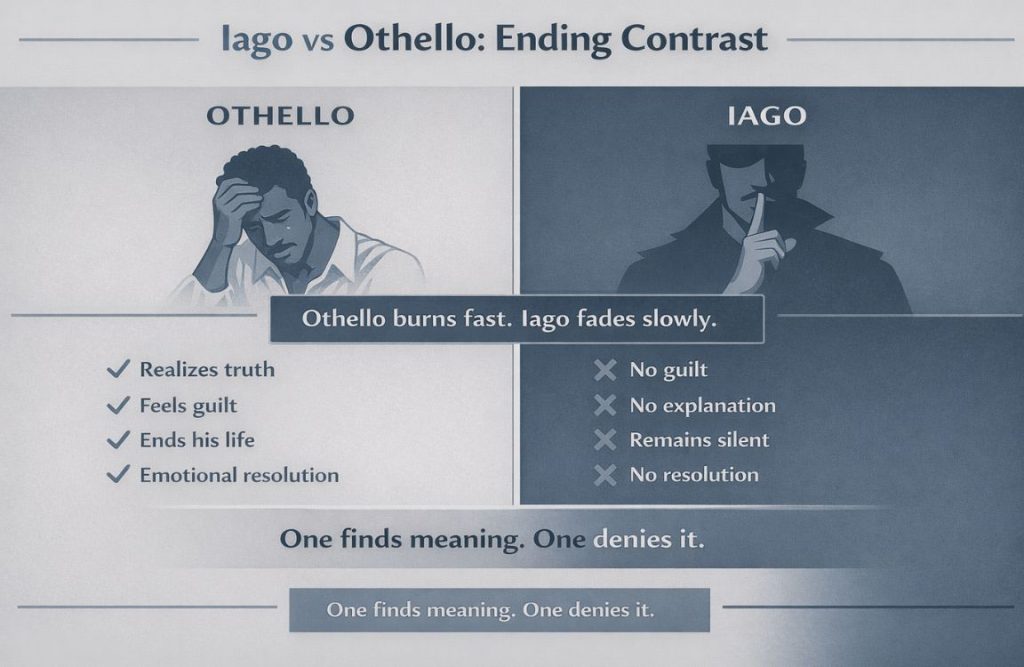
Othello, the tragic hero, reaches a moment of painful clarity. He sees the truth, feels overwhelming guilt, and chooses death. His end is dramatic, emotional, and, in a way, cleansing. This is a classic tragic hero vs villain structure.
Iago, on the other hand, experiences no such awakening. No guilt. No remorse. His ending is defined by silence and suffering, not redemption.
If you’re writing about the Othello vs Iago ending, here’s the key insight:
Othello’s death gives meaning to his tragedy. Iago’s survival denies meaning altogether.
And that, as I often point out to my students, is what makes Iago truly terrifying, not what he does, but what he refuses to become.
Key Quotes About Iago’s Ending (With Meaning)
Whenever we reach the final scene of Othello in class, I slow down. I advise my students, “Now listen carefully, this is where Iago becomes most dangerous, not least.”
The first quote I write on the board is: “Demand me nothing. What you know, you know.”
Here, Iago refuses truth itself. No confession, no clarity. I call this the moment language collapses.
Then: “From this time forth I never will speak word.” These are Iago’s final lines that define him. Silence becomes strategy, not defeat.
And notice: “I bleed, sir, but not kill’d.” Even wounded, he remains defiant.
Scholars call this “motiveless malignity”, evil without explanation. Iago leaves us with no answers, only unease.
I always tell my students: Shakespeare gives us a villain who exits not with a scream, but with a locked door, and we are left outside, still knocking.
What I Tell My Students About Iago’s Ending
Let me be honest, this is the moment when my classroom goes very quiet.
When we discuss Othello, I don’t just teach Iago’s character analysis as theory. I ask my students to feel it.
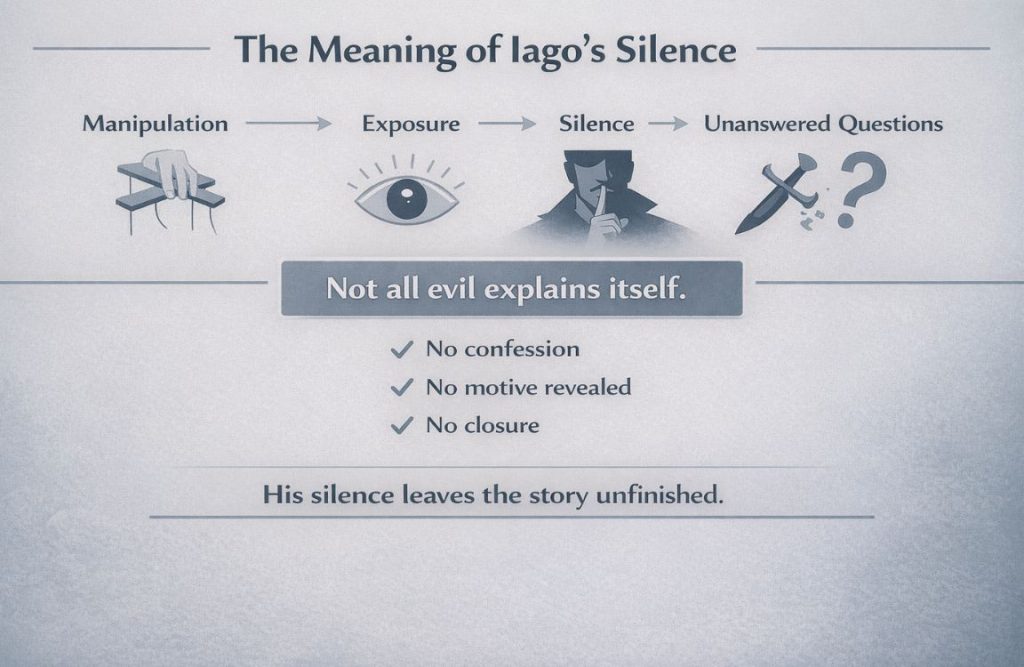
I often say, “Not all villains confess. Not all evil explains itself.”
Iago, the ultimate villain in Othello, never breaks down, apologizes, or reveals a clear motive. And that’s exactly what makes him so terrifying. In life, as in literature, we don’t always get closure.
His silence becomes a mirror. We search for reasons, but find none.
So when students ask me about the deeper meaning of Shakespeare’s Iago, I say this: he represents a kind of darkness that cannot be neatly explained or resolved.
And perhaps that’s Shakespeare’s final lesson: sometimes, the most dangerous thing isn’t what evil says… but what it refuses to say.
FAQs:
Why is Iago’s silence important at the end of Othello?
I tell my students, silence is Iago’s final weapon. In Othello, his refusal to speak denies truth, closure, and justice. It keeps his motives mysterious, making his evil linger beyond the play.
Does Shakespeare clearly show Iago’s death?
No, and that’s intentional. Shakespeare never stages Iago’s death in Othello. His execution is implied, but left unseen, shifting focus from death to psychological punishment and unresolved tension.
Why is Iago considered more terrifying than other Shakespearean villains?
Unlike villains who confess or justify, Iago offers nothing. In Othello, his lack of a clear motive and final silence make him unpredictable, almost like a shadow you cannot fully see or understand.
What lesson does Iago’s ending teach about evil?
I often say, evil doesn’t always explain itself. In Othello, Iago teaches us that some darkness resists logic, apology, or closure, leaving us unsettled and searching for answers that never come.
How does Iago’s fate affect the overall tragedy of Othello?
Iago’s survival deepens the tragedy. While others die, he remains, wordless and unresolved. In Othello, this imbalance denies emotional closure, making the ending more haunting and intellectually disturbing.
Conclusion:
So, when my students finally ask me, what happens to Iago at the end of Othello, I give them this answer: he lives just long enough to suffer, and then disappears into silence. No confession. No clarity. Just consequences.
And that, I believe, is the true meaning of Othello’s ending. Not justice neatly served, but justice that unsettles us. Iago’s fate is a living punishment, one that forces us to sit with discomfort rather than escape it.
Before you close Othello, let me leave you with this thought:
Next time you read Othello, ask yourself, what’s more frightening: a villain who speaks… or one who refuses to?
If this made you think a little deeper, share your thoughts or questions. I’d love to hear how you interpret Iago’s silence.
Iago does not end the tragedy. He leaves it unfinished.