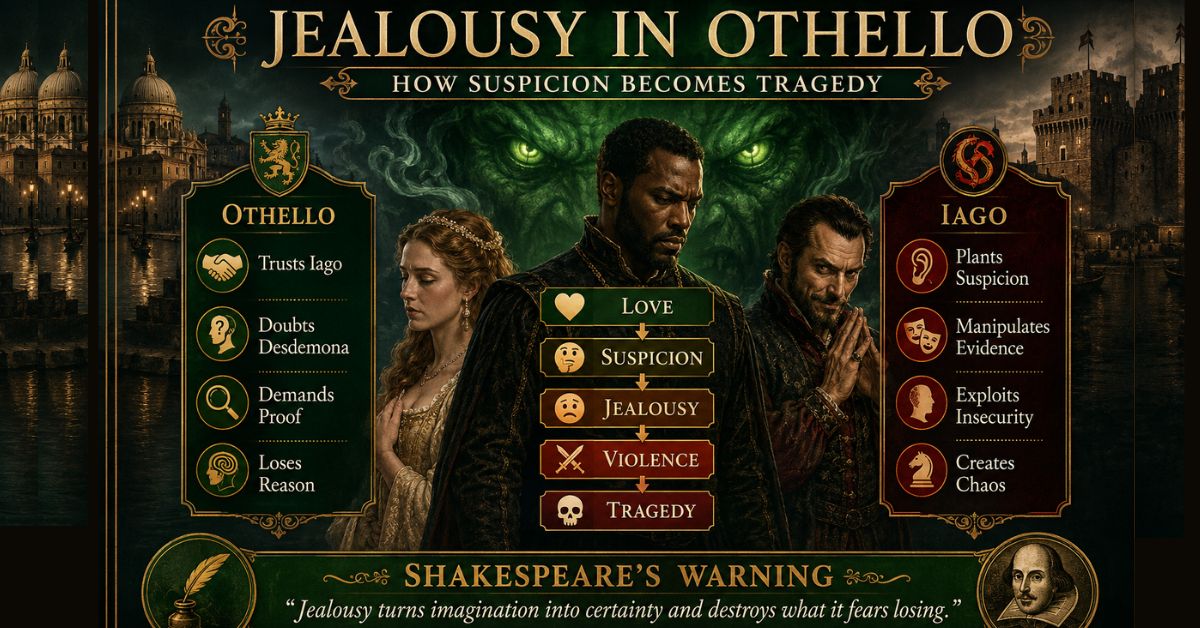
I always tell my students that words become dangerous in Othello before weapons are drawn. You see, Iago rarely needs to invent an entire story. Instead, he precisely manipulates the meaning of ordinary things: a glance, a conversation, a whisper, or a handkerchief, until suspicion begins to resemble evidence.
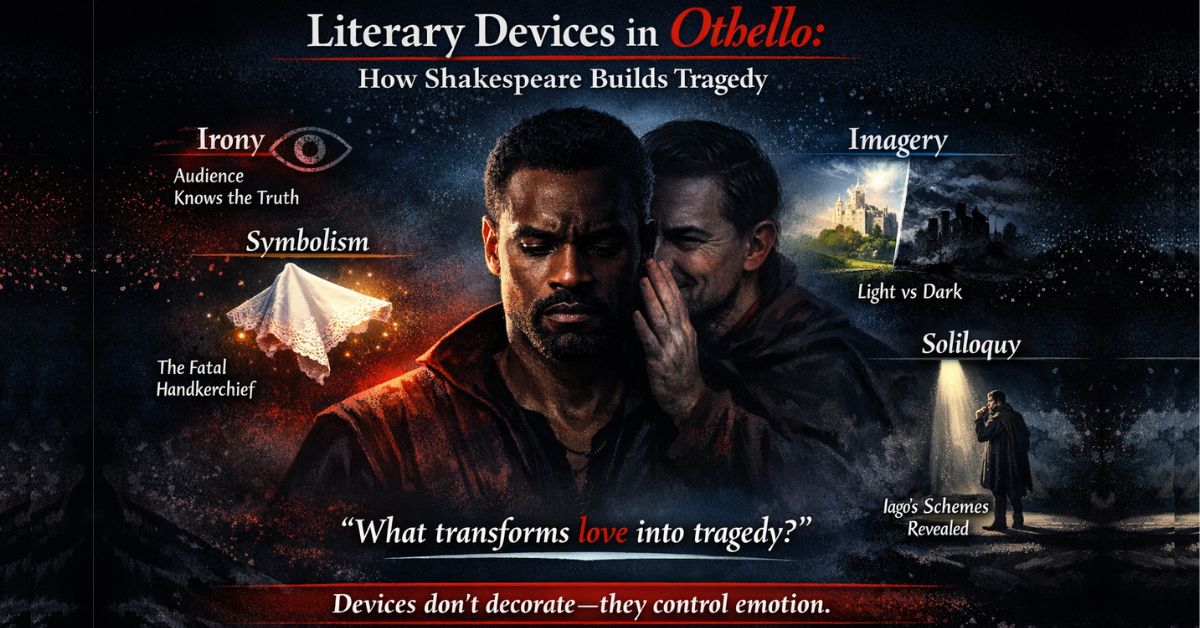
The major literary devices in Othello include dramatic irony, imagery, symbolism, metaphor, simile, allusion, foreshadowing, paradox, oxymoron, personification, hyperbole, repetition, and rhetorical questions.
The play also develops recurring motifs and uses soliloquies, asides, situational irony, and shifts in tone to deepen its exploration of jealousy, prejudice, and deception. Together, these techniques help Shakespeare explore how prejudice, misplaced trust, jealousy, and distorted interpretation lead to tragedy.
Literary Devices in Othello at a Glance
| Literary device | Example | Main effect |
| Dramatic irony | “honest Iago” | Contrasts Othello’s belief with the audience’s knowledge |
| Imagery | “an old black ram” and “your white ewe” | Combines animal imagery with racial prejudice |
| Symbolism | The handkerchief | Turns an object into supposed evidence of infidelity |
| Metaphor | “green-eyed monster” | Compares jealousy to a threatening creature |
| Simile | “Like the base Indian, threw a pearl away” | Expresses Othello’s recognition of his mistake |
| Biblical allusion | “I am not what I am” | Reverses biblical language |
| Foreshadowing | Brabantio’s warning | Gains significance through later events |
| Paradox | “I am not what I am” | Expresses a contradiction between appearance and intention |
| Oxymoron | “excellent wretch” | Combines conflicting emotional implications |
| Personification | “doth mock / The meat it feeds on” | Gives jealousy predatory agency |
| Hyperbole | “I had rather be a toad” | Exaggerates Othello’s distress |
| Repetition | “Put out the light” | Connects extinguishing a candle with death |
| Rhetorical question | “And what’s he then that says I play the villain?” | Exposes Iago’s self-justifying reasoning |
| Situational irony | Othello trusts Iago | Makes misplaced trust an instrument of destruction |
| Motif | Sight and blindness | Connects vision with judgment |
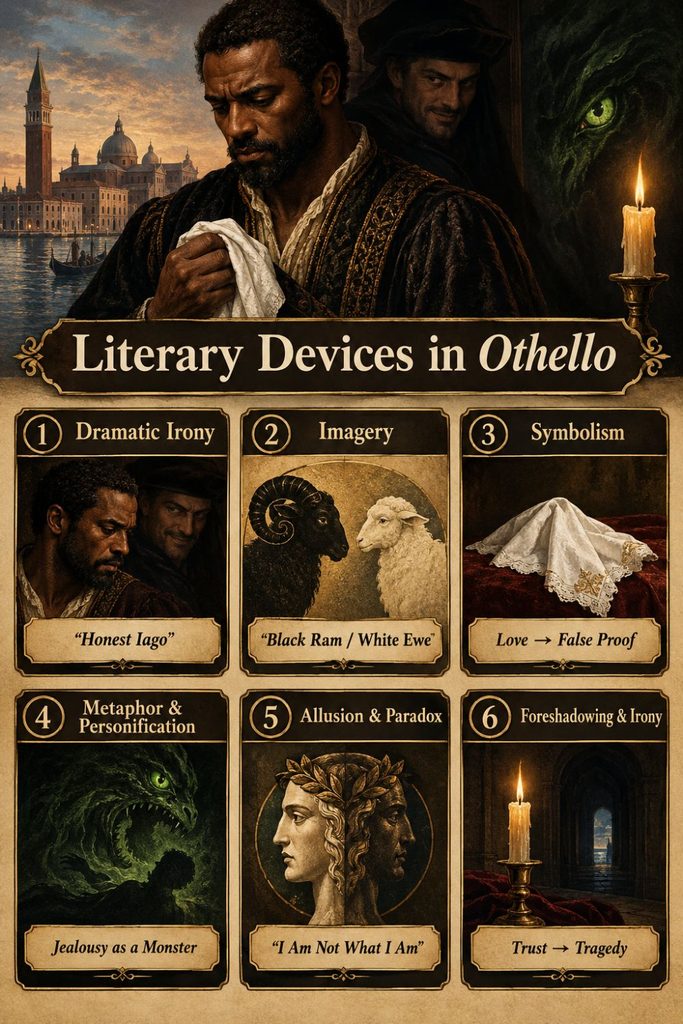
Table of Contents
Dramatic Irony in Othello
Dramatic irony occurs when the audience knows something that a character does not. In Othello, spectators discover Iago’s intentions while Othello continues to trust him.
The repeated description “honest Iago” makes this contrast especially powerful. Othello uses the phrase to express confidence in his ensign, but the audience knows that Iago is deceiving him. The word “honest” becomes bitterly ironic because Iago’s reputation protects his dishonesty.
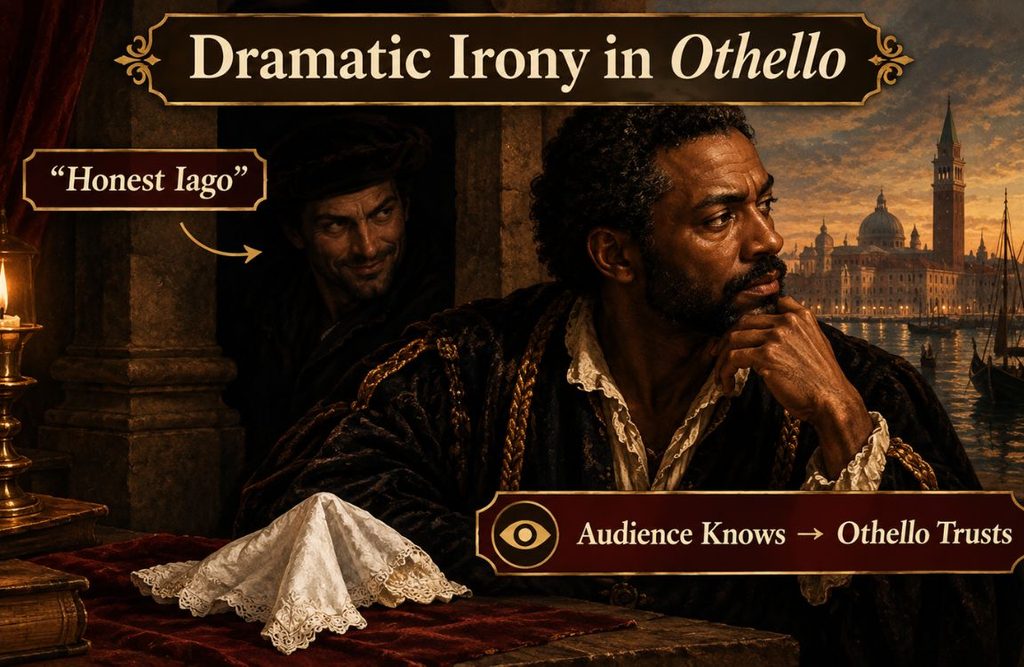
The same device shapes Othello’s suspicion of Desdemona. He believes she has been unfaithful. But what does the audience know?
Desdemona is innocent. The audience knows that Iago has manipulated the circumstances, so Othello’s growing certainty creates anxiety instead of reassurance.
The handkerchief intensifies the irony. Othello treats its apparent connection with Cassio as proof of adultery, but spectators know that Iago has arranged its movement.
The audience sees the difference between an object and the meaning Othello assigns to it. His tragedy grows from treating manipulation as knowledge.
Imagery in Othello
Imagery uses descriptive language to create sensory impressions and make ideas vivid. Shakespeare draws on animals, poison, disease, sight, and darkness to dramatize prejudice and suspicion.
i) Animal Imagery
In Act 1, Scene 1, Iago tells Brabantio:
“an old black ram / Is tupping your white ewe”
The comparison combines animal imagery with racialized language and sexual provocation. The contrast between “black” and “white” exploits Brabantio’s racial prejudice, while the animal terms dehumanize Othello and Desdemona.
Iago also calls Othello a “Barbary horse” and describes the couple as a “beast with two backs.” These crude expressions turn a marriage into a spectacle of sexual shame.
Iago does not offer evidence of wrongdoing. He tries to provoke disgust before Brabantio can judge the situation fairly. The imagery exposes how racist language can influence a person’s response before reason has a chance to intervene.
ii) Disease and Poison Imagery
Iago describes his plan as something that can infect Othello’s mind:
“I’ll pour this pestilence into his ear”
The image makes speech resemble a disease entering the body. Iago’s words are not physically violent, yet they begin to corrupt Othello’s judgment.
Similarly, “Dangerous conceits are in their natures poisons” compares harmful ideas to toxins. Suspicion may initially seem small, but it becomes destructive when Othello accepts it without reliable proof.
Disease and poison imagery therefore give psychological manipulation a physical force: Iago’s lies spread through Othello’s thinking until he can no longer distinguish fear from fact.
iii) Sight and Blindness
Sight often suggests knowledge, while blindness represents failures of judgment. Othello demands proof, but he misreads staged evidence and remains blind to Iago’s deception. Desdemona offers a contrasting perspective when she says:
“I saw Othello’s visage in his mind”
She values his inner character rather than judging him by outward appearance. Othello, however, increasingly trusts appearances that Iago has carefully arranged. This contrast makes sight more than a physical sense: it becomes a question of how people interpret what they see.
Symbolism in Othello
The handkerchief is the play’s central symbol. It represents the bond between Othello and Desdemona, carrying emotional significance beyond its physical form. Iago exploits that significance by arranging for the handkerchief to reach Cassio.
Othello treats its apparent transfer as proof of infidelity, although it establishes nothing about Desdemona’s conduct. The object has not changed its physical nature. Its meaning has changed in Othello’s mind. A token of love becomes supposed evidence of betrayal because he trusts Iago’s interpretation.
The candle in the final scene provides another powerful symbol in Othello. Othello says:
“Put out the light, and then put out the light.”
The first light refers to the candle, while the second anticipates Desdemona’s death. The repeated phrase connects an ordinary action with an irreversible decision. The handkerchief and candle serve different functions, but both help dramatize how meaning, once distorted, can contribute to destruction.
Metaphor in Othello
A metaphor describes one thing through another. Iago’s famous phrase “green-eyed monster” compares jealousy to a threatening creature. He warns Othello:
“O, beware, my lord, of jealousy; It is the green-ey’d monster which doth mock The meat it feeds on.”
Jealousy in Othello becomes a predator that consumes its victim. The image suggests that the emotion damages the person who experiences it, making Othello’s growing suspicion destructive to his own peace of mind.
Iago’s warning is ironic because he deliberately encourages the jealousy he claims to fear. His language sounds protective, allowing him to influence Othello while appearing loyal. Another metaphor occurs when Iago says:
“Our bodies are our gardens.”
The comparison presents human conduct as something that can be cultivated. It suggests that people have some control over their actions, while also reflecting Iago’s calculated effort to cultivate suspicion in Othello.
Simile in Othello
A simile compares things using “like” or “as.” After killing Desdemona, Othello reflects:
“Like the base Indian, threw a pearl away.”
Othello compares himself to someone who discards a precious pearl. The pearl represents Desdemona and the love he has destroyed. He finally recognizes her value, but this understanding comes too late to undo his actions.
The quotation has a textual complication. The First Folio reads “Iudean,” while the First Quarto reads “Indian.” The figure’s identity and the implications of the different readings remain disputed. It is therefore unwise to present one interpretation as unquestionably correct.
The comparison’s dramatic force, however, remains clear: Othello sees himself as someone who has thrown away something precious. His regret is sharpened by the irreversibility of Desdemona’s death.
Allusion in Othello
An allusion refers indirectly to another text, tradition, or cultural idea. Iago’s statement “I am not what I am” recalls the biblical wording associated with God’s self-identification in Exodus 3:14, commonly rendered “I AM THAT I AM.”
The reversal is significant. The biblical phrase affirms divine identity, while Iago’s version points to the gap between his public image and private intentions. He appears honest while concealing his malicious plans.
Iago also swears “By Janus,” invoking the Roman god associated with two faces. The reference suits a character who maintains a respectable public appearance while hiding his true intentions. Both allusions in Othello encourage the audience to question what lies behind appearances.
Foreshadowing in Othello
Foreshadowing occurs when an earlier statement anticipates or gains significance through later events. Brabantio warns Othello:
“She has deceived her father, and may thee.”
The warning becomes ominous when Othello later suspects Desdemona of betrayal. However, it does not prove that she is dishonest. Brabantio’s statement acquires its tragic force because Othello eventually interprets it through jealousy.
The storm in Cyprus also anticipates the turmoil that follows. The Turkish fleet is destroyed by the storm, but the characters face another kind of conflict: deception and suspicion within their relationships. Foreshadowing prepares the audience for later developments without making those developments inevitable.
Paradox in Othello
A paradox expresses an apparent contradiction that reveals a deeper truth. Iago’s “I am not what I am” qualifies because his public reputation conflicts with his private intentions.
He appears honest while deliberately deceiving others. The line is also a biblical allusion, but the terms describe different features: the allusion concerns its connection with scripture, while the paradox emphasizes the contradiction within Iago’s identity.
The play also creates a moral contradiction through Othello’s actions. He believes he is punishing betrayal, yet kills an innocent woman. His attempt to restore justice becomes an act of profound injustice.
Oxymoron in Othello
An oxymoron combines apparently contradictory terms. Othello calls Desdemona an “excellent wretch,” bringing admiration and distress together in one expression.
The phrase reflects his divided feelings. Desdemona remains precious to him, but jealousy has distorted the way he understands her. His affection has not simply disappeared. It has become entangled with suspicion and hostility.
The tension between the words makes his emotional conflict audible. Othello cannot reconcile his love for Desdemona with the false belief that she has betrayed him.
Personification in Othello
Personification gives human qualities or actions to animals, objects, or abstract ideas, making them seem more alive and expressive. In the “green-eyed monster” passage, jealousy “doth mock” the “meat it feeds on.” The verbs “mock” and “feeds” give the imagined monster actions associated with a living creature.
This personification strengthens the metaphor: jealousy does not remain a passive feeling but seems to torment and consume the person who experiences it.
Iago also speaks of events in “the womb of time” that will be delivered. Time is imagined as a body capable of giving birth, suggesting that future events remain hidden until they emerge. Both examples turn abstract ideas into active forces that readers can imagine.
Hyperbole in Othello
Hyperbole uses deliberate exaggeration to intensify emotion. Othello declares:
“I had rather be a toad, And live upon the vapour of a dungeon”
He imagines an existence of extreme misery as preferable to sharing the woman he loves with another man. The exaggeration reveals how jealousy has distorted his priorities.
Instead of questioning whether Desdemona has betrayed him, Othello treats imagined adultery as unbearable reality. His extreme language makes suspicion seem more painful than any alternative, exposing the power of a belief unsupported by reliable evidence.
Repetition in Othello
Repetition reinforces an idea, emotion, or image. Near the end of the play, Othello says:
“Put out the light, and then put out the light.”
The first reference concerns the candle. The second anticipates the death of Desdemona. Repeating the phrase links a simple physical action with an irreversible moral decision.
The line’s meaning shifts as it unfolds. Othello moves from extinguishing a flame to contemplating the destruction of a human life. The repeated words create a disturbing connection between the two actions while reminding the audience of their essential difference: a candle can be relit, but a life cannot be restored.
Rhetorical Questions in Othello
A rhetorical question invites reflection or strengthens an argument without requiring a direct answer. Iago asks:
“And what’s he then that says I play the villain?”
The question appears in Iago’s self-justifying speech. He tries to make his manipulation sound reasonable, as though his actions could not fairly be condemned. His reasoning reveals how he excuses his own deception. The question does not establish his innocence.
Instead, it shows how language can control the framing of an action. Iago encourages the audience to consider his explanation while exposing the self-serving logic beneath it.
Soliloquies and Asides
A soliloquy reveals a character’s private thoughts, while an aside shares a remark with the audience that other characters do not hear. These techniques expose Iago’s hidden intentions in Othello.
He declares, “Thus do I ever make my fool my purse,” admitting that he exploits Roderigo for financial gain. Later, he asks,
“And what’s he then that says I play the villain?”
His self-justifying question exposes his manipulative reasoning. These dramatic techniques create tension by allowing audiences to understand Iago’s schemes while Othello remains unaware of the danger surrounding him.
Situational Irony in Othello
Situational irony occurs when an outcome contradicts expectations. Othello trusts Iago because he considers him honest, yet that trust enables Iago to destroy his marriage.
The person Othello believes is loyal becomes the source of deception. Othello also believes killing Desdemona will restore justice, but she is innocent.
His attempt to punish wrongdoing becomes the tragedy’s greatest wrong. The irony lies in the distance between his intended purpose and the reality of his actions.
Motifs in Othello
A motif is a recurring image, idea, or pattern that develops significance throughout a work. Imagery often works within a particular passage. A motif gains force through recurrence. Important motifs include:
- Sight and blindness: Seeing does not guarantee sound judgment.
- Animals: Repeated animal comparisons can reduce people to appetite and instinct.
- Poison and disease: Suspicion resembles an infection that corrupts Othello’s thinking.
- Light and darkness: These images acquire associations with life, death, knowledge, and uncertainty.
The “black ram” and “white ewe” passage uses animal imagery, while recurring animal comparisons contribute to the wider motif. Recognizing the distinction helps readers connect individual quotations with broader patterns.
FAQs:
What is the most important literary device in Othello?
Dramatic irony is particularly important because the audience understands Iago’s intentions while Othello trusts him. This unequal knowledge creates suspense and makes Othello’s mistakes increasingly painful.
What is the “green-eyed monster” in Othello?
It is Iago’s metaphor for jealousy. The personification of the monster as something that mocks and feeds on its victim emphasizes jealousy’s destructive power.
Is Iago an unreliable narrator?
Not in the strict sense. Othello is a drama, and Iago is a deceptive character and speaker rather than a conventional narrator. His speeches nevertheless present misleading interpretations of events.
Conclusion:
The literary devices in Othello help build a tragedy in which language shapes belief and belief shapes action. Dramatic irony exposes the gap between Iago’s intentions and Othello’s understanding, while imagery gives prejudice a disturbing force. Symbolism turns the handkerchief into supposed evidence, and metaphor makes jealousy appear capable of consuming its victim.
These devices do not operate in isolation. Together, they show how Iago manipulates meaning until suspicion resembles truth. Othello’s downfall comes not simply from what he sees, but from what he has been persuaded to believe.