Monologues in Othello: A Complete Analysis

monologues in Othello

When I teach Othello, I tell my students this: monologues are Shakespeare’s X-rays. They let us see what the characters hide in public. In simple terms (and here’s your quick, snippet-ready takeaway): monologues in Othello are extended speeches that reveal motive, emotion, and moral collapse.

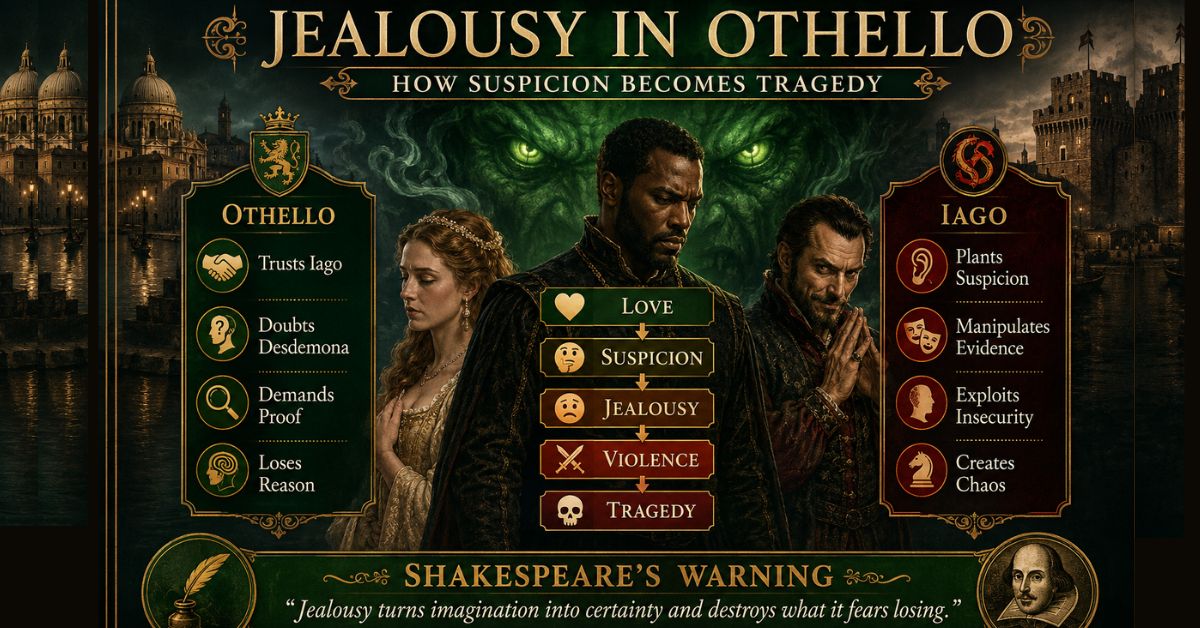
Why do they matter? Because this tragedy doesn’t turn on swords alone. It turns on words. Iago whispers his plans aloud (“I am not what I am”), Othello talks himself into jealousy, and suddenly a hero unravels in real time. These monologues from Othello are live teaching moments: psychology lessons disguised as poetry.

What will you gain here? Clear explanations, scene-wise insight, and exam-ready analysis, without the yawns. Think of it as sitting in my classroom, watching Shakespeare’s characters confess while the room goes quiet.

What Is a Monologue in Shakespeare’s Othello?

In class, this is the moment when someone raises a hand and asks, “Sir, is this just a long speech?” And I smile, because that question opens the door. A monologue in Othello is not just a character talking for a while. It’s a character thinking out loud while the plot holds its breath.

When Othello speaks at length, or when Iago explains himself, Shakespeare presses pause on action and turns up insight. A monologue allows us to watch emotions being built, not merely displayed. Jealousy in Othello doesn’t arrive fully formed. It creeps in, sentence by sentence. Power, love, fear, self-justification: these ideas grow inside monologues.

I often tell my students to imagine the stage lights narrowing. Other characters fade slightly. The speaker steps forward, not physically, but psychologically. We are invited closer. 

In exam terms, this is gold: monologues reveal motivation, inner conflict, and thematic direction. They are where Shakespeare shows us why a character acts, not just what they do.

What is monologue in Othello

Monologue vs Soliloquy in Othello

Now comes the classic confusion, and yes, examiners love it. Let’s clear it cleanly. A monologue is spoken to someone (or at least in their presence). A soliloquy, however, is spoken to oneself, or more precisely, to us.

Take the famous Iago’s soliloquy in Othello. When he declares, “I am not what I am,” he isn’t persuading another character. He’s taking the audience into his confidence, like a villain winking across the room. In that moment, we become uncomfortable partners in crime. That’s the dramatic purpose of a soliloquy: it creates intimacy and complicity.

Here’s how I explain it live in class:

  • Monologue in Othello → “This is what I want others to hear.”
  • Soliloquy in Othello→ “This is what I’d never say out loud.”

Shakespeare uses both strategically. Monologues shape public identity. Soliloquies expose private truth. In Othello, that distinction matters deeply because the tragedy depends on what is shown versus what is hidden. Once students grasp this, the play stops feeling confusing and starts feeling dangerous, in the best literary sense.

monologue vs soliloquy in Othello

Major Monologues in Othello: Act, Speaker, Theme, and Significance

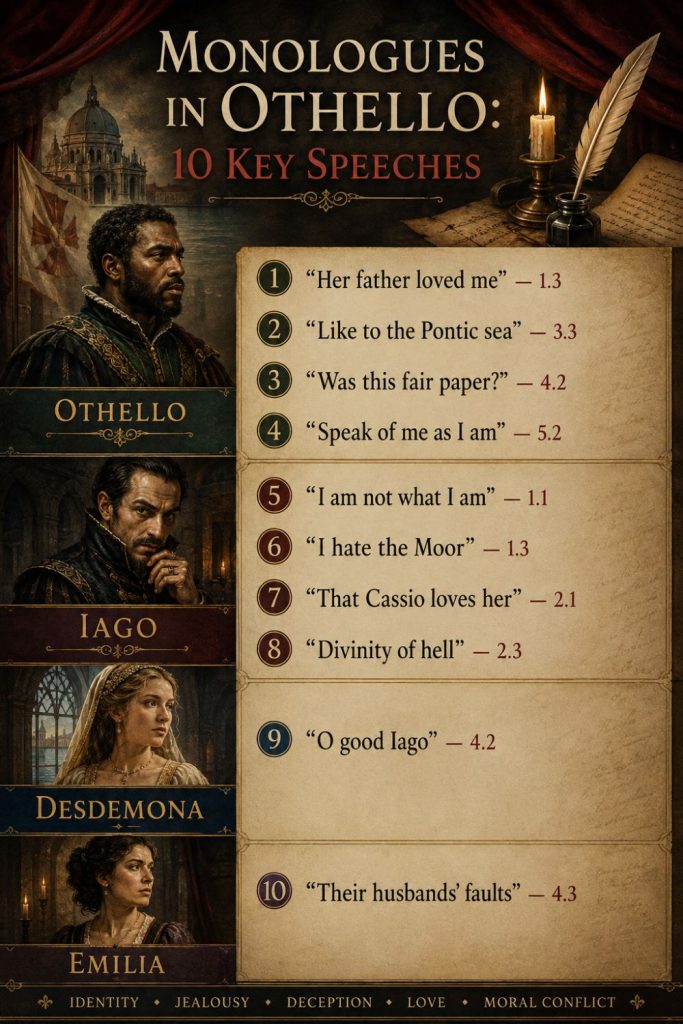
The major monologues in Othello appear at decisive moments where thought crystallises into action. Spoken by Othello, Iago, Desdemona, Emilia, and even Roderigo, these speeches expose motive before movement- allowing us to watch the tragedy being mentally rehearsed.

Monologue TitleSpeakerAct / SceneKey ThemeWhy It Matters
Her Father Loved MeOthello1.3Love & self-defenceEstablishes Othello as eloquent, rational, and morally grounded—the self he will later lose
That I Did Love the MoorDesdemona1.3Devotion & agencyShows reasoned love and moral courage within a patriarchal courtroom
I Am Not What I AmIago1.1Deception & identityIntroduces Iago’s philosophy of hypocrisy and invites the audience into complicity
I Hate the MoorIago1.3Villainy & plottingDeclares motive and shows how suspicion replaces evidence
Divinity of HellIago2.1Manipulation & moral inversionRebrands evil as virtue and exposes how harm masquerades as help
Put the Moor at Least into a JealousyIago2.1Psychological warfareReveals calculated manipulation aimed at destroying judgment itself
Was This Fair Paper?Othello4.2Jealousy & moral collapseShows how love language decays into obscenity and cosmic paranoia
O Good IagoDesdemona4.2Innocence & betrayalExposes how goodness and trust are weaponized against her
But I Do Think It Is Their Husbands’ FaultsEmilia4.3Gender & ethicsChallenges double standards and reframes female “sin” as a social consequence
It Is the CauseOthello5.2Moral self-deceptionTransforms murder into imagined justice through ritual language
Behold, I Have a WeaponOthello5.2Recognition & remorseMark Othello’s awakening and tragic self-judgment
Transported.. with a KnaveRoderigo1.1Panic & racial fearShows how private desire and prejudice ignite public chaos

Teacher’s Note: How to Read This Table

I often remind my students that: read the table top to bottom and you’ll watch the tragedy think itself into existence. We move from dignity → calculation → jealousy → justification → destruction → recognition. Shakespeare doesn’t rush disaster. He lets characters talk themselves into it.

 monologues in Othello analysis

Othello Monologues Analysis

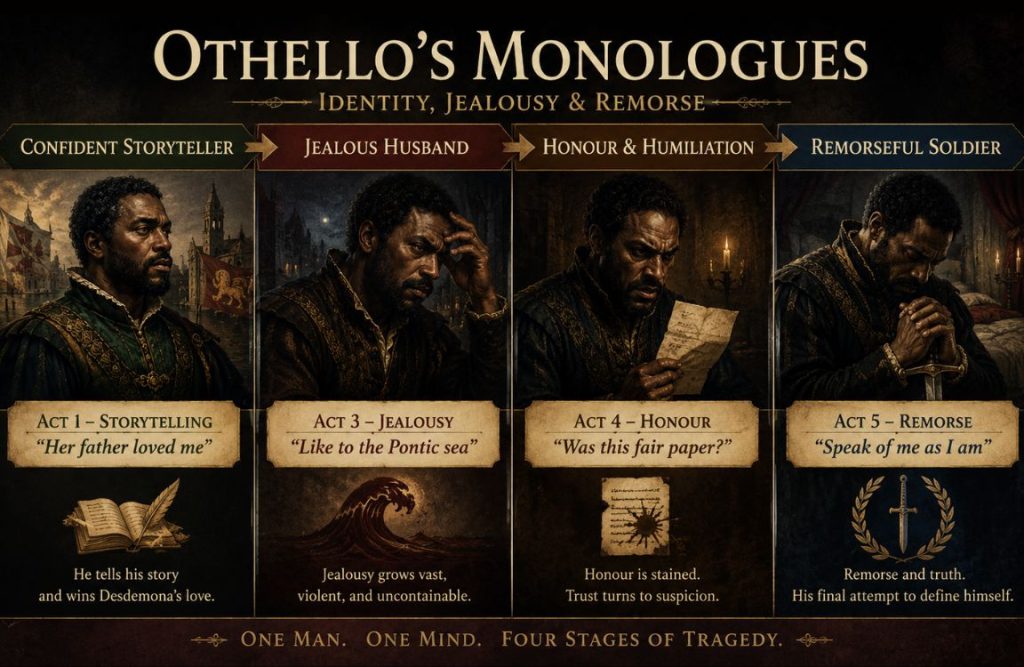
In this section, we explore Othello’s key monologues across the play- from his early public composure to his final, tragic self-judgment. Each speech marks a turning point, revealing how love, honor, identity, and jealousy reshape him from dignified general to fractured man.

i) Othello Monologue Act 1 Scene 3:

In Act 1, Scene 3 monologue, Othello calmly explains how his life story- marked by danger, suffering, and survival- won Desdemona’s love. It’s his quiet rebuttal to the charge of witchcraft, and it insists that their marriage grows from shared humanity, not spells.

When I read this monologue aloud in class, the atmosphere always shifts. Students stop labeling Othello a “tragic hero and start recognizing him as a man who has learned to convert pain into language. 

Listen to the catalogue of experience: “battles, sieges, fortunes,” enslavement, escape, strange lands. This isn’t bragging. It’s testimony. His life has been a battlefield, and storytelling is how he endures it.

What grips me as a teacher is how love begins here. Desdemona doesn’t fall for charm or flirtation. She listens. She hears with a “greedy ear” and “devours” his stories. That verb matters. His words nourish her imagination and awaken her empathy.

When Othello admits, “She loved me for the dangers I had passed,” I pause and remind my students: this is love grounded in respect and compassion, not passion alone. 

The tragedy, of course, is that this very gift, the power of narrative, will later betray him. Iago will poison the story. But here, before the Senate, Othello stands steady: “This only is the witchcraft I have used.”

No magic. No deceit. Just a life truthfully told, and that honesty makes his fall heartbreakingly inevitable.

Othello's Monologues

ii) Othello’s Monologue in Act 4, Scene 2:

When I read Othello’s monologue in Act 4, Scene 2, I always pause the class and say: “Listen, this is not a man speaking; this is a wound talking.”

Othello begins calmly, almost philosophically: “Had it pleased heaven / To try me with affliction … I should have found … a drop of patience.” Poverty, shame, even captivity, he claims he could endure them. 

But then comes the turning knife. The real pain is not loss of status. It is the imagined corruption of love. Desdemona, once “the fountain from the which my current runs,” is now, in his fevered imagery, a “cistern for foul toads.”

Here’s the live teaching moment: notice how Othello’s metaphors rot as his mind does. Books become obscene graffiti, “Was this fair paper… / Made to write ‘whore’ upon?” Nature itself recoils: heaven blocks its nose, the moon looks away. Shakespeare turns jealousy into a cosmic scandal.

As a teacher, I always say this: Othello is no longer seeking truth. He is prosecuting an idea. This monologue shows how language, once disciplined and noble, can become a weapon- sharp, loud, and tragically wrong.

iii) Othello’s Monologue in Act 5, Scene 2:

When I teach Othello act 5 scene 2 monologue, I lower my voice, not for drama, but out of respect. This is not rage anymore. This is the aftermath. Othello enters speaking like a retired warrior admiring an old sword: “Behold, I have a weapon.” Once, that sword carved paths through enemies. Now, it can’t carve a path out of guilt. That shift matters.

Here’s the live classroom moment: notice how Othello’s language turns nautical, “my journey’s end… the sea-mark of my utmost sail.” Soldiers talk of battles; condemned men talk of destinations. Fate has replaced choice. Even his bravado collapses into a question: “Where should Othello go?” That line always stops my students cold. The hero has run out of exits.

Then comes the cruel irony. He calls Desdemona “cold… even like thy chastity.” He finally sees her innocence, too late. Shakespeare twists the knife gently but deeply. Hell imagery floods the speech, not because devils are near, but because conscience is awake.

I often remind my students that this monologue isn’t about murder. It’s about recognition. Othello doesn’t fall here. He wakes up. And waking up, in tragedy, can be the most painful punishment of all.

iv) Othello Monologue Before Killing Desdemona (Act 5, Scene 2)

In Act 5, Scene 2, Othello completes his tragic descent by reframing murder as moral responsibility. He cloaks violence in the language of light, purity, and sacrifice, persuading himself that killing Desdemona is an act of justice.

This is the moment my classroom falls silent. Othello doesn’t shout or threaten. He reasons. And I like to point out that it is far more terrifying. He begins, “It is the cause, it is the cause, my soul!” repeating the phrase as if repetition might sanctify it. He never names the crime. That refusal matters. Silence becomes self-deception.

What unsettles me most is his fixation on cleanliness. He promises not to “shed her blood” or mar skin “whiter than snow.” In his mind, murder can be tidy, almost reverent. Tragedy, it seems, can wear white gloves.

Then comes the line I always underline: “Put out the light, and then put out the light.” A candle can return. Desdemona cannot. Othello knows this, yet moves forward. When he compares her to a rose that will wither once plucked, he admits the finality of the act while committing it anyway. Knowledge does not stop him. It escorts him.

The kisses seal it. “One more, one more.” Love and violence collapse into a single impulse. Here, Othello becomes his own judge and executioner, convinced that cruelty can be holy. That, I remind my students, is Shakespeare’s most chilling lesson about tragedy.

Iago’s Monologues in Othello

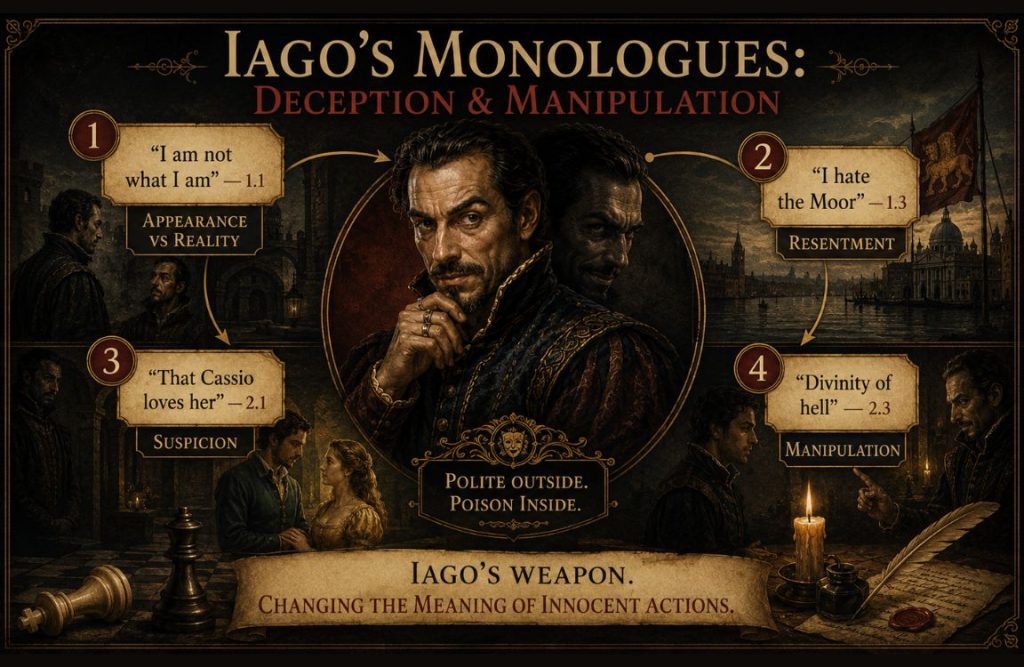
Iago monologues in Othello strip the play of moral comfort, letting us watch a mind invent evil in real time. Here, language becomes a laboratory where motives are mixed, tested, and released, showing how manipulation works before it works on anyone else.

Iago's monologues in Othello

i) Iago’s Monologue in Act 1, Scene 1: 

When I teach Iago’s monologue in Act 1, Scene 1, I tell my students, “Class, Shakespeare doesn’t hide his villain. He lets him brag.” Iago’s two monologues in this scene are Iago’s job interview with the audience, and disturbingly, he aces it.

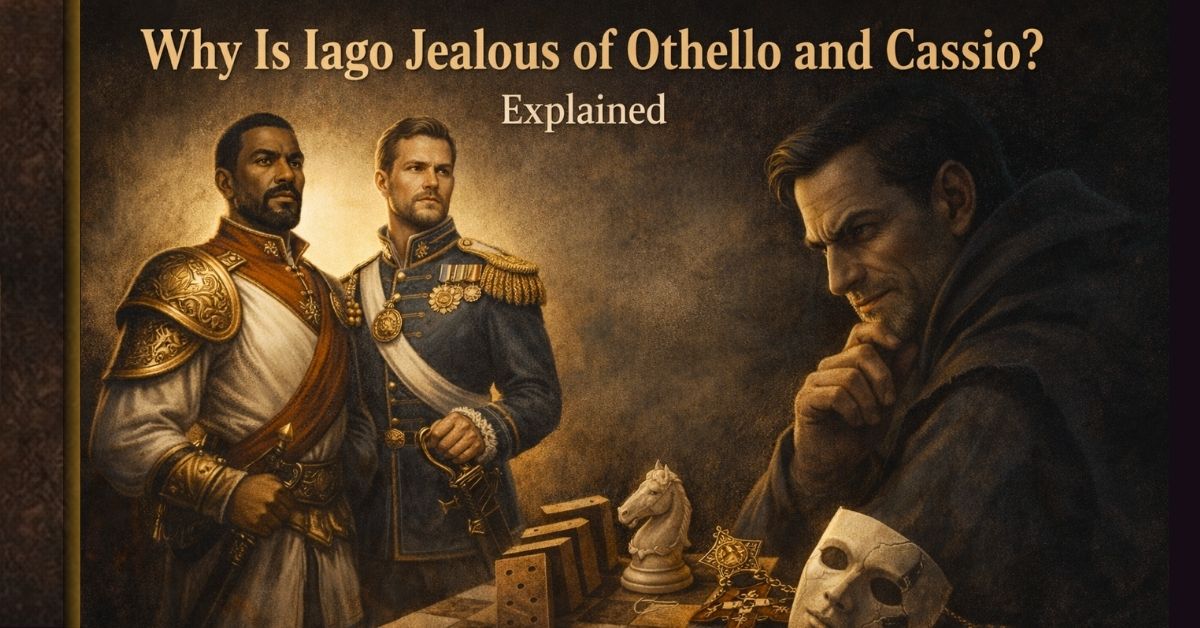
First, notice the grievance. Iago sounds like a passed-over employee ranting after office hours. Cassio, he sneers, is a “great arithmetician”– all theory, no battlefield mud. Iago measures worth by scars and service, and his wounded pride fuels everything that follows. This isn’t ideology yet. It’s ego with a sword.

Now comes the teaching moment. In the second monologue, Iago turns philosopher. He divides the world into two kinds of servants: donkeys who obey blindly, and clever hypocrites who “throw but show of service.” Guess which one he proudly claims to be. The line that always chills the room is his mic-drop confession: “I am not what I am.” That’s not just dishonesty. It’s a worldview.

As a teacher, I frame this as Shakespeare’s early warning system. Iago tells us exactly who he is before the tragedy begins. The danger isn’t that we don’t know him. It’s that we listen, and keep watching anyway.

ii) Iago Monologue “I Hate the Moor.” Act 1, Scene 3

In this monologue, Iago openly declares hatred and designs a calculated plot, revealing how suspicion, not proof, fuels his manipulation.

When I teach this speech, I encourage my students to listen for the sound of gears turning. Iago isn’t angry. He’s efficient. He begins with money, “Thus do I ever make my fool my purse,” and instantly we know his ethic: people are tools, friendships are investments, and conscience is an expense he refuses to pay.

The line “I hate the Moor” lands bluntly, almost bored. What matters more is what follows. Iago admits he has no evidence of Desdemona’s betrayal, only rumor. Yet he decides to act “as if for surety.” This is villainy powered by imagination. Suspicion becomes permission.

Then comes the chilling brilliance. He studies Cassio like a chess piece, “a proper man,” attractive enough to be suspected, and diagnoses Othello’s fatal flaw: an “open nature” that trusts appearances. I pause here in class and ask, who’s really on trial? Cassio never speaks in this plan; Othello’s mind does.

The final image, “Hell and night / Must bring this monstrous birth,” is Iago playing god, midwife to chaos. He doesn’t rush the crime. He nurtures it. This monologue shows us that evil rarely storms the gates. It drafts a memo, smiles politely, and waits. Patiently, methodically, without remorse.

iii) Iago’s Monologue in Act 2, Scene 1:

When I teach Iago’s monologue in Act 2, Scene 1, I request my students: “Watch carefully. This is where the villain stops ranting and starts planning.” In Act 1, Iago complained. Here, he calculates. And calculation is always more dangerous.

In the first monologue, Iago pretends to admire everyone. Othello is “constant, loving, noble.” Desdemona is a devoted wife, and Cassio is charming and lovable. That’s the trick. Evil, Shakespeare reminds us, often begins with compliments. 

But inside this praise, jealousy ferments like poison. The thought that Othello may have “leap’d into my seat” gnaws at him “like a poisonous mineral.” Notice the metaphor- his mind is already corroding.

Here’s my live teaching moment: pay attention to the word “jealousy.” Iago doesn’t need proof. He only needs suspicion. His goal is chillingly clear- “put the Moor / At least into a jealousy so strong / That judgment cannot cure.” That’s psychological warfare, not passion.

The second monologue in this scene shows the plan in action. Iago narrates chaos calmly, trimming truth like a dishonest editor. “Men are men,” he shrugs, turning violence into an accident. 

As a teacher, I stress this: Iago wins not by lying loudly, but by sounding reasonable. And that makes him Shakespeare’s most unsettling strategist.

iv) Iago Monologue “Divinity of Hell” (Act 2, Scene 1):

In this monologue, Iago rebrands evil as virtue, revealing how manipulation succeeds by disguising harm as helpful advice.

This is the speech where I always see students sit up straighter. Iago doesn’t hiss or snarl here. He reasons. And that should terrify us. He opens with a mock courtroom defense: “And what’s he then that says I play the villain?” Notice the trick. He puts himself on trial and acquits himself before anyone else can speak.

I tell my class to underline the word “honest.” Iago repeats it like a salesman repeating “limited offer.” His advice to Cassio is, on the surface, perfectly logical: appeal to Desdemona, because she is persuasive, generous, “framed as fruitful / As the free elements.” He praises her warmth only to weaponize it later. That’s the genius, and the poison.

Then comes the blasphemous poetry. Othello’s love, Iago claims, has the power to make him “renounce his baptism.” Love replaces religion. Desdemona becomes a false god. I pause here and say, watch how Iago inflates emotions until they look dangerous. If love is idolatry, then jealousy can pretend to be justice.

The famous line, “Divinity of hell!” is not a joke. It’s a mission statement. Iago understands that evil works best in clean clothes. He will “turn her virtue into pitch,” transforming goodness into glue that traps everyone. In this monologue, hell doesn’t roar. It smiles, offers help, and sounds very reasonable.

Iago’s Monologues and Manipulative Strategy

Iago’s monologues reveal how manipulation works: by understanding human weakness, rehearsing deception privately, and recruiting the audience as silent accomplices.

When I teach him, I warn my students: Iago is most dangerous when he is calm. He doesn’t lie to us; he studies us. Alone on stage, Iago turns the world into a laboratory and people into experiments. He tests weaknesses the way a chess player studies pieces- slowly, strategically, without emotion.

What unsettles me every time is his method. He speaks in ifs and laters. Evil here isn’t loud or chaotic. It’s bureaucratic. Othello becomes “free and open,” Cassio “too familiar,” Desdemona conveniently “fruitful.” No one is fully human to him- everyone is a pressure point. This is predator psychology at work: take virtue, rename it weakness, and wait.

And then comes the cleverest move. He recruits us. Each monologue is a quiet wink. We know the plan. We understand it. And we keep watching. That’s the tragedy. Iago wins because he rehearses reality first, and by the time his story reaches others, it already sounds true.

Watch my video tutorial on Iago’s villainy in Othello to see his manipulative strategy in action.

Roderigo’s Monologue in Act 1, Scene 1:

Roderigo's monologues in Othello

When I teach Roderigo’s monologue in Act 1, Scene 1, I smile and warn my students: “Listen carefully, fear often speaks in very good manners.” Roderigo sounds respectful, even submissive, but beneath the courtesy is sheer panic. It’s midnight, emotions are running wild, and his language gallops ahead of reason.

Notice how he piles up words like an anxious witness who won’t stop talking. Desdemona is not merely gone; she is “transported” with a “knave of common hire.” Othello is not a husband but a “lascivious Moor.” Here’s the teaching moment: Roderigo weaponizes language. He wraps racism and sexual fear in formal politeness, hoping Brabantio will explode, and he does.

What fascinates me is Roderigo’s desperation masquerading as civic duty. “Let loose on me the justice of the state,” he says, sounding brave while trembling inside. 

As a character, Roderigo isn’t evil. He’s emotionally reckless. Shakespeare uses him to show how private desire can ignite public chaos, one panicked speech at a time.

Desdemona’s Monologues in Othello

Desdemona’s monologues give voice to quiet courage. In Othello, she speaks not to dominate the room but to claim moral ground, balancing love, obedience, and selfhood within a courtroom of men and inherited power that defines her lasting dramatic presence.

Desdemona's monologues in Othello

i) Desdemona Monologue Act 1 Scene 3 “That I Did Love the Moor.”

Desdemona’s Act 1 Scene 3 speech reveals loyalty without blindness, innocence without naivety, and resistance shaped by love rather than rebellion.

As I point out to my students, this is not a whisper. It’s a calm thunderclap. Standing before the Venetian Senate, Desdemona chooses her words like clean arrows. “That I did love the Moor” is not an apology. It’s a thesis. She frames love as reasoned action, not reckless romance.

Her loyalty is radical. She transfers the “duty” expected toward Brabantio to Othello, exposing how patriarchal logic traps women in borrowed obedience. Yet she doesn’t reject the system loudly. She out-argues it. When she says she “saw Othello’s visage in his mind,” she teaches us how to read character beyond skin, rank, and rumor.

This is the moment I stop and unpack it: Desdemona asks to go to war. Not because she’s naïve, but because absence would hollow her identity. “Let me go with him” sounds simple, but it unsettles the room. Wives are moths of peace, the Senate assumes- pretty, still, expendable. Desdemona refuses that jar.

Innocence, here, is clarity. She believes in love’s honor because she has examined it. I make it clear to my students that this speech is her moral contract. Tragedy later doesn’t erase this intelligence. It proves how dangerous innocence is in a world trained to mistrust it completely, tragically, so.

ii) Desdemona’s Monologue in Act 3, Scene 3:

When I teach Desdemona’s monologue in Act 3, Scene 3, I encourage my students to notice: “This is what goodness sounds like when it doesn’t know it’s in danger.” Desdemona speaks quickly, warmly, almost breathlessly. Her words tumble forward, “to-morrow night; or Tuesday morn…”, as if kindness itself is impatient.

This is where the lesson comes alive: notice how reasonable she sounds. Cassio’s fault, she argues, is barely a fault at all. Helping him return is, to her, as natural as asking Othello to “wear your gloves” or “keep you warm.” That metaphor matters. Desdemona treats loyalty like self-care. She cannot imagine love refusing goodness.

But Shakespeare is quietly cruel here. The very persistence that proves her sincerity fuels Othello’s suspicion. When she says, “What you would ask me, that I should deny?” we, as readers, wince. Dramatic irony is doing the heavy lifting.

As a teacher, I frame this monologue as tragic innocence in motion. Desdemona isn’t manipulating. She’s trusting. And in Othello, trust, spoken aloud at the wrong moment, can sound like guilt.

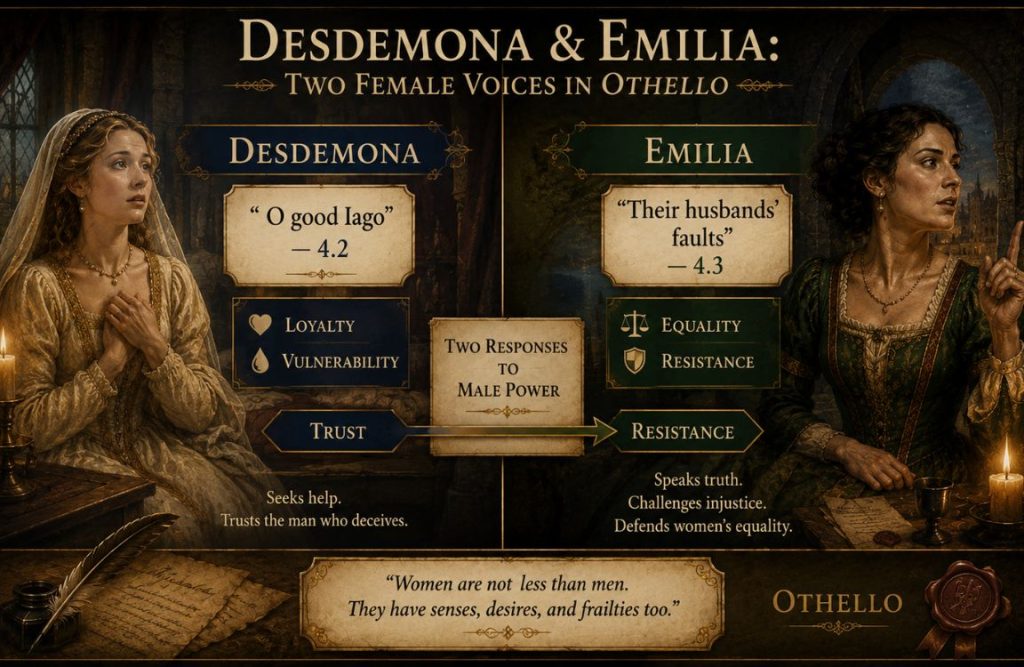
iii) Desdemona Monologue Act 4 Scene 2 “O Good Iago.”

This monologue reveals Desdemona’s tragic innocence, how loyalty becomes a liability, and exposes a culture that trains women to doubt themselves before doubting accusations.

Before I teach this speech, I pause, because it hurts. Desdemona kneels here, emotionally as much as physically. “O, good Iago” is dramatic irony at its cruelest. She trusts the very man arranging her destruction. Shakespeare lets innocence walk calmly into danger, believing it deserves no harm.

What strikes my students first is her confusion: “I know not how I lost him.” That line devastates. Desdemona doesn’t protest aggressively because she believes love should correct itself. If something is wrong, it must be her. That is patriarchy speaking- women taught to audit their souls when men erupt.

Her loyalty is absolute. Even “beggarly divorcement” cannot weaken it. “Never taint my love” becomes her moral code. Othello may “defeat my life,” but not her integrity.

And then the chilling moment: “I cannot say ‘whore.’” The word itself repels her. This is innocence as principle, not ignorance. Desdemona falls not because she is weak, but because she is good in a world that reads goodness as guilt.

Emilia’s Monologues in Othello

Emilia’s monologues crack the play open from the inside. Where others whisper or weep, she reasons, argues, and finally teaches. Her voice shifts the tragedy from private jealousy to public ethics, exposing marriage, power, and gender with fearless clarity.

i) Emilia Monologue Act 4 Scene 3 (“But I Do Think…”)

Emilia’s Act 4 Scene 3 monologue arrives quietly, but it changes everything. Each time I explore this speech, I always say: This is Emilia waking up while speaking. The keyword is “But.” “But I do think it is their husbands’ faults / If wives do fall.” That pause is resistance. She stops echoing society and starts interrogating it.

What follows isn’t anger. It’s an analysis. Emilia lists jealousy, neglect, and abuse as evidence, not excuses. Her blunt reminder, “we have galls”, isn’t self-loathing. It’s honesty. Women, she insists, are human, capable of desire and retaliation, but not born corrupt. Wrongdoing is learned under pressure.

Here’s my live teaching moment: Emilia claims women “see, and smell… for sweet and sour.” That equality is radical in Othello. She dismantles the double standard with logic, not slogans. Fidelity, she argues, is reciprocal. Treat wives as possessions, and don’t be shocked when consequences follow.

I call this the play’s ethical backbone. Emilia gives words to injustice before the tragedy makes it undeniable.

Emilia's monologues in Othello

Short Monologues in Othello for Auditions

When students ask me what Othello offers actors, I smile. This play is a casting director’s buffet. Its short monologues pack psychological punch, emotional contrast, and rhetorical fire- perfect for auditions where every second must do work.

i) 1 Minute Monologues in Othello:

If you’ve got sixty seconds, you want clarity, intensity, and a clean emotional lane. I always tell my students: a one-minute monologue is a scalpel, not a sword.

Short speeches from Iago are ideal here. His lines often sound reasonable while rotting from the inside. A brief excerpt like “I am not what I am” lets you show control, irony, and menace without shouting. Play it conversational- casting panels love danger that smiles.

Desdemona’s shorter pleas also work beautifully. Her language is simple, but emotionally loaded. Even a trimmed portion of “Let me go with him” allows an actor to show sincerity under pressure. The trick? Stillness. Let the honesty land.

For exams or auditions, I coach performers to choose monologues with a single emotional gear: persuasion, doubt, or quiet defiance. One minute is about precision, not fireworks.

ii) 2 Minute Monologues in Othello

Two minutes? Now you can travel. This is where Othello really flexes.

A slightly longer Iago monologue lets you build rhythm- logic sliding into obsession. I often demonstrate how his arguments stack like dominoes: reasonable premise, poisoned conclusion. Audition panels love that arc.

Emilia’s speeches are gold for actors wanting intelligence and edge. Her Act 4 Scene 3 reasoning can be shaped into a compact two-minute piece that shows wit, moral confidence, and simmering anger. It’s not loud, but it’s fearless.

For performers, here’s my live teaching tip: don’t “perform Shakespeare.” Think it. Speak it like a sharp conversation you’re winning. Let the verse breathe, let the pauses accuse.

Practically speaking, Othello monologues work because they are audition thought. They show how a character reasons, manipulates, loves, or resists. And that, I remind my students, is exactly what casting directors are listening for- someone who can think out loud, brilliantly, under pressure.

Why Monologues Are Central to the Tragedy of Othello

In Othello, monologues function as moral MRI scans- revealing hidden motives, private fears, and ethical fractures that dialogue deliberately conceals.

Every time, while teaching this play, I tell my students: the tragedy doesn’t explode in public. It decays in private. Monologues are where that decay becomes visible. They’re Shakespeare’s confession rooms, moments when the mask slips and the truth steps forward.

Iago’s monologues don’t interrupt the plot; they are the plot. While others talk, he prepares. When he asks, “And what’s he then that says I play the villain?” I stop the class. That line shows how evil justifies itself- not loudly, but persuasively.

Othello’s monologues tell a different story. His verse fractures as his mind fractures. I tell students to listen closely: his thoughts no longer flow; they collide.

What fascinates me most is how monologues isolate characters. Desdemona speaks truthfully, Emilia reasons boldly, and Iago plots silently, but none of them hear each other’s inner worlds. That dramatic loneliness fuels the catastrophe.

Dialogue builds relationships. Monologues destroy them. And we, the audience, hear everything and can do nothing.

FAQs:

What is the most famous monologue in Othello?

In my classroom, the crown usually goes to Iago’s “And what’s he then that says I play the villain?” It’s chilling because it teaches us how evil explains itself- smoothly, logically, and without guilt- inviting the audience into dangerous agreement.

How many monologues does Iago have?

Iago delivers multiple major monologues across Othello, with most clustered in the early acts. I always point out that this dominance matters: Shakespeare gives him the most private thinking time, positioning him as strategist, commentator, and unseen director of the tragedy.

How many monologues does Othello have?

Othello delivers two to three major monologues, each marking a moral turning point. I tell my students to track them carefully: they chart his journey from dignified self-command to corrosive jealousy and, finally, to devastating self-recognition and judgment.

Conclusion:

When I step back with my students at the end of Othello, this is what I want them to see: the tragedy is not born in public arguments or battlefield chaos, but in private speech. 

Monologues in Othello are where thoughts harden into decisions, where suspicion learns to speak fluently, and where morality quietly fractures. Iago plans, Othello convinces himself, Desdemona trusts, and Emilia finally tells the truth- alone, each time. 

And we, the audience, hear everything. That is Shakespeare’s final twist. By letting us inside these minds, he makes us witnesses, then accomplices, forced to watch knowing what others cannot. Othello breaks our hearts not because we are surprised, but because we understand too well, and still cannot stop it.

Leave a Comment

Your email address will not be published. Required fields are marked *

Scroll to Top