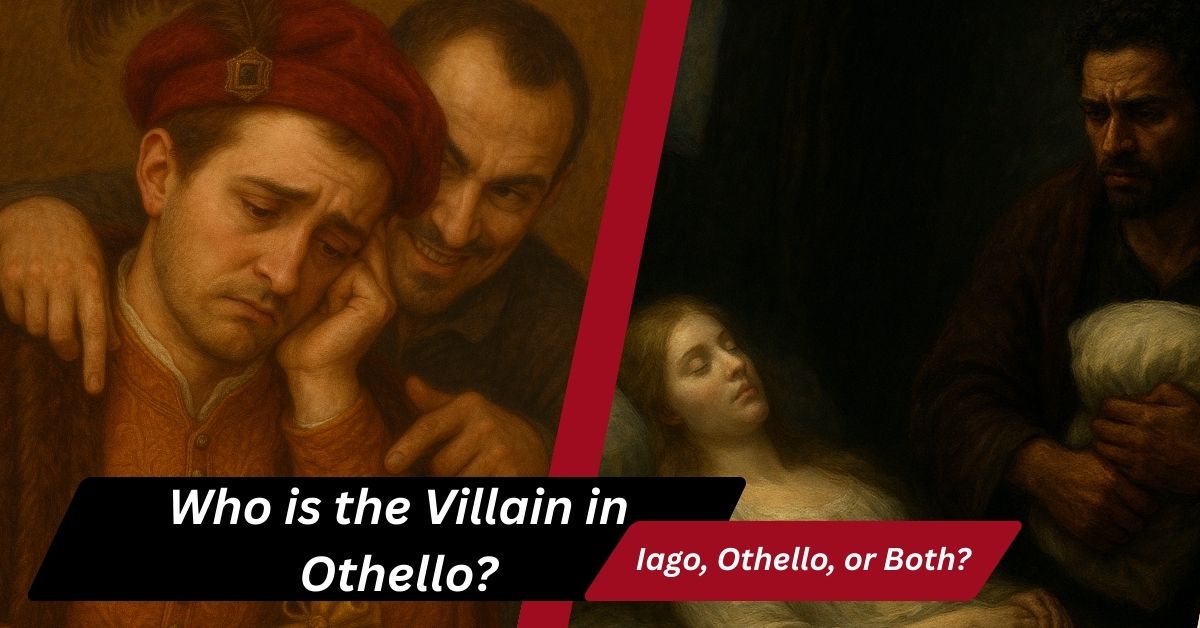
Who is the Villain in Othello? Iago, Othello, or Both?

villain in Othello

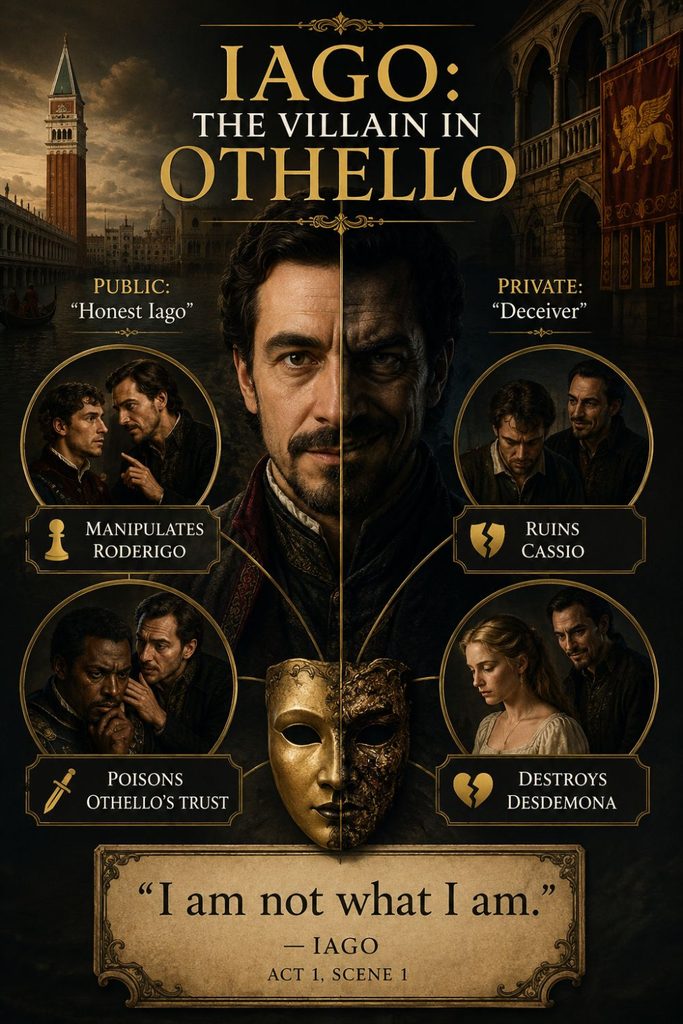
Every year, when I write villain in Othello on the board, I can almost hear my students thinking, Easy- Iago. Case closed. But then I pause, smile, and ask the question that refuses to behave: Who is the real villain in Othello? And just like that, certainty slips on a banana peel.

Yes, Iago struts in as the usual suspect- smooth-talking, smile-wearing, poison-pouring. But Shakespeare is far too mischievous to hand us a single black-hatted villain and call it a day. This play is a courtroom drama where blame keeps changing seats. Iago manipulates. Othello chooses. Jealousy whispers. Society nods. And Shakespeare? He watches us squirm.

That’s my thesis, students: villainy in Othello isn’t born. It’s constructed, shared, and unsettlingly human. So buckle up. This trial has more than one defendant, and none of them leaves with clean hands.

Who Is the Real Villain in Othello?

The real villain in Othello is not Iago alone, but also Othello. Iago engineers the plot, but Othello’s choices- his jealousy, mistrust, and willingness to act without proof- make the tragedy possible. Villainy in the play is shared, not owned.

When my students finally look up and ask, “So… who’s really the bad guy in Othello?” I don’t repeat the answer. I let the silence do the teaching. They’re waiting for Iago’s name. What unsettles them is realizing that Shakespeare isn’t interested in easy villains. He’s interested in responsibility- who acts, who believes, and who chooses not to question what they’re told.

i) Iago: The Architect of Chaos (The Antagonist)

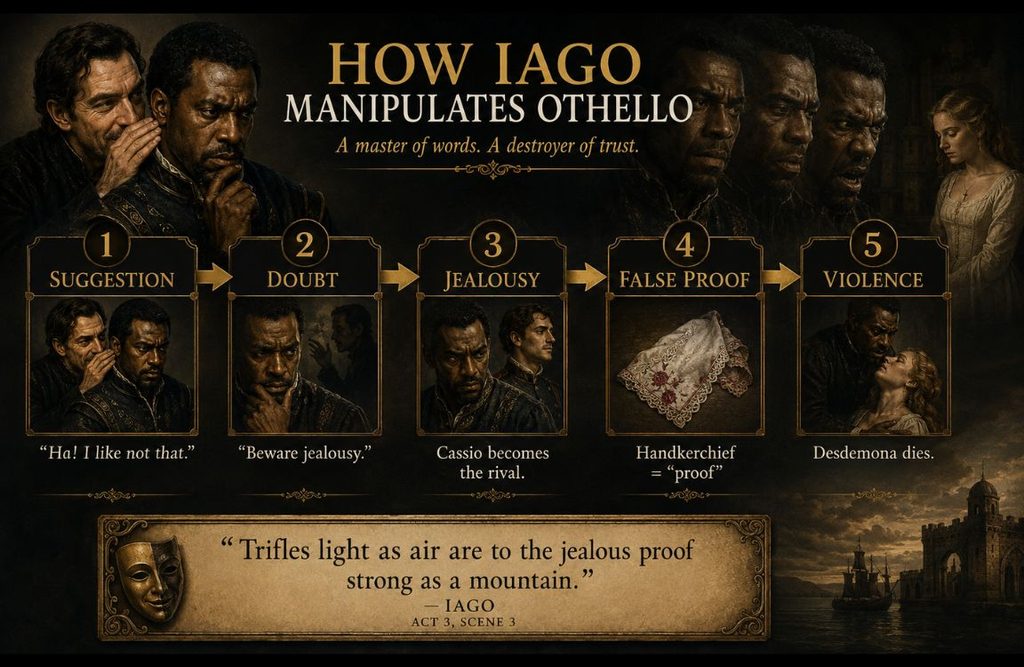
Let’s be fair before we get uncomfortable. Yes, Iago lights the fuse. He manipulates language, drops hints like breadcrumbs, and lets doubt do the dirty work. He doesn’t shout accusations; he whispers possibilities. That’s far more dangerous.

In technical terms, Iago is the antagonist- the engine of conflict. He pushes events forward with chilling precision. Without him, suspicion would never find its voice. I tell my students that Iago doesn’t wait for disaster. He designs it, step by step, like a man assembling a trap and smiling as someone walks into it.

ii) Othello: Choice, Agency, and Moral Responsibility

But tragedy doesn’t happen unless Othello participates. This is where the room usually shifts. Othello is not dragged kicking and screaming into violence. He walks there willingly. Shakespeare gives him agency, and with it, responsibility.

He chooses jealousy over trust, suspicion over conversation, and imagination over evidence. Watching this unfold in class feels like watching someone ignore every warning sign on the road, and then blame the map when they crash. Iago may hand him the poison, but Othello decides to drink it.

I often describe this moment as a moral relay race. Iago passes the baton of suspicion. Othello doesn’t drop it. He grips it tightly and sprints. By the time jealousy crosses the finish line, tragedy has already won.

iii) The Invisible Villains: Jealousy and Manipulation

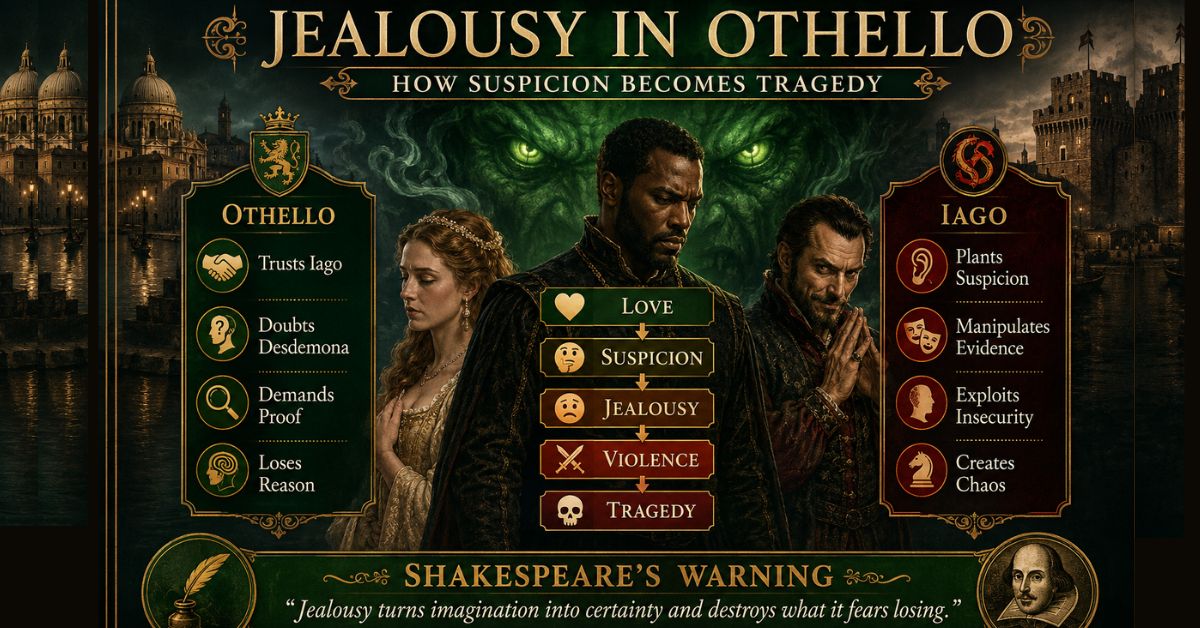
Then come the forces that don’t speak but dominate the stage. Jealousy seeps into the mind like dampness into walls. Manipulation quietly rewires perception. These abstract villains turn love into doubt and certainty into violence, proving that the most dangerous enemies are often internal.

That’s the twist I want my students to sit with: villainy in Othello isn’t owned. It’s shared. The real danger isn’t just the voice that whispers poison. It’s the ear that decides to listen.

Read Also, “Iago in Othello: Character Analysis, Motives & Quotes

How Does Shakespeare Present Iago as a Villain?

When I teach Iago, I tell my students to forget daggers and poison. Shakespeare builds this Shakespearean villain with something far sharper: language, patience, and a terrifying understanding of how people think. Iago doesn’t attack bodies first. He targets beliefs, and that’s where the real damage begins.

i) Iago as a Machiavellian Villain:

I often describe Iago as a man who has read the instruction manual on human weakness and memorized the footnotes. His villainy runs on cold logic, not hot temper. Every move is calculated, every word weighed like a chess master hovering over the board. Emotion is something he studies, not suffers from.

This is where the faint shadow of Machiavelli’s The Prince appears- not shouted, just whispered. Iago understands that power doesn’t come from force but from control. Control of information, especially. He decides what others see, hear, and suspect. Truth, in his hands, becomes optional.

What makes this chilling is his restraint. He rarely rushes. He waits. He plants an idea and lets it grow wild in someone else’s mind. Watching him work is like watching a spider that knows the fly will come eventually. He doesn’t chase; he arranges.

ii) Iago as a Puppet Master:

Here’s the part where I usually stop reading and look up at the class. “Notice,” I say, “how rarely Iago does anything.” Instead, he engineers moments. He nudges conversations, times entrances, and lets silence do half the work. This is Iago manipulating Othello without ever issuing a direct command.

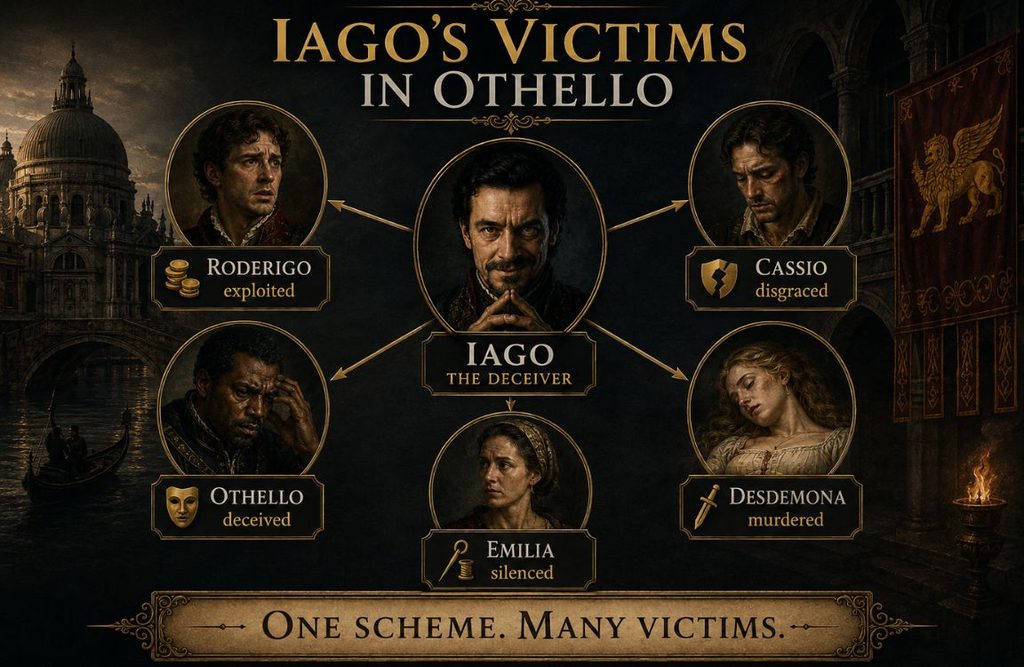
Othello, Cassio, and Desdemona become pieces on his board—each moved with just enough pressure to believe they’re acting freely. A pause here. A hint there. A raised eyebrow at exactly the wrong time. Psychological warfare replaces physical violence, and it’s far more effective.

Iago doesn’t need to shout accusations. He lets others supply them. That’s the genius, and the horror, of his method. He turns imagination into evidence and suspicion into certainty, all while keeping his own hands clean.

iii) “Honest Iago”: The Mask of Trust

And then we reach the most cruel joke of all: honest Iago. Every time that word appears, my students groan, because dramatic irony is doing somersaults on stage. We know the truth. The characters don’t. And Shakespeare makes us watch the disaster unfold anyway.

Reputation becomes Iago’s sharpest weapon. His carefully crafted image of loyalty and plain speaking gives his words a weight they don’t deserve. When he lies, the lie arrives dressed as concern. When he manipulates, it feels like advice.

This is what makes Iago so unsettling. He doesn’t look evil. He looks like someone you’d trust with your secrets. And that, Shakespeare suggests, is the most dangerous disguise of all.

“How Am I Then a Villain?”- Iago’s Self-Awareness

This is the moment in class when I lower my voice and tell my students, Listen carefully. This is Iago talking to himself, not to the world. In the Iago monologue “How am I then a villain”, Shakespeare gives us something far more disturbing than a confession: a mind that refuses to recognize its own darkness.

i) A Close Reading of the Monologue:

Iago isn’t asking a genuine question here. He’s performing one. The line sounds like self-examination, but it’s really self-defense. He twists logic the way a lawyer twists facts, arguing that if his actions seem helpful, then they cannot be wicked. 

I always tell my students to watch the verbs- how quickly he slides from doubt into justification. The monologue reveals a man who thinks morality is negotiable, not fixed.

ii) Moral Emptiness and Rhetorical Games:

What makes Iago truly unsettling is not rage or jealousy, but emptiness. There’s no emotional core pulling him toward guilt or compassion. 

Instead, he fills the void with clever reasoning. He plays rhetorical games with himself, stacking excuses like cards in a house that never collapses, because he never tests it against his conscience.

iii) Villainy Without Guilt:

Here lies the answer to what makes Iago evil: he commits harm without remorse and deception without inner conflict. He doesn’t see himself as evil because he doesn’t believe in moral accountability. 

And that, I tell my students, is why audiences shiver. A villain who knows he’s evil can still be reached. A villain who doesn’t believe in evil at all? That’s far more dangerous, and far more real.

Is Iago the Only Villain, or Othello Too? 

This is the question that makes the classroom go quiet. We’re comfortable blaming Iago. But once the dust settles, we’re forced to ask whether Othello’s villain is only the man who whispers, or also the man who listens. And yes, that leads us straight to responsibility.

i) Othello’s Agency: Where Manipulation Ends, and Choice Begins

I tell my students to mark the exact moment when Othello could have stopped. Shakespeare gives him pauses, questions, and even warnings. Iago suggests, Othello interprets. That distinction matters. 

Manipulation opens the door, but Othello walks through it willingly. He trusts suspicion over love, imagination over evidence. If he were merely a puppet, tragedy would feel hollow. Instead, Shakespeare gives him agency, and with it, blame.

ii) His Swift Surrender to Jealousy:

What unsettles me every time I teach this play is how quickly Othello yields. Jealousy doesn’t batter down the door. It’s invited in for tea. Within moments, a respected general becomes emotionally reckless, treating doubt as proof and silence as guilt. 

His fall isn’t slow and tragic. It’s fast and frightening. Shakespeare seems to ask us: if love collapses this easily, how strong was it to begin with?

iii) Violence as a Conscious Act:

Here’s where the excuses end. Othello’s violence is not an accident, not a loss of control, not a momentary lapse. It is planned, justified, and executed with chilling calm. He convinces himself that cruelty can be moral if he names it justice. 

When I reach this point in class, I remind my students: intention matters. And Othello intends harm.

iv) The Tragic Villain:

This is the uncomfortable truth. Othello fits the shape of a tragic villain. He is not evil in design, but he becomes destructive through choice. His remorse arrives too late to undo the damage. 

Shakespeare doesn’t let us dismiss him as a victim, nor does he paint him as a monster. Instead, he shows us how a good man, when stripped of self-control and critical thought, can become terrifying.

And that, perhaps, is the most disturbing lesson of all.

Othello as a Villain vs Iago as a Villain

This is where I ask my students to stop thinking in terms of good versus evil and start thinking in types of evil. Shakespeare doesn’t recycle villains. He designs them. In this tragedy, we meet two radically different faces of destruction, and together they define the idea of the tragic villain in Othello.

i) Iago: Cold, Calculating & Unrepentant

Iago operates like a machine that runs on logic instead of emotion. He plans, adjusts, and proceeds without hesitation. What strikes my students most is his lack of regret, not even a flicker. He watches lives unravel with the detachment of a scientist observing an experiment. 

This emotional distance is precisely what makes him terrifying. He isn’t overwhelmed by passion. And he is empowered by control. His villainy is deliberate, efficient, and chillingly self-aware.

ii) Othello: Emotional, Reactive & Remorseful

Othello, by contrast, is all exposed nerve. He feels first and thinks later. His decisions spring from wounded pride and unchecked emotion rather than strategy. Yet remorse haunts him once the truth emerges. 

Unlike Iago, Othello collapses under the weight of what he has done. His guilt doesn’t erase his actions, but it does define his tragedy. He suffers because he understands, too late, the cost of his choices.

iii) Moral Responsibility vs Moral Intention:

Here’s the distinction I insist my students grasp: intention and responsibility are not the same. Iago intends harm from the beginning. Othello intends justice but commits cruelty. One plans evil. The other stumbles into it. 

Yet both are responsible for the damage they cause. Shakespeare refuses to excuse outcomes simply because motives were confused or emotions sincere.

iv) Victim and Villain:

This is Shakespeare’s final twist. Othello is manipulated, yes, but he is also accountable. He is wounded by deception yet complicit in violence. 

By making Othello both victim and villain, Shakespeare forces us to confront an unsettling truth: tragedy is born not only from wicked minds but from flawed ones. And that realization lingers far longer than any single act of evil.

How Villainy Is Constructed in Othello

At this point in the lesson, I usually tell my students, “Stop pointing fingers.” Shakespeare is doing something far more unsettling here. He shows us how villainy is constructed in Othello, not born in one character, but built piece by piece by the world around them.

i) Social Pressures: Race, Masculinity, Honor

I ask my class to imagine carrying the weight Othello carries every time he enters a room. He is constantly proving himself- his masculinity questioned, his honor tested, his race whispered about. 

These pressures don’t excuse his actions, but they shape them. Shakespeare exposes how a society obsessed with reputation and dominance quietly manufactures the conditions for moral collapse.

ii) Language as a Weapon:

If swords win wars, words win minds. Shakespeare turns language into a blade that never draws blood but always leaves wounds. Half-spoken suggestions, loaded pauses, and carefully chosen phrases reshape reality itself. Meaning becomes slippery. Certainty erodes. 

What fascinates my students is how easily truth is replaced, not by lies, but by interpretations. Language doesn’t just describe events here; it manufactures them.

iii) Jealousy as a Corrosive Force:

Jealousy in this play isn’t loud or explosive. It’s slow and chemical. I compare it to rust: invisible at first, then suddenly the structure collapses. 

Once jealousy enters the mind, it rewrites logic. Love becomes suspicion. Silence becomes proof. Shakespeare shows us how a single emotion, left unchecked, can rot judgment from the inside out.

iv) Villainy as a System, Not a Single Character:

This is where the big idea clicks. Villainy doesn’t belong to one person alone. It emerges from interactions- power imbalances, unchecked emotions, social expectations, and linguistic manipulation. 

Everyone contributes something. Some push. Some permit. Some fail to question. Shakespeare builds evil the way storms are built: through accumulated pressure.

v) From Blame to Meaning:

So, we move beyond who did it to why it happened. Shakespeare isn’t interested in courtroom verdicts. He’s interested in diagnosis. By shifting our focus from individuals to systems, the play stops being a tragedy about one villain and becomes a warning about how easily ordinary human forces can create one.

Why Jealousy Strengthens the Villainy in Othello

When I ask my students who the villain of Othello is, they answer instantly: “Iago.” And they’re not wrong, but they’re not finished either. That’s when I pause, tilt my head, and complicate things. Iago may strike the match, but jealousy is what keeps the fire burning long after he steps back.

i) Personification of Jealousy:

Jealousy in Othello doesn’t sit politely in the background. It behaves like a character with ambition. Shakespeare gives it hunger, movement, and a frightening persistence. I ask my class to picture jealousy as a living thing- small enough to ignore at first, but clever enough to grow quietly until it takes over the whole room.

ii) Iago as the Spark, Jealousy as the Fire:

Here’s the teaching moment I love: Iago never forces Othello to act. He simply lights the spark. Jealousy does the rest. Like dry wood waiting for a flame, Othello’s trust and insecurity ignite instantly. 

Iago steps back, and the fire rages on its own, consuming reason without needing another push.

iii) Why Jealousy Succeeds so Easily in Othello’s Mind:

Jealousy wins because it sounds logical. I remind my students that Othello doesn’t feel irrational. He feels certain. His love is deep, but his self-doubt is deeper. 

Jealousy slips in wearing the disguise of proof, turning imagination into evidence and suspicion into conviction, all while pretending to protect his honor.

iv) Connecting Jealousy to a Universal Human Weakness:

This is where the room gets quiet. Jealousy works in Othello because it works in us. It feeds on fear of loss, fear of being replaced, fear of not being enough. 

Shakespeare isn’t warning us about villains out there. He’s warning us about the ones we invite in.

How Does Iago Show His Villainy with His Language?

When I teach Othello, I always warn my students: Iago is the kind of villain who doesn’t shout—he quietly erodes trust and manipulates from the shadows. This isn’t about swords or dramatic monologues; it’s about how language, silence, and suggestion become sharper than steel.

i) Deception: “I am not what I am.” (Act 1, Scene 1)

I pause the class here. This line is Iago’s mission statement. He doesn’t just lie. He celebrates lying. Unlike typical villains who hide their evil, Iago announces it and dares the world to notice. As I tell my students, this quote shows how deception is his craft and his weapon.

ii) Nihilism: “Virtue? A fig!” (Act 1, Scene 3)

This is where Iago chills me every time. He doesn’t believe in morality, loyalty, or goodness. He only believes in control. I explain to my students that Iago isn’t driven by passion or love. He’s driven by emptiness. When nothing has value, destroying others feels like a game. That moral void makes him terrifyingly free.

iii) Manipulation: “Thus do I ever make my fool my purse.” (Act 1, Scene 3)

Here’s the live teaching moment: the “fool” isn’t just Roderigo. It’s anyone Iago can bend. He studies weakness like a chemist experiments with chemicals, mixing trust, hope, and desperation until it explodes. The quote shows Iago’s deliberate, calculated cruelty.

iv) Psychological Control: “Men should be what they seem.” (Act 3, Scene 3)

This one earns nervous laughter in class. Iago says it while being the exact opposite. It’s verbal misdirection at its finest- using moral language to mask immoral intent. He doesn’t command. He suggests, which is far more dangerous.

v) Why Iago Remains Shakespeare’s Most Chilling Villain

What makes him unforgettable isn’t his deeds. It’s his calm precision. No tragic excuse softens him. No wounded heart appeals to pity. Through these quotes, we see a villain who manipulates, corrupts, and terrifies purely through intellect and cunning.

FAQ:

Is Iago a Villain or a Victim?

I tell my students to acknowledge Iago’s resentment without adopting it. Yes, he feels overlooked and socially insecure, but he chooses cruelty. Pain may explain his anger, but it never excuses his delight in destroying others for sport.

Why Is Iago Considered a Villain?

Because he manipulates without guilt and harms without hesitation. In class, I stress this: Iago doesn’t stumble into evil. He plans it. Worse, he enjoys watching people unravel, which moves him beyond flawed into frightening.

Is Othello Responsible for His Actions?

Yes, and this is always uncomfortable. I remind students that manipulation only works when someone participates. Othello chooses suspicion over trust, action over dialogue. Iago whispers, but Othello listens, and that choice carries tragic consequences.

Is Iago a Tragic Villain?

No. Tragic villains typically recognize their downfall too late. Iago never reflects, never regrets, never learns. I tell my class that tragedy requires self-awareness, and Iago’s moral blindness disqualifies him. He doesn’t fall. He simply stops speaking.

Does Iago Ever Feel Guilt?

Not once. I ask students to track guilt like footprints. There are none. Iago rationalizes everything, which makes him dangerous. A villain without guilt doesn’t pause, hesitate, or soften. He just keeps going.

Is Iago Intelligent or Just Lucky?

Intelligent and observant. I point out that Iago reads people better than they read themselves. He notices insecurity, pride, and longing, then applies pressure. Luck may open doors, but strategy keeps him in control.

Why Doesn’t Iago Explain Himself at the End?

That silence is power. I tell my students it’s his final act of control. By refusing explanation, Iago denies closure, forcing others, and us, to sit with unanswered questions and unresolved damage.

Is Iago More Dangerous Than Traditional Villains?

Absolutely. He doesn’t look dangerous. I explain that sword-wielding villains are easy to spot. Conversational ones aren’t. Iago blends in, earns trust, and dismantles lives politely, which is far more unsettling.

What Makes Iago Still Relevant Today?

I see it every year: students recognize him instantly. Iago survives centuries because manipulation, envy, and performative honesty still exist. Shakespeare didn’t write a monster. He wrote a warning we keep ignoring.

Conclusion: 

When I close my book in class, I remind my students of this uncomfortable truth: Iago acts, but Othello chooses. The real bad guy in Othello isn’t a single character. It’s a collaboration. Manipulation opens the door, but weakness steps through it willingly. That’s what makes the villain in Othello so unsettling.

Iago supplies the poison, yes, but Othello lifts the cup. His fear of being deceived, of not being enough, gives jealousy a place to grow. And that’s why the play still rattles modern readers. We recognize that moment when doubt feels safer than trust.

Shakespeare doesn’t let us sit comfortably, pointing fingers at Iago alone. He turns the mirror toward us. The play asks a question I leave hanging in the classroom: when suspicion whispers, do we challenge it, or invite it to speak louder?

Leave a Comment

Your email address will not be published. Required fields are marked *

Scroll to Top