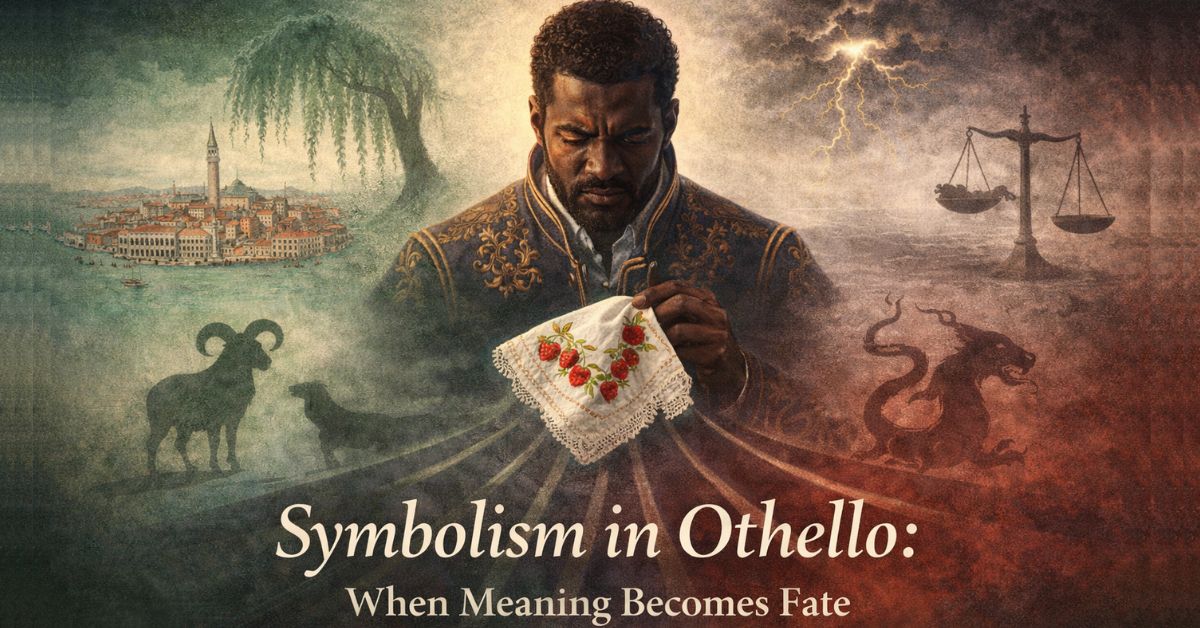
If I ask my students what destroys Othello, they usually say, “Jealousy.” I smile and say, “Yes, but jealousy needs props.” That’s where symbolism in Othello becomes the silent architect of tragedy.
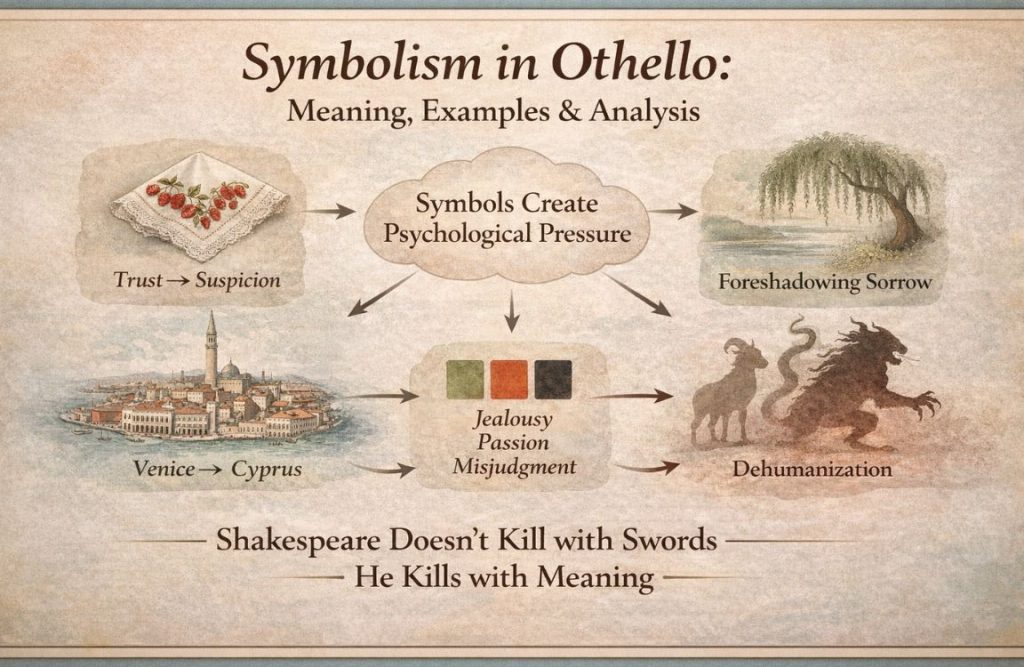
Symbolism is when an object, color, or image carries meaning beyond its literal form. In Othello, these meanings don’t sit quietly in the background. They whisper, provoke, and eventually explode. The handkerchief becomes more than fabric. It turns into proof, obsession, and a weapon.
The willow song becomes more than music. It foreshadows sorrow. Animals, colors like green and red, and even the shift from Venice to Cyprus. These are not decorative details. They are emotional pressure points.
When I teach Othello symbols, I tell my students this: Shakespeare doesn’t stab his hero with a sword. He suffocates him with meaning. The symbols in Othello tighten like invisible strings until the tragedy feels inevitable.
Table of Contents
What Is Symbolism in Othello? (Meaning & Literary Context)
The meaning of symbolism in Othello lies in Shakespeare’s use of objects, images, and recurring references to represent larger themes like jealousy, race, prejudice, love, reputation, and betrayal. A symbol carries layered meaning, while a motif is a recurring pattern that reinforces those meanings.
Now let me slow that down for you.
Symbolism is not the same as imagery. Imagery paints a picture. Symbolism plants an idea. When Iago warns Othello about the “green-eyed monster,” that’s vivid imagery. But when that image repeatedly represents jealousy’s destructive force, it becomes symbolic.
Similarly, motifs in Othello- such as deception or sight versus blindness- recur throughout the play. A motif repeats; a symbol concentrates meaning into a specific object or image.
Understanding the imagery and symbolism in Othello helps students see how themes grow organically. The handkerchief isn’t just mentioned once. It evolves. It absorbs suspicion, male honor, and fragile trust.
In my classroom, I describe symbolism as emotional gravity. The more the symbol appears, the heavier it becomes, until even a small piece of cloth can pull a hero into darkness.
The Handkerchief Symbolism in Othello (Love, Jealousy & Betrayal)
The handkerchief in Othello transforms a small love token into emotional dynamite. It carries memory, trust, and fear all at once, quietly shifting from a symbol of romance to one of accusation- a striking reminder of how fragile belief becomes in a manipulated mind.
i) What Does the Handkerchief Symbolize in Othello?
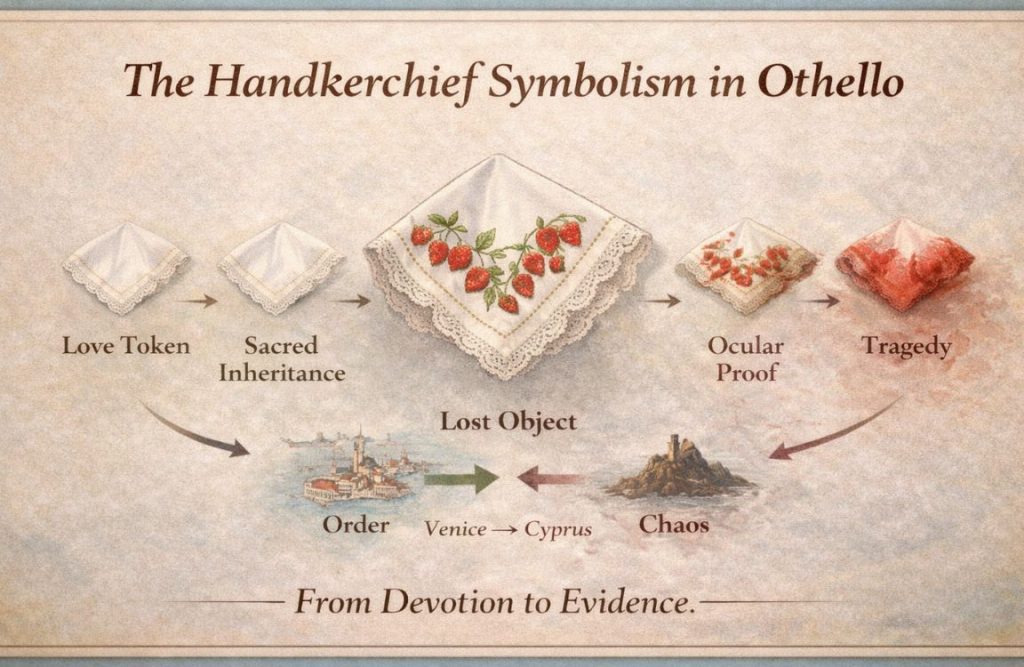
The handkerchief begins as a symbol of marital fidelity and love, but soon mutates into proof of betrayal, fueling jealousy and tying Othello’s sense of honor to possession.
Now, let me tell you how I explain this in class.
At first, the cloth is tender. Othello gives it to Desdemona as a story wrapped in fabric- a charm tied to love and protection. In that moment, it stands for devotion. Students usually see it as sweet. I warn them: sweet things in tragedy rarely stay sweet.
Then comes the famous handkerchief scene in Othello, the turning point where imagination outruns truth. Once Iago plants doubt, the object transforms into one of the most powerful symbols that represent jealousy.
Notice the terrifying logic: Othello never witnesses betrayal. He interprets evidence. The cloth becomes a courtroom where suspicion is the judge and reason never shows up.
Here’s the cruel psychology: Othello treats the lost handkerchief not as a mistake but as a moral confession. To him, love must be visible, provable, almost measurable. That’s why it connects to male honor. If Desdemona loses it, he feels he loses dignity itself.
I often tell my students, tragedy happens when feelings demand physical proof. The play’s symbolic themes in Othello converge here: trust collapses because love is reduced to an object.
A marriage falls, not because a crime occurred, but because a symbol convinced a man it had.
ii) Symbolism of Strawberries in Othello
In Othello, the strawberries embroidered on Desdemona’s handkerchief symbolize love, chastity, marital fidelity, and ultimately the bloody collapse of trust. What begins as a tender love token becomes the “ocular proof” that fuels Othello’s jealousy and seals the tragedy.
When I teach this scene from Othello, my students are always surprised. They expect something grand and royal. Instead, Shakespeare gives us red strawberries stitched onto white linen. It’s simple, domestic, but dangerous.
The white cloth evokes purity and the Renaissance obsession with bridal virginity- the image of blood on wedding sheets. The red strawberries quietly echo that symbolism. Othello even mythologizes the handkerchief, claiming it was dyed with “mummy” from maidens’ hearts, giving it magical power to preserve fidelity. That belief makes its loss catastrophic.
Once the handkerchief passes from Desdemona to Cassio through Iago’s plotting, love turns into evidence. Those innocent red patterns begin to resemble bloodstains in Othello’s imagination. The object doesn’t change- his perception does.
As I tell my students, Shakespeare shows us how jealousy can transform “trifles light as air” into sacred proof. A small piece of cloth becomes the engine of destruction.
iii) Why Is the Handkerchief So Important to Othello?
Because he needs certainty in a world he cannot emotionally control. The significance of the handkerchief in Othello lies in his fear of chaos. Othello is a soldier. He understands battlefields, strategies, and enemies you can point at. Love is different. Love requires trust, and trust is invisible. That terrifies him.
So he clings to proof.
When students ask me what Iago does with the handkerchief, I say: he weaponizes Othello’s psychology. He doesn’t change reality. He changes the interpretation. Othello’s mind begins to orbit the object. Sleep, reason, tenderness- all shrink. The handkerchief becomes emotional gravity.
In class, I describe it as a mental cage: Othello locks himself inside and throws away the key, convinced he is defending honor while actually surrendering judgment.
iv) Handkerchief Quotes in Othello
For exam revision, I always tell my students: track the handkerchief, and you track the tragedy in Othello. Each quote marks a psychological shift- story → suspicion → fixation → conviction. The plot barely moves; the mind collapses.
i) “That handkerchief did an Egyptian to my mother give.”
When I read this aloud in class, I lower my voice. Suddenly, the handkerchief is no longer fabric. It is folklore. Othello wraps it in myth, magic, maternal legacy. The object gains sacred authority.
And once something feels sacred, questioning it feels like betrayal. Shakespeare shows how belief, not evidence, builds emotional truth. Othello doesn’t trust Desdemona. He trusts the story attached to a piece of cloth.
ii) “Trifles light as air / Are to the jealous confirmations strong.”
Here, Iago becomes a psychological puppeteer. I tell my students: jealousy is a magnifying glass. A feather becomes a dagger. A misplaced handkerchief becomes adultery. Suspicion doesn’t need proof; it feeds on imagination. Shakespeare exposes how the mind edits reality.
iii) “The handkerchief!”
Notice the repetition. One word. Again and again. I call this tunnel vision in poetic form. Othello’s language shrinks because his world shrinks. Obsession narrows thought until only one object remains.
iv) “I found it in my chamber.”
In Othello, Cassio casually says he “found” the handkerchief in his room, unaware it was planted. That innocent remark becomes fatal evidence. Shakespeare shows how tragedy grows not from facts, but from how characters interpret them, and Othello chooses suspicion over trust.
Animal Symbolism in Othello (Jealousy, Race & Dehumanization)
The animal symbols in Othello strip characters of humanity. Shakespeare loads the dialogue with insults and creature metaphors so the audience feels moral decay before it becomes visible action- a powerful case of imagery and symbolism in Othello, shaping emotion.
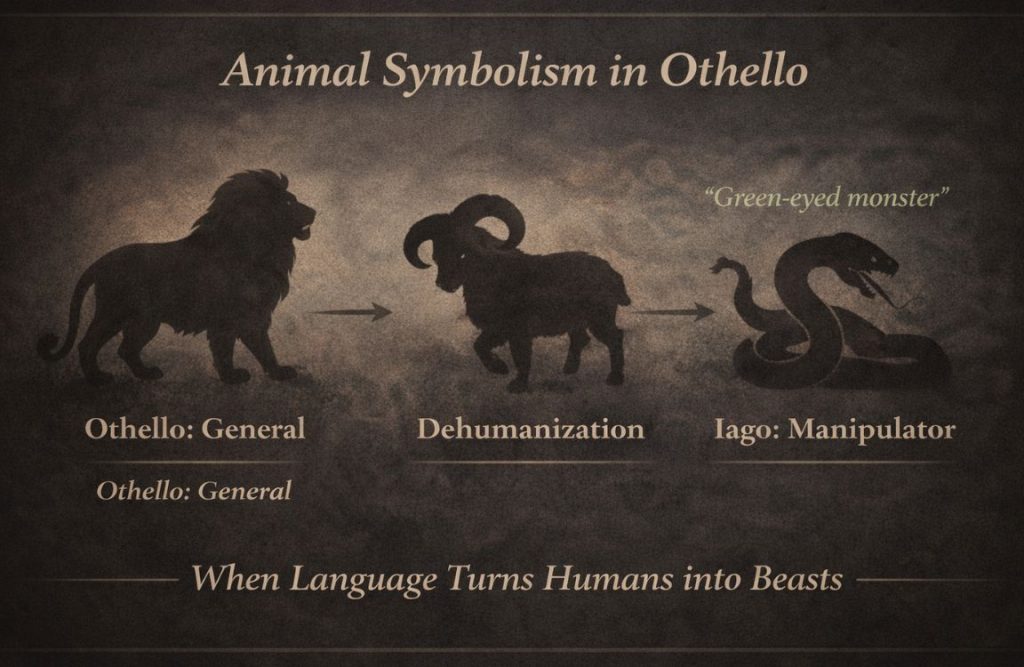
i) The Black Ram Symbolism in Othello
Animal language appears before violence appears, and that’s the warning sign. Early in the play, Iago shouts to Brabantio:
“An old black ram is tupping your white ewe.”
Students usually react with shock, which is exactly the point. This black ram symbol in Othello works as deliberate dehumanization. Othello is reduced from a respected general to breeding livestock. The insult attacks race, sexuality, and social order all at once.
In Othello Act 1, the tragedy hasn’t begun yet, but the moral atmosphere has. Shakespeare plants racial anxiety in language before it appears in action. The audience hears society’s fear first, then watches Othello slowly internalize it.
I tell my class: the most dangerous weapon in the play is vocabulary. Before Othello doubts Desdemona, the world has already taught him what he is supposed to be.
ii) Animal Imagery and Moral Corruption
Jealousy in the play Othello behaves like a biological infection. Iago never argues logically. He breeds instinct. His famous warning:
“O, beware, my lord, of jealousy;
It is the green-eyed monster which doth mock…”
This is classic animal symbolism in Othello. Jealousy isn’t an emotion but a creature. And creatures don’t negotiate. They consume.
Soon, conversation fills with bestial language: goats, monkeys, dogs. Reason quietly exits. When people are described as animals, moral rules loosen. Violence becomes easier because empathy shrinks.
These are the play’s most vivid symbols that represent jealousy: once Othello imagines Desdemona in animalistic terms, love transforms into disgust. The mind protects itself by dehumanizing what it fears losing.
iii) Symbolism of Animals and Jealousy
When I teach this section of Othello, I tell my students something unsettling: Iago never argues with facts. He engineers perception.
Animal symbols and images in Othello work like psychological conditioning. Repeat an image often enough- “beast,” “ram,” “goat,” “monkey”- and the mind begins to see it. Iago never proves Desdemona’s betrayal. Instead, he plants vivid, physical pictures in Othello’s imagination and lets those images ferment. He doesn’t argue. He rehearses. He doesn’t demonstrate. He suggests.
Gradually, Othello stops asking, Is it true? and starts asking, How could I not see it? That shift terrifies me every time I read it. Because that is the symbolic engine of jealousy in Othello: not evidence, but interpretation; not reality, but visualization hardened into certainty.
Here’s how I explain it in class: Iago writes a story inside Othello’s mind. Once Othello begins picturing Cassio and Desdemona as creatures of appetite rather than people of affection, tragedy becomes inevitable.
And then comes Shakespeare’s cruel irony. Othello, once noble and composed, begins speaking in the very animal metaphors meant to degrade him. Language reshapes identity. The hero is not destroyed by proof. He is destroyed by adopting the vocabulary of his enemy.
Color Symbolism in Othello (Green, Red & Black)
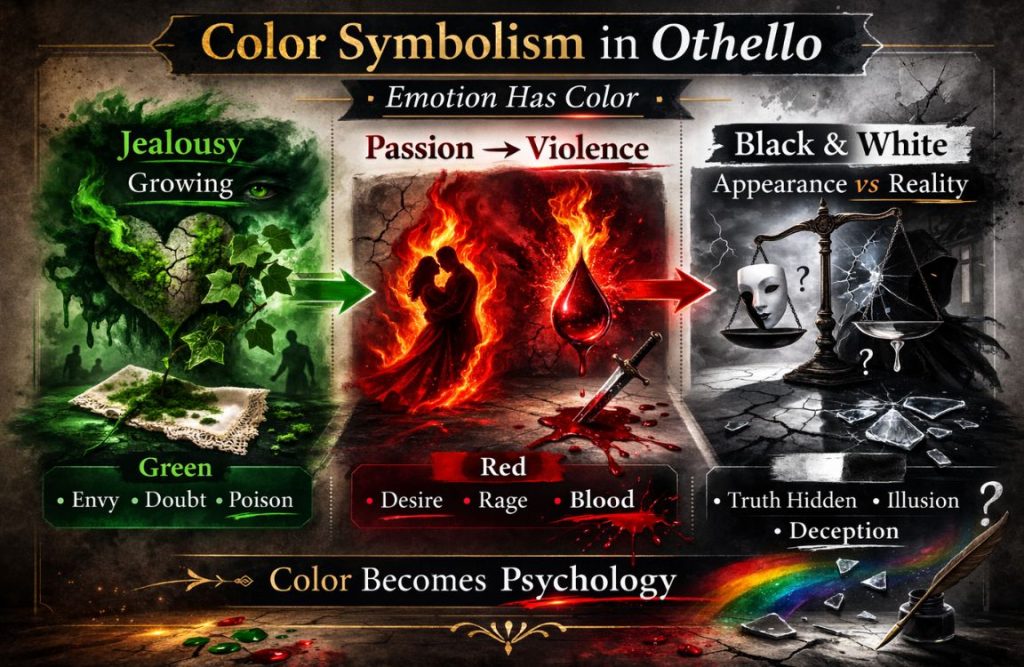
The color symbols in Othello work like emotional lighting on a stage. Shakespeare doesn’t just let characters speak. He paints their psychology. Each color quietly forecasts decisions the characters themselves don’t yet understand.
i) Green Symbolism in Othello
Green represents jealousy and envy growing from suspicion into obsession. When I teach the green symbol in Othello, I tell students to imagine mold. It begins as a tiny invisible patch and ends by covering the entire wall. Jealousy works exactly the same way.
Iago famously warns Othello about the “green-eyed monster.” Notice the irony- the villain describes the danger accurately while secretly feeding it. Green here isn’t explosive anger. It’s slow corrosion. The mind keeps replaying possibilities until imagination feels like memory.
Among the play’s strongest symbols that represent jealousy, green shows how emotion matures biologically. Othello doesn’t leap into rage. He incubates it. Every pause, every silence becomes evidence. Shakespeare turns a color into a psychological timeline — suspicion → fixation → certainty.
I often ask my class: What’s scarier- a sudden storm or a quiet poison? Shakespeare clearly prefers the second.
ii) Red Symbolism in Othello
Red signals passion, sexual jealousy turning into violence. The color red in Othello tracks emotional temperature. Love begins warm but gradually overheats. By the end, tenderness burns into destructive intensity.
The earlier symbolism of strawberries in Othello prepares us for this shift: red appears where intimacy and danger overlap. Shakespeare connects desire and death visually. The audience senses impending catastrophe long before characters do.
I like telling students that tragedy doesn’t change emotions. It overheats them. Love becomes possession. Devotion becomes punishment. Red marks the point where feeling stops listening to reason.
ii) Black and White Imagery in Othello
In Othello, black and white imagery is repeatedly used to shape moral judgment. Blackness is linked to evil, corruption, and animalistic instinct, while whiteness suggests purity, innocence, and virtue.
Yet the play shows these labels are constructed, not factual. Iago’s “old black ram” and “white ewe” references to a “sooty bosom,” and the night-filled setting encourage characters to read morality through appearance.
Later, Emilia calls Othello the “blacker devil,” while Desdemona lies pale, “as her smock,” exposing tragic misjudgment. The supposed moral code collapses: the “white” Iago engineers evil, and the “black” Othello becomes its victim.
The imagery, therefore, reveals prejudice masquerading as certainty- people trust what they see, and that trust destroys them.
The Willow Song Symbolism in Othello
The willow tree symbolism in Othello quietly predicts heartbreak. Through this symbol, Shakespeare lets music mourn before tragedy arrives- a gentle warning the characters cannot hear but the audience cannot ignore.
i) Symbolism of the Willow Song in Othello
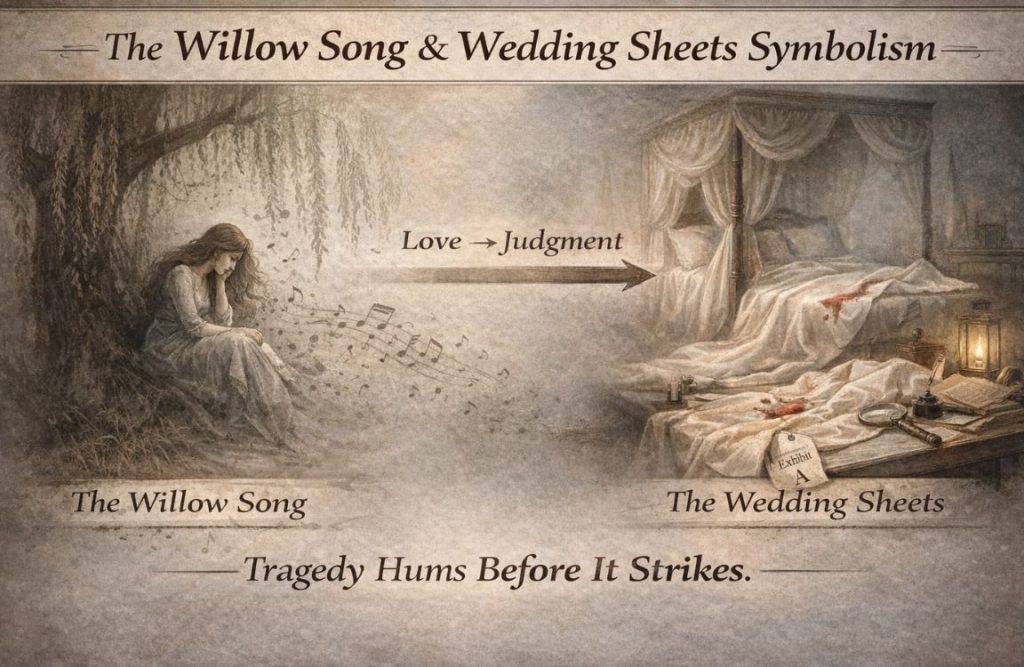
The Willow Song in Othello foreshadows Desdemona’s death, symbolizes abandoned love, and reveals how tragedy begins in mood before it erupts in action.
Now the live teaching moment: I read aloud, “The poor soul sat sighing by a sycamore tree… Sing all a green willow,” and the room goes quiet. Nothing violent happens. Yet grief slips in early, like thunder before rain. The willow, a classic emblem of disappointed love, becomes Desdemona’s emotional weather report: loyalty misunderstood, innocence left out in the cold.
I tell my students that Shakespeare dims the lights before the knife appears. The song echoes Barbary’s fate and exposes a cruel pattern- women absorb the cost of male jealousy. What stings most? Desdemona’s mercy: “Let nobody blame him.” Tragedy doesn’t crash the party. It hums backstage, warming up.
ii) Wedding Sheets & Death Imagery in Othello
In Othello, the wedding sheets shift from symbols of innocence to a shroud, turning the marriage bed into a courtroom where jealousy delivers its sentence.
Live in class, I pause on Desdemona’s plea, “If I do die before thee, prithee shroud me / In one of those same sheets.” The room tightens. Linen meant for love becomes legal evidence.
I tell my students the bed doesn’t change. Its meaning does. Once a promise of tomorrow, it’s rebranded as a crime scene today. When Othello vows the “lust-stained” bed will be “spotted,” jealousy stains what was never stained at all.
That’s the trick: suspicion writes in invisible ink. By the final scene, white sheets hold a verdict no witness saw, proving tragedy peaks when love and punishment share a pillow.
Setting Symbolism in Othello (Venice, Cyprus & the Storm)
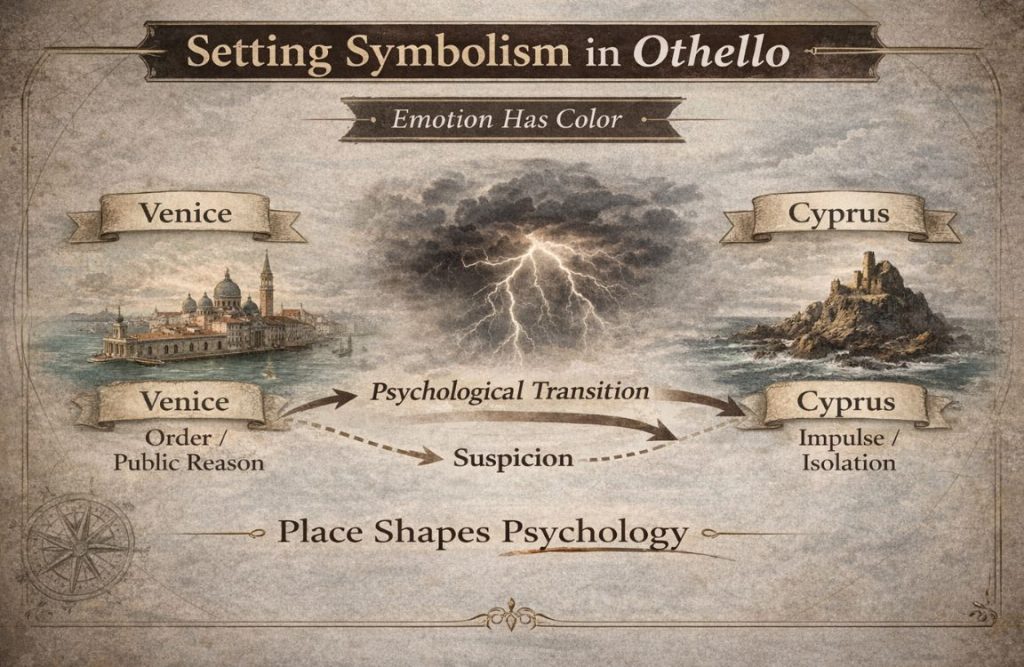
In Othello, place shapes psychology. Venice in Othello symbolizes order, Cyprus suggests instability, andthe storm represents emotional chaos arriving.
i) Symbolism of Venice in Othello
In Othello, Venice symbolizes public order and polished reason- a “courtroom society” whose rules steady Othello, even as prejudice hides behind procedure.
Live in class, I point to Othello calmly defending his love before the Duke and Senate: evidence presented, witnesses called, feelings footnoted. Venice is a stage where truth wears a suit and tie.
I tell my students this city believes reason will save us. Yet it only teaches bias to speak politely. Othello thrives here because he knows the script: serve well, speak well, earn trust.
But watch the masks. Venice smiles at outsiders, it needs, then whispers behind their backs. The moment the play leaves this orderly city for Cyprus, the guardrails drop, and passion drives the plot off the road.
ii) Symbolism of Cyprus in Othello
Cyprus represents chaos, passion, and destruction- a place where inner instincts run wild, free from the restraints of social discipline.
From the moment the characters arrive in Cyprus, formal debate disappears. The private interpretation takes over. No senate, no witnesses, no stabilizing institutions- only personal judgment.
I tell students to imagine moving from a courtroom to an isolated island with rumors as the only news source. Thoughts grow louder there. Without social restraints, imagination gains authority.
Cyprus allows whispers to replace evidence. Relationships are no longer public contracts but emotional negotiations. The characters start reacting instead of reasoning. The environment doesn’t create conflict. It removes the brakes that once controlled it.
iii) Symbolism of the Storm in Othello
The storm marks the transition from Venice’s orderly world to the chaotic, terrific atmosphere of Cyprus- a psychological doorway between rationality and impulse. Before personal conflict escalates, nature erupts first, signaling the emotional turbulence to come.
Shakespeare uses the storm to foreshadow behavior: the external chaos mirrors the internal unraveling of his characters.
So what does the storm in Othello symbolize? Transition. The physical turbulence signals the collapse of external order and the rise of inner turmoil. After the storm, the seas may calm, but human minds remain unsettled.
I often tell my students: the storm ends in the sky, yet its echoes continue in Othello’s heart and mind.
Key Examples of Symbolism in Othello (Quick Summary Table)
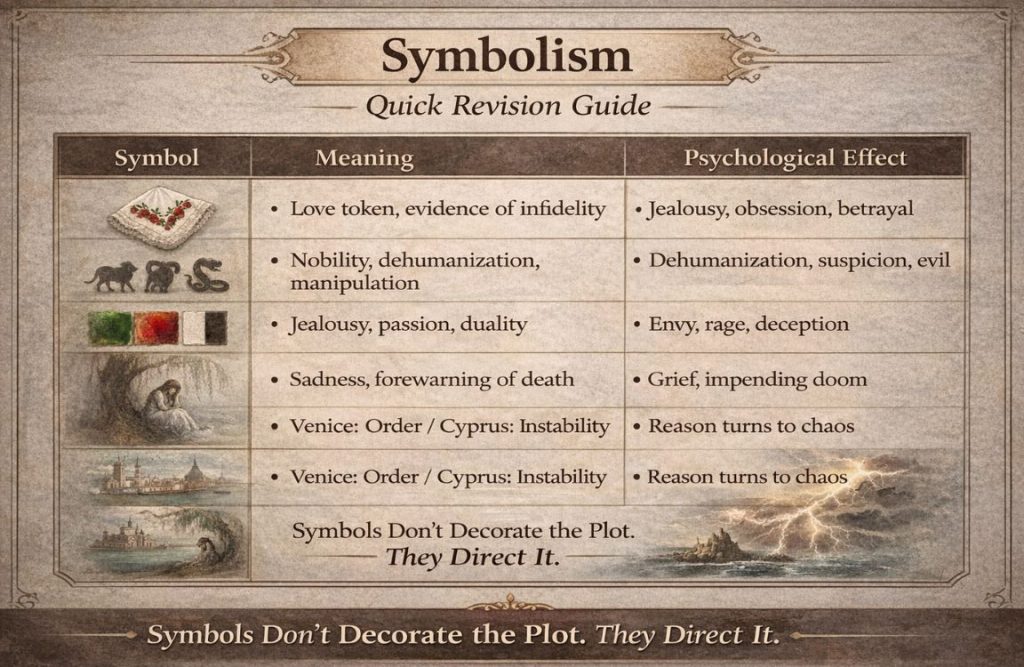
Here’s a revision-friendly guide to the examples of symbolism in Othello– useful before exams and essays:
| Element | Meaning | Dramatic Effect |
| Handkerchief | Trust turned to suspicion | Drives tragic decisions |
| Animal Language | Loss of humanity | Encourages cruelty |
| Color Contrasts | Emotional interpretation | Distorts judgment |
| Willow Song | Anticipated sorrow | Creates inevitability |
| Settings Shift | Order → instability | Enables manipulation |
These important symbolic moments show how the play operates less like a mystery and more like a psychological experiment. These Othello symbols don’t decorate the story. They guide it.
When students revise, I remind them: symbols in Othello act like pressure points. Press one gently, and the entire tragedy reacts.
Why Symbolism in Othello Matters
The power of symbolism in Othello lies in how it transforms emotions into visible forces- turning jealousy, racial anxiety, and gender expectations into tragic momentum.
When I ask students why Othello collapses psychologically, they often search for a single mistake. But tragedy here isn’t one decision. It’s accumulated meaning. Every object, image, and setting quietly pressures the hero until his inner balance fractures.
Jealousy, for instance, doesn’t appear as sudden rage. It matures through suggestion, interpretation, and wounded pride. Othello’s imagination becomes both courtroom and executioner. As I tell my class, the mind can become a more dangerous battlefield than any war.
Race deepens that vulnerability. Othello constantly measures himself against how others describe him. When society frames someone as “other,” self-doubt becomes easier to ignite. Shakespeare shows how identity, once destabilized, searches desperately for certainty.
Gender expectations sharpen the tragedy further. Desdemona is expected to be pure, silent, and obedient; Othello is expected to be decisive and dominant. When these rigid roles collide with insecurity, compassion disappears. Love turns into ownership.
Here’s the painful brilliance: the tragedy feels inevitable not because fate commands it, but because interpretation spirals unchecked. By the final act, Othello believes he is restoring order-
“Yet she must die, else she’ll betray more men.”
That line chills my classroom every time. He thinks he is acting rationally.
And that is why symbolism matters. It doesn’t decorate the tragedy. It builds the logic that makes destruction feel justified, until it is too late.
FAQs:
What are the key symbols in Othello?
The key symbols in Othello are the handkerchief (love and fidelity), animals (instinct and dehumanisation), light and darkness (truth and jealousy), and the willow song (sorrow and betrayal).
What is the symbol of Iago?
Iago symbolises deception, manipulation, and hidden evil. He represents appearance versus reality and the destructive power of unchecked jealousy and ambition. He is the smiling poison. He symbolises moral corruption dressed as honesty. Like a virus, he spreads doubt invisibly.
What animal represents Othello?
Othello is often associated with the noble lion, but Iago reduces him to animalistic imagery, such as a “Barbary horse,” symbolising how jealousy strips him of dignity to instinct.
What animal is Iago?
Iago is commonly linked to a serpent or devilish creature, symbolising cunning, temptation, and hidden malice beneath a calm exterior. If Othello is the fallen lion, Iago is the serpent in the grass. He coils quietly. He waits.
Conclusion:
When I close this lesson, I remind my students that symbolism in Othello is not decorative embroidery stitched onto the plot. It is the stitching that holds the tragedy together. The handkerchief, the animals, the colors, the storm, the bed sheets, each begins as something ordinary and ends as something fatal.
Shakespeare doesn’t rush Othello toward destruction. He surrounds him with meaning until he can no longer breathe clearly.
That is the quiet genius of the play. Symbols become arguments. Images become evidence. Settings become psychological weather. By the time the final scene unfolds, we realize Othello was not destroyed by a single lie, but by interpretations he believed were true. And that, I tell my class, is what makes this tragedy timeless and terrifying.