Figurative language means words that say more than they literally mean. In Shakespeare, images don’t decorate emotion. They create it. In Othello, jealousy begins not with evidence, but with the pictures characters imagine.
Now, let me tell you how I introduce this in class. I ask my students, “When does Othello actually see betrayal?” They pause. Never.
Instead, he hears stories. He sees mental images. And that is where tragedy starts.
Similes and metaphors in Othello are not poetic ornaments. They are psychological weapons. Iago never argues. He paints pictures- animals, monsters, poison- and Othello’s mind supplies the fear.
This is the importance of figurative language in Othello: language becomes experience. Once Othello imagines, he believes. Once he believes, he acts.
So, the play isn’t really about jealousy appearing. It’s about jealousy being spoken into existence.
Table of Contents
What Are Similes and Metaphors in Othello?
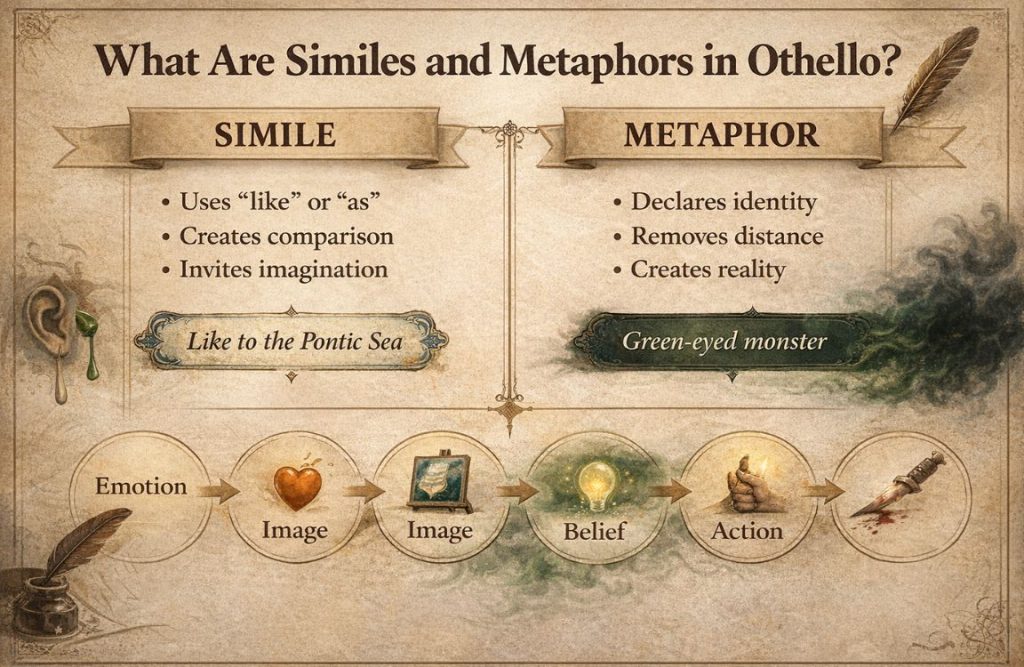
Similes and metaphors in Othello are figurative comparisons that turn emotions into images. Similes compare using “like” or “as”; metaphors state identity. Shakespeare uses them to make jealousy visible- so characters react to imagined pictures rather than facts.
i) Difference Between Simile and Metaphor
When I teach this, I tell my students: a simile knocks; a metaphor owns the house.
A simile compares using “like” or “as.” Love is like light. The mind is invited to imagine. There’s breathing room.
A metaphor removes the distance. Love is light. No hesitation. No maybe. It declares identity. In Shakespeare’s metaphors, the mind is forced to believe.
And that difference matters. A simile suggests resemblance. A metaphor creates reality. One opens possibilities; the other closes debate.
I always ask my students: Which sounds stronger?
They say metaphor.
The moment Othello stops comparing and starts declaring, his thinking hardens. Language shifts from poetry to verdict, and once words sound like truth, characters stop questioning them.
i) Why Shakespeare Uses Figurative Language in Othello?
Shakespeare uses figurative devices in Othello to manipulate emotion, reveal psychological breakdown, reinforce the theme, and transform jealousy into a recurring motif that shapes both character and tragedy.
Here’s my favorite classroom moment: I ask my students, “Why doesn’t Iago just present evidence?”
Because evidence persuades the brain, images persuade the soul.
The literary devices in Othello work like emotional shortcuts. Instead of arguments, Shakespeare gives imagery in Othello: monsters, animals, poison, and darkness. Each picture plants a feeling before logic can respond.
Then repetition turns it into a motif in Othello. The audience keeps hearing similar images- corruption, infection, vision- until suspicion feels natural. We don’t watch jealousy grow. We feel it spreading.
Shakespeare understood psychology centuries ago: humans trust vivid pictures more than careful reasoning. So, the play becomes less a crime investigation and more a mind infection. By the time Othello demands proof, language has already rewritten reality.
iii) How Language Drives the Tragedy in Othello?
Language drives the tragedy in Othello by reshaping perception, manipulating trust, and turning imagined betrayal into lived reality through dramatic irony and the collapse of appearance vs reality.
I tell my students: the play has no murder weapon until Act 5. The real weapon is vocabulary.
Through appearance vs reality in Othello, words replace proof. Iago frames suspicion as evidence and calls himself “honest” until the label becomes truth. The audience sees the lie. That’s the devastating, dramatic irony in Othello. We watch a man react to events that never happened, only narrated.
Even Othello’s language deteriorates. Noble verse fractures into jealous prose. Once imagery replaces investigation, perception hardens.
Shakespeare’s cruel lesson?
Tragedy begins when language stops describing reality and starts rewriting it.
For a deeper understanding of the similes and metaphors in Othello, you can watch my video tutorial here.
Types of Metaphors in Othello (Categorized Analysis)
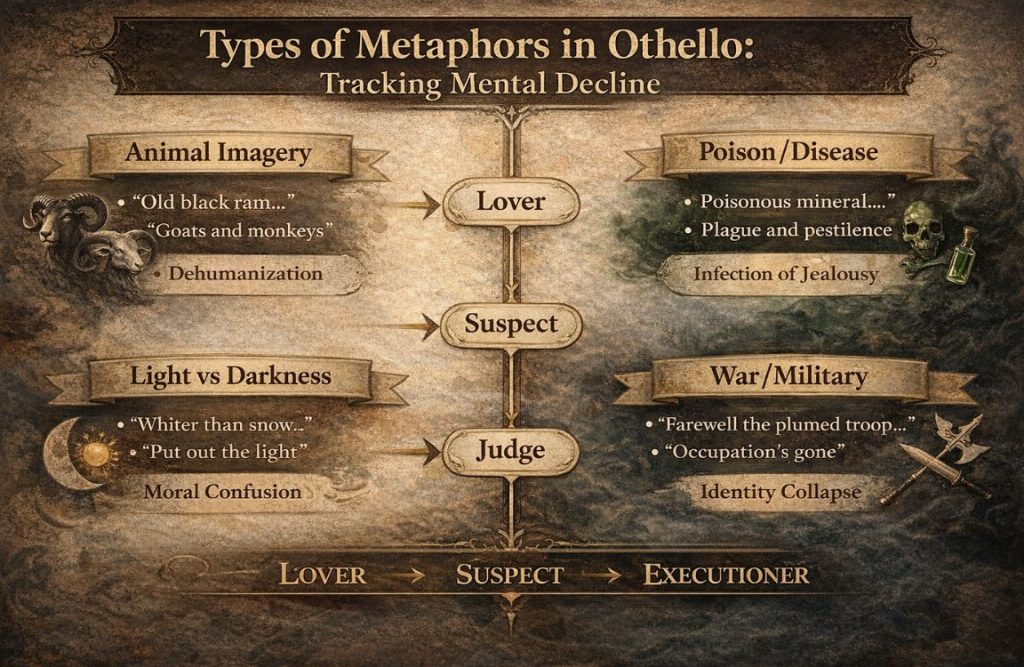
The metaphors in Othello fall into clear groups- animal, disease, light-dark, and military imagery- each tracking Othello’s mental decline. As the imagery changes, his identity changes: lover → suspect → judge → executioner.
i) Animal Metaphors in Othello (Dehumanization)
Animal metaphors in Othello dehumanize characters, fuel racism and jealousy, and transform love into instinct-driven revulsion, driving the psychological collapse that leads to tragedy.
The first time I read, “An old black ram is tupping your white ewe,” someone laughs in my class. Then the room goes still.
Because the insult isn’t clever. It’s corrosive.
In any serious Iago’s animal imagery analysis, we see the strategy immediately. Othello becomes a “Barbary horse.” The lovers become the “beast with two backs.” Later, jealousy rots into “goats and monkeys.” Notice the descent. Human affection is rewritten as appetite. Marriage becomes livestock breeding.
And here’s the psychological brilliance: once people are described as animals, dignity evaporates. You can debate facts. You cannot easily erase a vivid, humiliating picture.
Even more chilling? Othello eventually echoes the same language. “Goats and monkeys!” he cries. The manipulated mind begins to echo the manipulator.
By reducing love to instinct and identity to stereotype, Shakespeare shows how language can strip away civilization itself.
The tragedy begins not with violence, but with vocabulary that turns humans into beasts.
ii) Disease and Poison Imagery in Othello (Jealousy Infection)
In Othello, disease and poison imagery present jealousy as an infection spread through language, gradually corrupting the mind until suspicion feels like physical illness rather than emotion.
I sometimes tell my students: jealousy in this play doesn’t explode. It incubates.
The language of jealousy in Othello borrows from medicine: plague, pestilence, contamination. Iago promises to “pour this pestilence into his ear,” and later boasts, “The Moor already changes with my poison.” Notice what Shakespeare does here: lies become toxins.
Soon, Othello feels a “poisonous mineral” gnawing at his inwards. He doesn’t think he is doubting; he thinks he is sick. Each insinuation becomes a symptom. Each pause becomes a fever.
Even the handkerchief transforms into “a raven o’er the infected house.” The world itself seems diseased.
I ask my class: Why doesn’t he verify the facts?
Because sick people seek cures, not evidence. Revenge begins to look medicinal.
That’s the terrifying brilliance of Shakespeare. Othello doesn’t believe he is committing murder.
He believes he is removing the infection.
And that fatal misunderstanding begins entirely in language.
iii) Light and Darkness Imagery in Othello (Moral Confusion)
Shakespeare uses light and darkness imagery in Othello to explore moral confusion, racial tension, and appearance vs reality. Light symbolizes truth and innocence, while darkness represents deception and jealousy, yet the tragedy occurs when Othello mistakes imagined darkness for real evil.
Here’s what I ask my students: When the lights go out, does truth disappear, or does certainty?
The symbols in Othello constantly shift between brightness and shadow. We’re told light equals goodness and darkness equals corruption. Desdemona is framed in “white” innocence. Iago wraps himself in metaphorical night. Early racist imagery cruelly equates Othello’s skin with evil, planting seeds of doubt long before jealousy blooms.
But here’s Shakespeare’s twist: darkness doesn’t create evil. Interpretation does.
Through appearance vs reality, Othello’s characters trust what imagery suggests more than what evidence proves. Othello demands “ocular proof,” yet he believes imagined pictures over living truth. By Act 5, the bedroom candle becomes devastating symbolism. He thinks extinguishing physical light will restore moral clarity.
It won’t.
The tragedy unfolds because Othello confuses shadow with sin. In the end, Shakespeare shows us something terrifying: humans don’t destroy what they see. They destroy what they think they see.
You can watch my video tutorial to explore the symbolism in Othello in detail.
iv) War and Military Metaphors in Othello (Identity Collapse)
In Othello, Shakespeare uses war and military metaphors to reveal how completely Othello’s soldierly identity consumes his personal life, turning love into conquest and jealousy into combat- ultimately leading to psychological and moral collapse.
When I teach this section, I ask my students: What happens when a soldier brings the battlefield home?
Othello understands the world through command, rank, and strategy. In the figurative language in Othello Act 3, affection begins to sound like warfare. “Farewell, the plumed troop.” “Occupation’s gone.” His vocabulary shifts from intimacy to artillery. This is the essence of Othello’s jealousy language- emotion becomes an enemy force to defeat.
Though the Turkish fleet vanishes, the true war ignites within his mind. Iago operates like a calculating tactician, conducting psychological warfare. Desdemona becomes contested ground. Proof functions as intelligence. Judgment feels like execution.
Othello does not process doubt through conversation; he mobilizes against it.
His tragedy lies in identity collapse: the general cannot become the husband. And when jealousy sounds its trumpet, he responds as a soldier- decisively, violently, fatally.
v) The Green-Eyed Monster Metaphor in Othello
In Othello (Act 3, Scene 3), the “green-eyed monster” metaphor describes jealousy as a self-consuming force that mocks and destroys the person who harbors it, ultimately leading to Othello’s tragic downfall.
When I teach this line, I pause. Iago warns: “Beware, my lord, of jealousy; it is the green-eyed monster which doth mock the meat it feeds on.”
Jealousy here is not a feeling. It’s a predator. In Renaissance symbolism, green signaled envy and sickness. The image suggests something alive, feeding, tormenting its host.
Othello thinks he can manage suspicion. He cannot. The monster does not need proof; it needs fear.
And once Othello imagines it, the creature becomes real enough to destroy love, sanity, and life itself.
Famous Similes in Othello (With Explanation)
The famous similes in Othello compare emotions to visible images using “like” or “as.” These comparisons make abstract feelings- love, jealousy, grief- physically imaginable. Shakespeare uses similes to reveal psychology before characters themselves understand it.
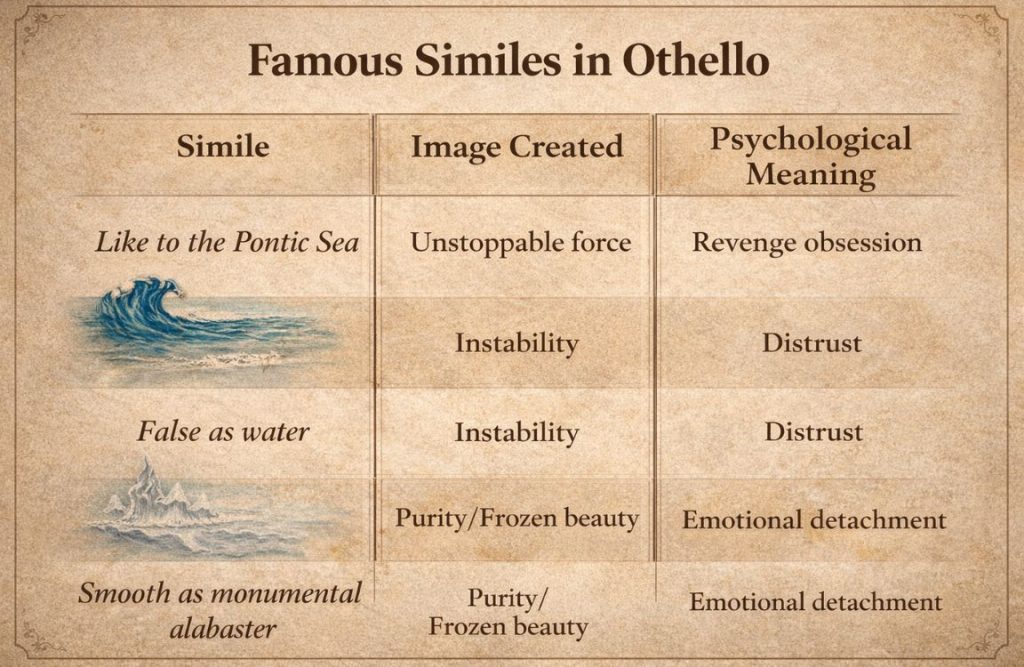
i) Similes in Othello
When I introduce similes in Othello, I tell my students, “Watch how comparison becomes confession.” At first, Othello speaks with balance and authority. But as jealousy tightens its grip, his language begins to lean on similes, and that leaning tells us everything.
Take Act 3: “Like to the Pontic Sea,/Whose icy current and compulsive course…” Here, Othello compares his revenge to the unstoppable Black Sea. Notice the shift. He is no longer reasoning calmly; he is surrendering to force. The simile shows motion- relentless, cold, irreversible.
Then in Act 5, doubt hardens into accusation: “She was false as water.” Water, unstable and shifting. In one line, Desdemona’s identity dissolves into suspicion. Earlier, he had described her skin as “whiter… than snow, / And smooth as monumental alabaster.” Snow. Alabaster. Purity turned into a fragile object.
Even Iago confesses through comparison: his thoughts “like a poisonous mineral” gnaw within. Similes in Othello do more than decorate speech. They expose psychological fractures. Unlike metaphors, which declare certainty, similes reveal a mind still arguing with itself.
And that’s what I ask my students: when Othello starts comparing, is he seeking truth, or manufacturing it?
ii) Desdemona and Purity Imagery
Now here’s where I lower my voice in class. Desdemona is wrapped in light from the very beginning. She is “heavenly,” “angelic,” her skin “whiter than snow.” Even Othello’s final line before killing her, “Put out the light, and then put out the light,” fuses her body with radiance itself.
But purity in Othello is dangerously fragile.
Her whiteness, her association with Diana’s chastity, even the delicate handkerchief- all become symbols of spotless virtue. And spotless things are easily imagined as stained. Once the handkerchief is lost, purity turns into suspicion.
I tell my students: Desdemona does not change. The imagery around her does.
When someone is mythologized as a saint, any rumor feels like contamination. Othello isn’t only afraid of betrayal. He’s terrified that the sacred image he built- light, heaven, snow- might be an illusion.
And Shakespeare reminds us of something chilling: the brighter the pedestal, the harder the fall.
iii) The “Monumental Alabaster” Simile Analysis
Now we reach the chilling moment in Othello (Act 5, Scene 2):
“Yet she must die, else she’ll betray more men…
Smooth as monumental alabaster.”
On the surface, Othello compares Desdemona’s skin to polished white stone used in tomb monuments. Alabaster suggests purity, saintliness, perfection. But listen closely- this is not admiration. It is preparation.
I tell my students: he freezes her before he kills her.
Stone cannot argue. Stone cannot bleed- at least not emotionally. By imagining her as a “monumental” statue, he detaches her from life. The simile transforms a breathing wife into an art object, cold and worshipped. And objects are easier to destroy.
Notice the cruel contrast: white stone against the red blood he is about to spill. This is not blind rage. It is a calculated obsession. He aestheticizes the murder, convincing himself he is preserving honor.
Why compare a wife to a tomb?
Because jealousy has already buried her in his mind.
And here Shakespeare whispers his darkest truth: language does not just describe violence. It makes it possible.
Famous Metaphor Quotes in Othello (Deep Analysis)
The most famous metaphor quotes in Othello transform jealousy into monsters, love into light, and suspicion into poison. These metaphors do not decorate emotion. They redefine reality, pushing Othello from rational general to tragic executioner.
i) Metaphors in Othello Act 1
When I teach metaphors in Othello Act 1, I tell my students: “Before jealousy enters, imagery is already sharpening its knives.”
Act 1 is full of violent metaphors spoken by Iago. He doesn’t announce Othello’s marriage; he describes it as animal chaos, “an old black ram… tupping your white ewe.” That is not a comparison. That is transformation. Othello becomes livestock. Desdemona becomes breeding stock. Love becomes an animal instinct.
And he doesn’t stop there. “Covered with a Barbary horse.” “Making the beast with two backs.” Each metaphor strips away humanity and replaces it with grotesque spectacle.
Literal level? He is provoking Brabantio.
Psychological level? He implants disgust.
Thematic level? Language divides Othello from Venetian society before Othello ever divides himself. He is reduced to appetite, not affection.
Then comes Iago’s chilling confession: “I am not what I am.” Even identity becomes a metaphorical disguise.
I pause and ask: If your story is told in animal terms long enough, does it begin to feel true?
Act 1 plants the metaphorical seeds. Jealousy has not bloomed yet- but the soil is already poisoned.
ii) Metaphors in Othello Act 3
Now we arrive at Act 3, and I always tell my students, “This is where the mind catches fire.”
Iago’s warning is famous:
“O, beware, my lord, of jealousy;
It is the green-eyed monster which doth mock / The meat it feeds on.”
Jealousy is no longer an emotion. It is a predator. Something that devours its owner. Once Othello imagines a monster, he stops reasoning and starts battling.
Then Iago tightens the trap: reputation is the “immediate jewel” of the soul. Suddenly honor feels stealable. Fragile. Precious.
And watch Othello change. “Arise, black vengeance, from thy hollow cell!” Now, revenge is a creature too. He personifies violence. He summons it.
I pause in class and ask: Do you see the shift? In Act 1, metaphors are used against him. In Act 3, he speaks them himself.
That’s the infection point.
Language moves from suggestion to conviction. Once Othello begins manufacturing monsters, tragedy no longer creeps. It charges.
iii) Extended Metaphors in Othello
Extended metaphors in Othello are not single sparks. They are slow-burning fires.
Take the poison imagery. Othello speaks of a “poisonous mineral” gnawing at his heart. The image doesn’t vanish after one line. It lingers. It grows. Suspicion becomes contamination.
Or consider jealousy as the “green-eyed monster.” Introduced by Iago, the image doesn’t fade after one warning. It grows teeth. It feeds. It mocks the very man it devours. That’s the danger of extended metaphor: it creates a creature too powerful to reason with.
Then there is light. “Put out the light, and then put out the light.” A candle becomes Desdemona’s life. Murder becomes ritual. He convinces himself he is restoring order, not destroying innocence.
I often tell students: extended metaphors trap characters inside one way of thinking. Garden. Web. Poison. Light. Once Othello accepts the image, he lives inside it.
And once he does, tragedy is no longer possible to prevent, only to witness.
How Figurative Language Controls Othello’s Mind
Figurative language in Othello doesn’t just describe jealousy. It manufactures it. Through repeated metaphors of poison, monsters, darkness, and warfare, Shakespeare shows how Othello’s thoughts shift from love to violence. His tragedy begins in vocabulary long before it ends in death.
When I teach this, I draw a simple line on the board:
romance → suspicion → obsession → murder → justification
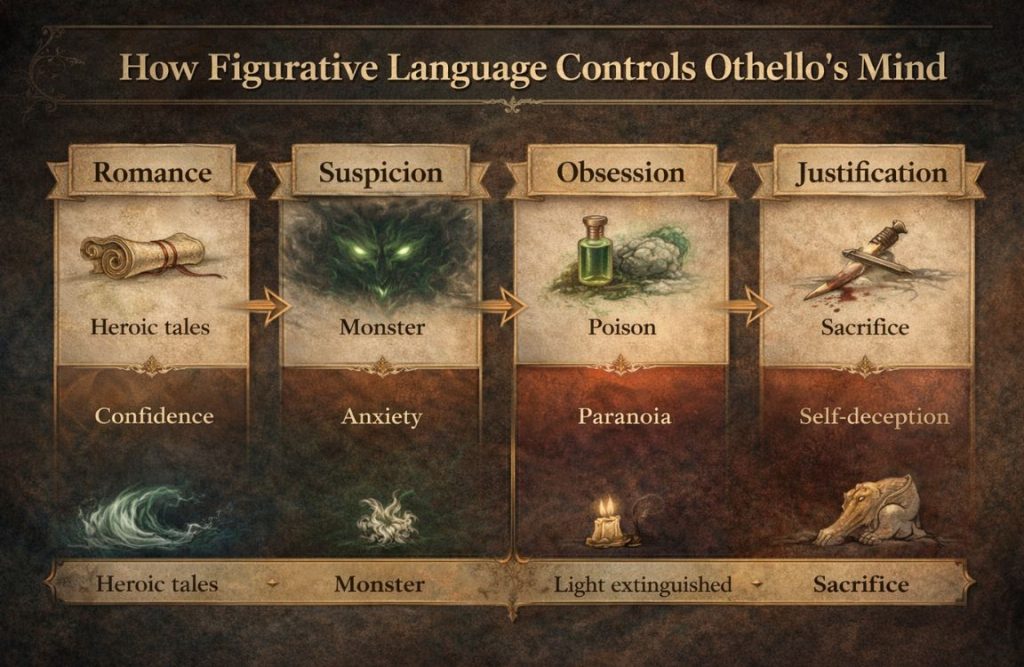
Then I ask: What pushes him along that line?
Not evidence. Not witnesses. Language.
At the beginning, Othello speaks in the language of romance. He recalls how Desdemona “loved me for the dangers I had passed.” Love is storytelling. Identity is heroic. His metaphors are dignified, controlled.
Then suspicion enters, gently. Iago whispers about the “green-eyed monster.” That single metaphor plants an image. Notice how metaphors show jealousy in Othello: they give emotion claws. A feeling becomes a predator.
Soon, the language of jealousy in Othello turns physical. Othello feels a “poisonous mineral” gnawing inside him. Jealousy is no longer a doubt. It is an infection. And infected minds seek cures, not conversations.
By Act 4, obsession dominates- his speech fractures. Repetition replaces reasoning. Imagery grows violent. Desdemona becomes “fair paper” that must be stained. The metaphor shifts her from person to object.
And then comes murder, disguised as morality.
“Put out the light, and then put out the light.”
In my classroom, I pause here. He believes he is restoring order. That is the final, devastating stage of Othello jealousy language analysis: metaphor becomes justification. If she is “light,” extinguishing her feels symbolic, almost necessary.
Here’s the psychological progression I show my students:
| Stage | Dominant Imagery | Mental State |
| Romance | Heroic tales, devotion | Confidence |
| Suspicion | Monster | Anxiety |
| Obsession | Poison, disease | Paranoia |
| Murder | Light extinguished | Distorted righteousness |
| Justification | Sacrifice, duty | Self-deception |
I tell my students: Othello doesn’t fall because he lacks intelligence. He falls because he trusts imagery over reality.
The most dangerous weapon in this play isn’t a sword. It’s a metaphor believed too deeply.
Why Iago Speaks in Images Instead of Facts
Iago speaks in images instead of facts because imagery persuades faster than logic. In Othello, symbolism replaces evidence, allowing suspicion to grow without proof. Shakespeare uses this technique to heighten dramatic irony and expose how easily perception overrides reality.
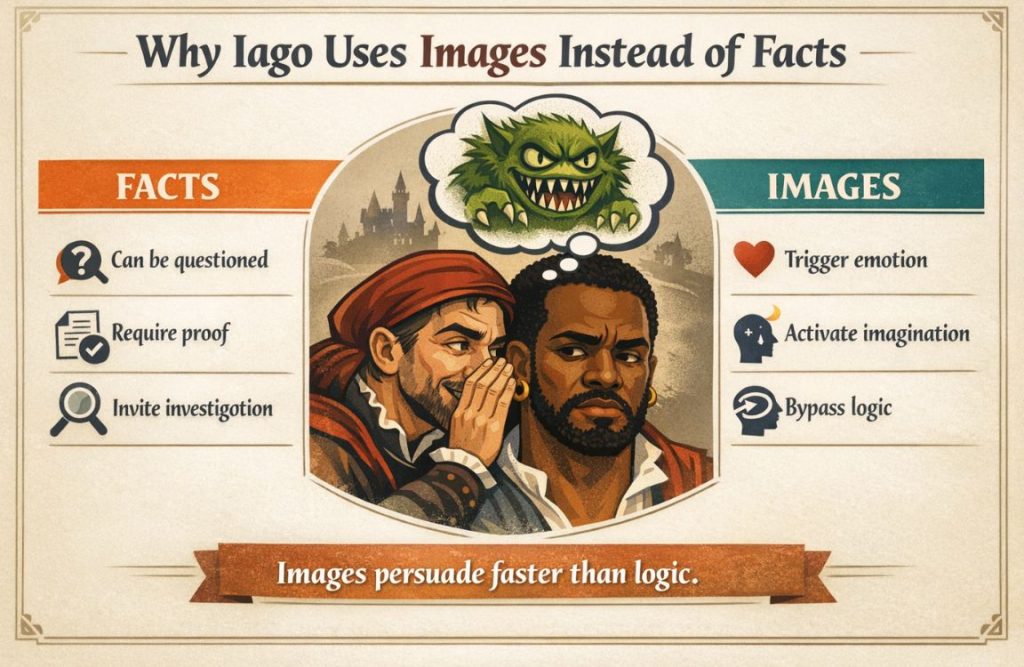
When I teach this, I ask my students: Why doesn’t Iago simply lie clearly? Why not invent a solid story?
Because facts can be questioned, images cannot.
Iago understands persuasion psychology long before modern rhetoric textbooks. If he offered evidence, Othello might investigate. But when he offers images, “green-eyed monster,” “poison,” “beast with two backs”. He activates imagination. And imagination is self-generating.
Here’s the trick: once Othello imagines betrayal, he becomes the author of his own torment. Iago only sketches. Othello paints the rest.
That is the genius of symbolism in Othello. Symbols feel universal, almost timeless. They bypass debate and go straight to emotion.
And this is where dramatic irony in Othello becomes almost unbearable. We, the audience, see the manipulation clearly. Othello does not. We watch a mind responding to pictures as if they were memories.
I tell my students: Rhetoric isn’t always loud. Sometimes it whispers. And in this play, a whispering image proves deadlier than any shouted accusation.
FAQs:
What is the metaphor of the garden in Othello?
The garden metaphor in Othello (Act 1, Scene 3) suggests that humans will control the cultivation of virtue or vice, though Iago ironically becomes the one who plants jealousy. When I draw a garden on the board, I remind students: minds must be pruned, or they will be poisoned.
What are the most impactful similes in Othello?
Some of the most impactful similes in Othello include Othello’s comparison of Desdemona’s skin as “smooth as monumental alabaster” and his revenge “like to the Pontic Sea.” These similes make emotions visible, revealing love’s fragility and jealousy’s unstoppable momentum.
How do similes reveal Iago’s manipulative nature in Othello?
I ask students to imagine Iago whispering: every “like” or “as” becomes a trap. Comparing Desdemona to “water” or infidelity to a “poisonous mineral,” he paints images that infect Othello’s mind. Similes here are not innocent. They are miniature assaults on reason.
What are the most impactful metaphors Iago uses to manipulate Othello?
Iago’s metaphors are masterclasses in mental warfare. The “green-eyed monster” externalizes jealousy. Othello becomes a garden under siege. Othello’s love turns into light to be extinguished. Each metaphor transforms thought into action, nudging a noble mind toward self-destruction.
Conclusion:
The similes and metaphors in Othello do more than beautify speech. They construct perception. Shakespeare shows that when language reshapes reality, reality reshapes action, and tragedy becomes inevitable.
When I close this lesson, I tell my students: Othello does not die because of a handkerchief. He dies because of imagery.
The importance of figurative language in Othello lies in its power to replace facts with feelings. A “green-eyed monster” becomes more convincing than proof. “Put out the light” becomes moral reasoning.
That is the quiet terror of similes and metaphors in Othello. Language reshapes perception. Perception reshapes action. Action creates tragedy.
And Shakespeare leaves us with one unsettling question: If words can build jealousy, what are our words building today?