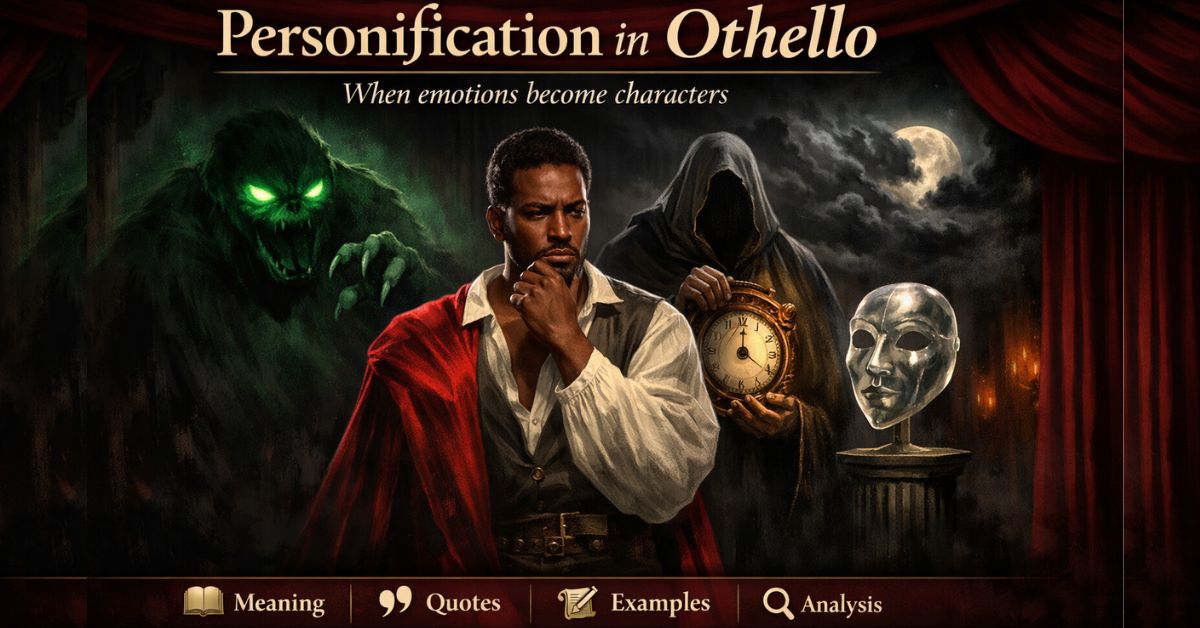
What if jealousy could whisper, reputation could breathe, and fate could silently watch every move? In Othello, William Shakespeare transforms abstract emotions into living forces. Jealousy doesn’t just exist. It stalks, grows, and destroys. Reputation feels fragile, almost human.
This is the power of personification in Othello, a device that makes emotions vivid and unforgettable.
As a tragedy driven by manipulation and psychological conflict, Othello uses personification to intensify drama and reveal inner turmoil.
In this guide, you’ll find a clear explanation of Othello personification, with examples, quotes, and simple analysis to help you understand and write confidently.
What Is Personification in Figure of Speech? (Definition)
Personification is a figure of speech where human qualities are given to non-human things or abstract ideas, making them act, feel, or speak like people.
Let me explain this the way I do in class. Imagine I say, “Time passes.” Fine. But when I say, “Time runs away from us,” suddenly time feels alive, almost mischievous. That’s personification- turning the invisible into something we can see and feel.
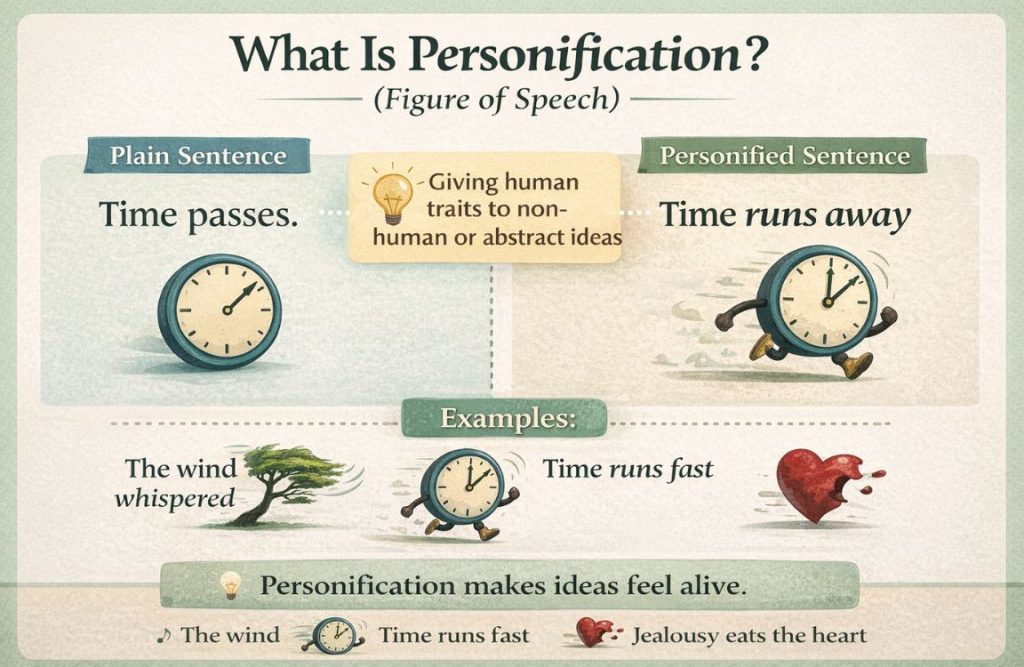
Now, don’t confuse it with a metaphor. A metaphor compares- “time is a thief.” But personification goes further: it lets that “thief” actually act- run, steal, escape.
We use it every day without noticing:
- “The wind whispered through the trees.”
- “Time runs fast before exams.”
And here’s where it gets interesting for literature:
- “Jealousy eats the heart.”
See that? Emotion behaves like a living force. That’s exactly the doorway to understanding drama at a deeper level.
Table of Contents
Personification in Othello (Overview)
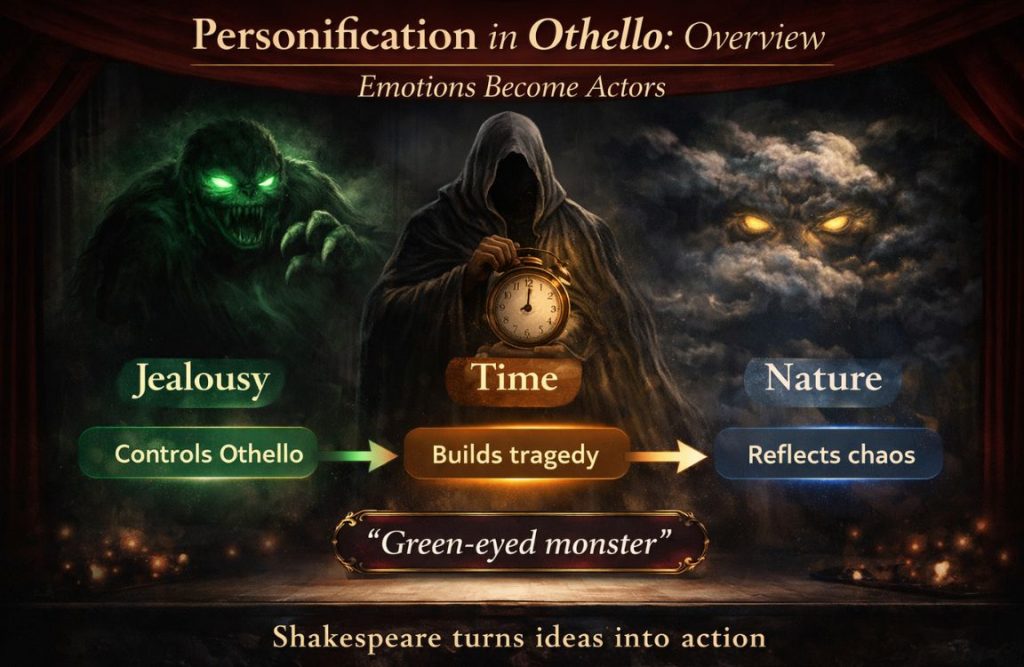
Personification in Othello occurs when abstract ideas like jealousy, time, and nature act like living forces, shaping characters and intensifying the tragic outcome.
When I teach this, I tell my students: don’t read Othello as a story of people alone. Read it as a stage where emotions walk freely. Jealousy isn’t silent; it becomes the “green-eyed monster,” feeding and mocking its victim. That’s not a description. That’s a living force at work.
But here’s where we go deeper. Even nature joins the drama. The storm in Act 2 feels like it speaks, almost warning us of chaos ahead. Time itself gains a “womb,” as if quietly preparing Iago’s evil plans. And when Othello looks at the “chaste stars,” they seem to watch like silent witnesses.
This is the genius of William Shakespeare. He turns ideas into actors. And once inner impulses begin to act, tragedy doesn’t feel accidental. It feels unavoidable, almost destined.
Examples of Personification in Othello (With Quotes)
In Othello, personification appears when inner passions like jealousy and reputation behave like living beings, influencing characters and driving the tragic outcome.
Let me take you into a live classroom moment. I pause and ask: What if jealousy could stare at you? Then we read Iago’s warning:
“O, beware, my lord, of jealousy; it is the green-eyed monster which doth mock…”
The verb “mock” is crucial. Jealousy is not just present. It actively humiliates and torments, turning emotion into a cruel psychological force.
Now consider Cassio’s despair:
“Reputation… is an idle and most false imposition.”
The phrase “false imposition” suggests reputation is unstable and deceptive, as if it can betray the very person who depends on it.
Even time itself seems alive when Iago declares:
“The womb of time shall bring this monstrous birth to the world’s light.”
The “womb” personifies time as a creator, implying that destructive events are already forming, waiting to emerge.
As the tragedy deepens, Othello cries:
“Arise, black vengeance, from thy hollow cell!”
The command “arise” transforms vengeance into a summoned force, revealing how Othello surrenders control to destructive emotion.
Even nature is not silent:
“The heavens themselves… make men mad.”
The “heavens” are personified as influencing human behavior, shifting responsibility from individuals to larger cosmic forces.
Why does Shakespeare do this? Because once emotions begin to act, they begin to control. And when they control, tragedy doesn’t simply occur. It unfolds with a disturbing sense of inevitability.
Key Insight: Personification transforms abstract ideas into active forces, making the audience feel, not just observe, the tragic collapse.
These personification quotes in Othello reveal how emotions like jealousy and fate become powerful agents shaping the play’s inevitable downfall.
Personification Act-by-Act Analysis
In this section, I guide you through how personification evolves across the play, showing how inner passions slowly gain power, influence decisions, and finally dominate the tragic movement from order to irreversible destruction.
i) Personification in Othello Act 1
Personification appears through reputation and honor in Act 1 of Othello, which behave like fragile living forces shaping social tension and conflict.
I tell my students: Act 1 feels like a crowded courtroom where invisible forces speak louder than people. Reputation trembles in every accusation, almost breathing under pressure. Honor stands tall, yet easily wounded.
When characters defend names and status, it feels as if these ideas can bleed. This is where chaos quietly begins, not through action, but through living abstractions that create tension beneath every line.
ii) Personification in Othello Act 2
Act 2 is deceptively calm. I often call it “the quiet before emotions wake up.” Nothing explodes yet, but feelings move silently. It’s like watching clouds gather- personification here is subtle, preparing the stage for something darker to unfold.
iii) Personification in Othello Act 3
Now I pause dramatically in class, because Act 3 is where everything changes. Jealousy no longer waits. It acts. Through Iago’s manipulation, it feels like an unseen voice guiding Othello. Feeling turns into authority, quietly taking control of thought and judgment.
iv) Personification in Othello Act 4 & 5
By Acts 4 and 5, emotion doesn’t whisper. It commands. Reason steps aside as jealousy dominates. I tell my students: Othello is no longer making decisions; something within him is.
Personification reaches its peak here, where abstract forces complete the tragedy with chilling inevitability.
How Shakespeare Uses Personification in Othello
Shakespeare uses personification in Othello to turn emotions like jealousy and vengeance into active forces, driving manipulation, psychological conflict, and the inevitable tragic collapse.
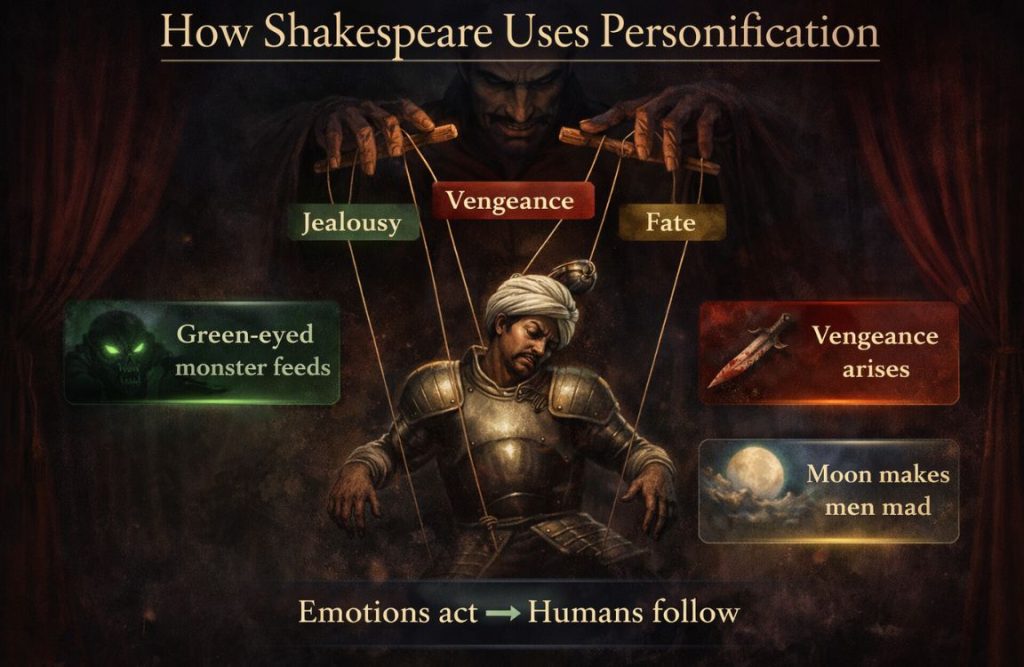
When I teach this, I often say- watch the puppeteer, not just the puppets. Shakespeare uses personification to give Iago invisible tools. Iago doesn’t force Othello; instead, he awakens abstract feelings that begin to act on their own. It’s like planting a seed that grows into a storm.
Think of jealousy as the “green-eyed monster”– not just an idea, but something that feeds and mocks. Or when Othello cries, “arise, black vengeance,” it’s as if revenge becomes a character he summons. Even the moon seems to “make men mad,” shifting blame away from human choice.
Here’s the twist: emotions begin to act, and Othello begins to follow. His downfall feels less like a decision and more like surrender.
That’s Shakespeare’s strategy. Personification turns inner conflict into action, making tragedy feel not sudden, but disturbingly inevitable.
Effects & Importance of Personification in Othello
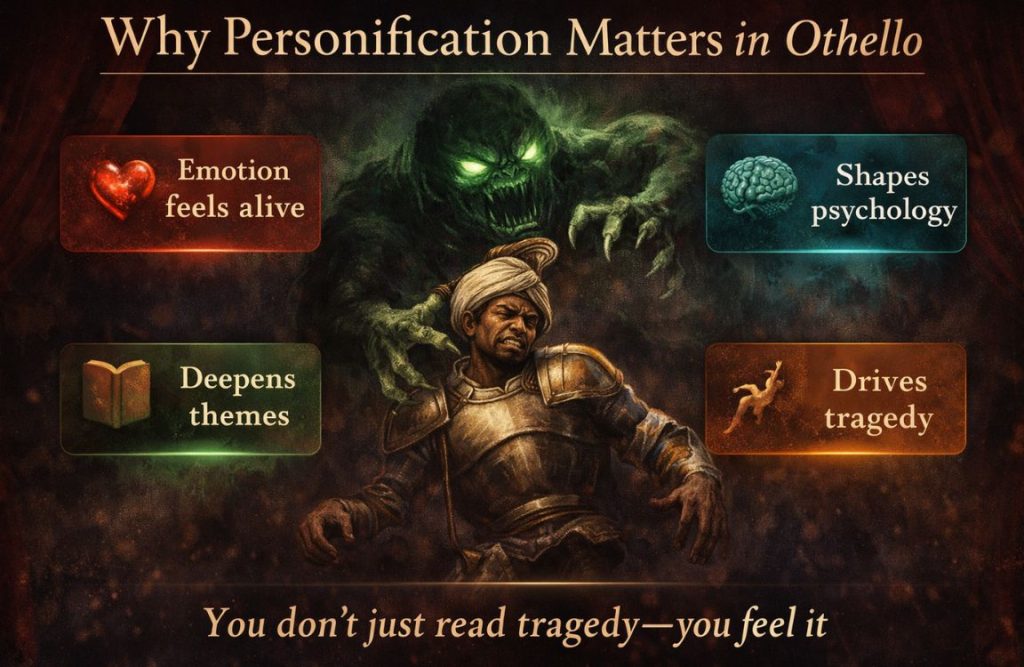
Personification in Othello intensifies emotional experience by turning abstract ideas into active forces, deepening themes, shaping character psychology, and driving the tragic structure forward.
Let me tell my students something honestly. Without personification, Othello would feel distant. But here, emotions breathe. They move, act, and sometimes even deceive.
Take jealousy as a “monster.” It doesn’t just exist; it consumes, making Othello feel like its victim rather than its creator. That’s a clever shift- responsibility blurs. Or think of time having a “womb,” quietly suggesting that events are already forming, waiting to unfold.
Even nature joins in. Storms rage, winds “kiss,” and the world itself seems disturbed. It’s as if the universe reflects human chaos.
This is where Shakespeare becomes brilliant. He doesn’t just tell a tragedy. He lets you feel it.
And that’s the real power: you don’t just study Othello’s fall. You experience it.
Personification vs Other Literary Devices in Othello
Personification differs from metaphor and imagery in Othello by giving human actions to abstract ideas, making emotions act like characters rather than just descriptive comparisons.
Now, in class, this is where confusion usually begins- so let me simplify it clearly.
Metaphor says something is something else. For example, calling jealousy a “monster” compares it to one. But personification goes further. It allows that “monster” to behave, to influence, and to almost think.
Imagery, on the other hand, paints pictures. It appeals to the senses. But it doesn’t necessarily make things act.
Here’s my quick exam tip:
If an abstract idea is doing something like a human, you’re looking at personification.
So, metaphor compares, imagery describes, but personification animates. And in a tragedy like Othello, that animation is what makes emotions feel dangerously alive. For better understanding, watch my tutorial on similes and metaphors in Othello.
Personification in Othello Essay/Notes
Personification in Othello turns abstract feelings into active forces, helping students analyze themes, examples, and effects quickly for exams.
Let me give you the kind of notes I’d write on the board before an exam- sharp, memorable, and effective:
- Definition: Personification gives human traits to abstract ideas, making emotions act like living forces.
- Key Examples: Jealousy as a “green-eyed monster”; reputation behaving like something fragile and unstable.
- Effects: Intensifies emotion, makes scenes vivid, and turns internal conflict into visible action.
- Themes: Highlights jealousy, fate, and psychological struggle.
I always tell my students- if you can remember these four points, you can build a strong answer under pressure without panic.
FAQs:
Why does Shakespeare prefer personification over direct description in Othello?
Because it makes emotions active rather than passive. Instead of simply describing feelings, it dramatizes them, allowing the audience to experience psychological conflict as if it were unfolding physically on stage.
How does personification reflect Othello’s psychological state?
It mirrors his inner turmoil. As emotions begin to act independently, it reflects how Othello loses control over his thoughts, showing a gradual shift from rational thinking to emotional domination and instability.
Can personification influence audience sympathy in Othello?
Yes, it humanizes emotional struggle. When feelings seem alive, audiences empathize more deeply, understanding how overwhelming and uncontrollable these forces become, which increases sympathy for Othello’s tragic downfall.
Is personification more effective than metaphor in tragedy? Why?
In tragedy, yes. Personification adds action to emotion, making it dynamic. While metaphor explains, personification dramatizes, which aligns perfectly with the emotional intensity and movement required in tragic storytelling.
How can students identify personification quickly in exams?
Look for action verbs linked to abstract ideas. If something non-human is behaving like a person- thinking, feeling, or acting. It’s personification. Spotting this quickly can secure marks in analysis questions.
Conclusion:
Personification in Othello is more than a stylistic choice. It is a powerful tool that brings emotions to life. By turning jealousy, reputation, and fate into active forces, William Shakespeare deepens emotional intensity and drives the tragedy forward.
It helps readers not just understand but feel the destructive power of human emotions.
Next time you read Othello, don’t just read the lines. Listen to the emotions speaking.
Want more insights like this? Explore detailed guides on imagery, symbolism, and themes in Othello to strengthen your literary analysis.