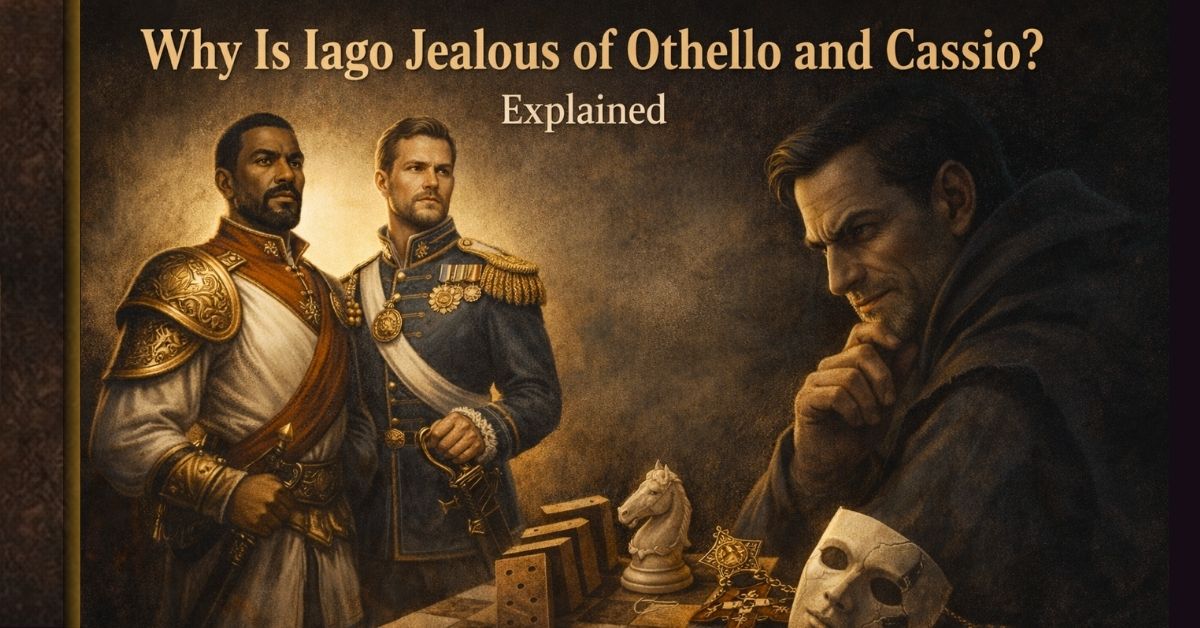
When I introduce Lodovico in Othello, I watch my students underestimate him, and that’s exactly when Shakespeare is at his sneakiest. Lodovico doesn’t storm in with speeches or schemes. He arrives quietly, clipboard energy intact, ready to observe. And observation, in this play, is everything.
Think of him as the calm adult entering a room mid-meltdown. Through Lodovico’s presence, we suddenly see Othello from the outside, stripped of heroic glow and exposed in harsh daylight. This is where a careful character analysis of Lodovico in Othello really pays off. His role sharpens our understanding of power, judgment, and public accountability.
In this guide, you’ll explore Lodovico’s character traits, his symbolic importance, and why his silence speaks volumes. Watch closely. He’s more essential than he looks.
Who Is Lodovico in Othello?
Lodovico is a Venetian nobleman who enters late but carries authority, calm judgment, and moral weight. He arrives as an outsider-observer, connected to Venice and Desdemona, watching events unfold with measured concern.
i) Lodovico: A Venetian Noble with Authority
When I explain Lodovico to my students, I describe him as Venice walking into Cyprus. He isn’t a soldier, schemer, or lover. He’s a statesman.
As a respected nobleman, he represents law, order, and civic responsibility- the values Othello once embodied but is now slipping away from.
ii) His Connection to Venice and Desdemona:
Lodovico’s ties to Venice, and to Desdemona’s family, matter deeply. He knows the rules, the reputations, and the expectations.
So when he witnesses shocking behavior later in the play, his reaction carries weight. This isn’t gossip from the sidelines. It’s an official concern from the heart of power.
iii) Why Shakespeare Brings Him in Late:
I always tell my class: Shakespeare waits on purpose. Lodovico enters when things are already cracking. His late arrival allows us to see Othello through fresh eyes, unclouded by loyalty or manipulation.
iv) First Impressions: Calm, Formal, Observant:
Lodovico doesn’t rush to judge. He watches, listens, and quietly measures. Like a substitute teacher taking notes before speaking, he reminds us that sometimes the most powerful role is simply bearing witness.
Table of Contents
When Does Lodovico Appear in Othello?
Lodovico appears late in the play, entering at a moment when calm has vanished. His arrival marks a turning point, showing what Othello has become and quietly asking the audience to judge the damage already done.
i) Lodovico’s Arrival in Cyprus
Lodovico arrives in Act 4, and I always pause here in class because timing is everything. He comes bearing official news and instructions, not gossip or rumor. His presence signals political oversight at a moment when personal chaos has taken over.
While others react emotionally, Lodovico observes, listens, and responds with measured restraint. He doesn’t fix problems. He documents them.
Think of him as the calm administrator walking into a classroom where the lesson has already gone wildly off-script. What he does in Othello is simple but powerful: he witnesses authority unraveling in real time.
ii) Why His Timing Matters
Shakespeare brings Lodovico in only after Othello has begun to crack, and that choice is deliberate. By now, the audience is deep inside the tragedy. Lodovico gives us distance.
Through his shocked, controlled reactions, we see Othello as Venice would see him- no longer heroic, no longer steady.
Structurally, this is crucial. Tragedy needs a mirror, and Lodovico becomes it. His late arrival confirms that the fall isn’t private anymore. The damage is visible, undeniable, and irreversible.
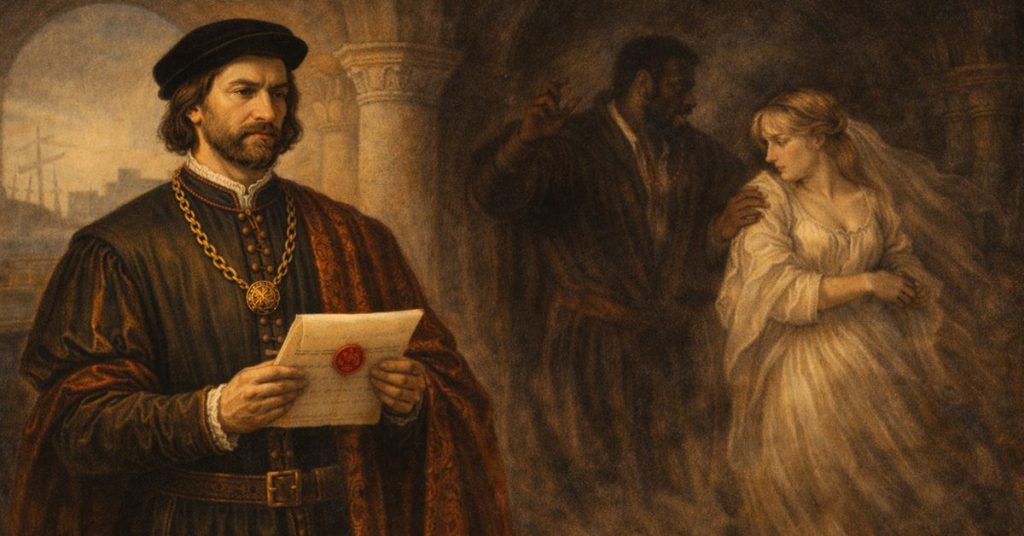
Role of Lodovico in Othello
Lodovico’s role in Othello unfolds quietly but decisively. He doesn’t drive the action. He evaluates it. By watching, reacting, and reporting, he turns private collapse into public consequence and brings moral order back into a world spinning off its axis.
i) A Moral and Social Witness:
When I teach this part of the play, I tell students to watch Lodovico’s face. He is our stand-in. He observes Othello’s public behavior- his harsh words, his loss of control- and reacts not with conspiracy or malice, but with genuine shock. That matters.
Lodovico represents what Venice considers normal: restraint, civility, and reasoned authority. He doesn’t assume guilt or invent motives. He simply cannot reconcile the noble general he’s heard about with the man standing before him.
In literary terms, he’s a moral thermometer. As Othello’s behavior rises in violence, Lodovico’s disbelief confirms how far things have gone wrong.
ii) Bridge Between Venice and Cyprus:
Lodovico also functions as a bridge, and this is where his importance quietly expands. Until his arrival, the tragedy feels sealed inside Cyprus, like a storm trapped at sea. Lodovico carries Venice into the room. Through him, private actions gain public weight.
I often describe this moment as the play opening a window- suddenly, fresh air rushes in, and the damage is impossible to hide. He brings judgment without delivering a speech, accountability without raising his voice.
By the time he leaves, the question is no longer what happened but how Venice will respond. That shift is the beginning of consequences.
What Does Othello Do in Front of Lodovico?
This is the moment I warn my students about- the point where private madness steps onto a public stage. In one brutal gesture, Othello exposes his unraveling, and Lodovico becomes the witness who confirms that the fall is no longer imagined.
i) The Public Slap Scene:
When this scene lands in class, the room goes quiet. Othello strikes Desdemona in front of Lodovico, and the shock ripples outward. Until now, his cruelty has lived behind closed doors, whispered into soliloquies and suspicion.
Here, it explodes in daylight. Lodovico’s reaction is crucial: disbelief, horror, and a stunned silence that says more than any accusation. This is the first undeniable proof that something has broken beyond repair.
I often tell students to imagine a respected leader losing control on live television- reputation collapses faster than dignity can be recovered.
ii) Why This Moment Is Crucial
This single act dismantles Othello’s authority. The general who once commanded respect now commands fear, and even that is slipping. By raising his hand publicly, he forfeits the moral high ground that once defined him.
Lodovico, calm and observant, begins to question whether Venice has placed its trust in the wrong man.
For students, this is the turning point: the hero crosses into tyranny, not through secret plots, but through an action everyone can see. The tragedy stops being personal and becomes political, and there’s no stepping back from that stage.
Lodovico and Gratiano in Othello
I like to describe these two as Venice walking onto the stage together. They don’t cause the chaos, but they frame it. Through their eyes, the audience finally sees Cyprus the way the civilized world would.
i) How They Function Together:
When Lodovico and Gratiano appear side by side, they act as paired witnesses rather than movers of the plot. Both carry a Venetian worldview– measured, lawful, and rooted in order.
In class, I tell students to imagine them as observers in the back of the courtroom, quietly taking notes. They don’t interfere. They watch, absorb, and react. Their shared presence confirms that what’s happening isn’t normal or acceptable.
By responding with disbelief instead of suspicion, they validate the audience’s horror and signal that Othello’s behavior has crossed a visible line.
ii) Differences Between Lodovico and Gratiano:
That said, they aren’t interchangeable. Lodovico brings authority. His words carry judgment, and his reactions hint at consequences waiting beyond the island.
Gratiano, on the other hand, is more immediate and vocal. He reacts as a family member, not a magistrate- emotion first, analysis later.
I often say Lodovico thinks like a judge, while Gratiano speaks like the shocked relative at the scene. Together, they balance reason and response, showing how public order and personal outrage collide when tragedy can no longer be contained.
Lodovico’s Character Traits and Personality
Lodovico enters the play without fireworks, and that is precisely the point. His personality is defined by steadiness. In a world unraveling with emotion, he stands as a reminder of reason, order, and measured judgment.
i) Calm, Rational, and Controlled:
When I introduce Lodovico to my students, I often say, “Watch how little he needs to say.” He listens first. He observes before reacting.
Even when confronted with shocking behavior, he doesn’t explode. He processes. This calm rationality gives him quiet authority. Lodovico isn’t passive. He’s controlled.
Like a still lake reflecting a storm, his composure makes the chaos around him more visible. His restraint signals intelligence and credibility, the kind that doesn’t shout to be heard. In the emotional turbulence of Othello, his steadiness feels almost radical.
ii) A Man of Order, Not Passion:
What defines Lodovico most is his allegiance to order rather than impulse. Set him beside Othello’s emotional collapse, and the contrast sharpens instantly. While others are driven by jealousy, loyalty, or fear, Lodovico embodies law, restraint, and civic responsibility.
I tell students to think of him as the rulebook walking into the room- unemotional, necessary, and impossible to ignore. He represents a world where actions carry consequences and authority demands self-control. In that sense, Lodovico doesn’t just observe disorder. He quietly stands against it.
What Does Lodovico Represent in Othello?
When students ask me what Lodovico really stands for, I say this: he isn’t a character who acts. He’s a character who measures. He represents the moment when chaos is finally seen, named, and judged by the world beyond Cyprus.
i) Venetian Law and Justice:
Lodovico embodies the steady pulse of Venetian law. Where others shout, scheme, or unravel, he observes.
In class, I describe him as the clipboard in a room full of flying papers- calm, official, and quietly damning. His presence reminds us that Othello is not just a husband or soldier, but a public servant accountable to a governing power.
Lodovico doesn’t rush to punish, but his questions carry weight. They suggest procedures, consequences, and records that will outlive emotional excuses. He stands for order in a play addicted to disorder, showing that violence doesn’t vanish once committed. It waits to be answered for.
ii) Moral Judgment from the Outside:
More importantly, Lodovico represents society watching from the outside. He arrives too late to prevent tragedy, and that lateness is the point.
I tell students to think of him as history’s gaze- arriving after the damage, asking how this was allowed to happen. His reactions give voice to what the audience feels: disbelief, horror, and moral clarity. He doesn’t save lives, but he saves truth from being buried.
In a world where manipulation thrives in secrecy, Lodovico’s role is to see clearly and report honestly. He reminds us that even when reason comes late, it still matters- because someone must tell the world what went wrong.
Lodovico’s Role at the End of the Play
At the play’s close, Lodovico steps forward not as a hero, but as a steady hand. When everything has burned down, he becomes the one who gathers the ashes, restores order, and reminds us that chaos does not get the final word.
i) Restoring Order After Chaos:
When I reach these final moments with my students, I always say: notice who is still standing, and who is thinking clearly. Lodovico doesn’t rage or moralize. He listens, assesses, and acts.
In a room filled with bodies and broken truths, he represents calm authority returning after a storm. Think of him as the adult arriving after a disastrous party: no shouting, just consequences.
His presence signals that the madness of Cyprus will not be allowed to drift unchecked into history. Law, reason, and civic order quietly re-enter the play through him.
ii) Custody of Iago and Cassio’s Appointment:
Lodovico’s final actions are practical, not theatrical, and that’s exactly the point. He places Iago under custody, ensuring that manipulation finally meets justice. \
At the same time, Cassio is entrusted with authority, suggesting a future built on discipline rather than suspicion.
I often tell students this is Shakespeare’s way of resetting the moral compass. Power returns to Venice, away from emotional volatility and personal vendettas.
The tragedy cannot be undone, but Lodovico ensures it will be answered. In that final transfer of control, manipulation ends, and accountability takes its place.
Lodovico Quotes in Othello
Lodovico doesn’t speak often, but when he does, the play pauses to listen. His lines work like moral checkpoints- quiet, measured reactions that expose just how far Othello has fallen in the public eye.
1. “Is this the noble Moor whom our full senate / Call all in all sufficient?”
This line always lands like a collective gasp in my classroom. Lodovico isn’t insulting Othello. He’s genuinely confused. The contrast between reputation and reality is unbearable. Shakespeare uses Lodovico to voice the audience’s shock: the hero celebrated in Venice no longer matches the man standing before them.
2. “My lord, this would not be believed in Venice, / Though I should swear I saw’t.”
Here, Lodovico becomes a living witness. What he sees is so disturbing that it sounds unbelievable. I tell students this is Shakespeare’s way of saying the truth has outpaced rumor. Othello’s behavior isn’t just wrong. It’s scandalous enough to shake an entire city’s trust.
3. “Are his wits safe? Is he not light of brain?”
This line walks a careful line between concern and judgment. Lodovico searches for an explanation that doesn’t involve moral failure. Madness feels safer than cruelty. In teaching, I point out how this moment shows society scrambling to excuse behavior it can’t yet confront directly.
4. “This would be treason in my face, were it in Venice.”
Power shifts here. Lodovico reminds us that authority exists beyond Cyprus. I often call this a legal thunderclap- quiet but ominous. Othello’s actions aren’t just personal failings. They carry political consequences once judged under Venetian law.
5. “O Spartan dog, / More fell than anguish, hunger, or the sea!”
By the end, Lodovico’s restraint cracks. This outburst marks the moment judgment becomes condemnation. In class, I describe it as the moral verdict being read aloud. The calm observer finally names the villain, and justice steps back onto the stage.
FAQs:
Is Lodovico Desdemona’s cousin?
Yes. I usually point this out in class because it explains his concern and shock. He isn’t just a state official. He’s family, which makes Othello’s behavior feel personal, not merely political.
How many lines does Lodovico have in Othello?
Surprisingly few. I tell students this is Shakespeare’s trick. Lodovico proves that impact isn’t about volume. A handful of measured lines can expose a collapsing hero more effectively than a long speech.
Does Lodovico die in Othello?
No, and that matters. He survives to witness, report, and restore order. Tragedy consumes the passionate characters, not the calm observers who step in after the emotional wreckage.
Is Lodovico a major character?
On paper, no. In practice, absolutely. I call him a structural heavyweight- minor in stage time, major in meaning. Without him, Othello’s downfall would stay frighteningly private.
What does Lodovico symbolize?
Lodovico is the moral mirror. He symbolizes law, restraint, and civilized judgment- society watching in horror as private cruelty turns public, reminding us that violence doesn’t stay hidden forever.
How old is Lodovico in Othello?
Shakespeare never gives Lodovico an age, and I tell students that’s deliberate. He reads as mature and seasoned- old enough to command respect, young enough to act decisively- an embodiment of steady Venetian authority rather than youthful impulse.
Is Lodovico a judge in Othello?
No, Lodovico is not a judge in Othello. He’s a Venetian noble with political authority, not a courtroom official. He observes, assesses, and reports—bringing order without staging a formal trial.
Conclusion: Why Lodovico Matters in Othello
When students ask why a seemingly minor figure deserves attention, I smile because this is where Shakespeare quietly proves his genius. Lodovico in Othello reminds us that tragedy doesn’t exist in a vacuum. Someone must see it, judge it, and carry its meaning beyond the stage.
Lodovico functions as our moral lens. He reacts the way we do: with disbelief, restraint, and an aching sense that something noble has gone terribly wrong. His calm presence doesn’t stop the bloodshed, but it confirms it- publicly, officially, and permanently. Through him, Othello’s downfall is no longer rumor or private failure. It becomes history.
This is why smaller characters matter. They anchor the chaos. They translate emotion into consequence. By the end, Lodovico stands as proof that the tragedy wasn’t imagined, exaggerated, or misunderstood. It was real, witnessed, and judged, and that makes it unforgettable.