Let me begin the way I often begin in class- with a question: What if a single whisper could destroy a life? That is the quiet terror at the heart of Othello by William Shakespeare. This is not just a tragedy of action; it is a tragedy of the mind- where jealousy grows, suspicion spreads, and truth suffocates.
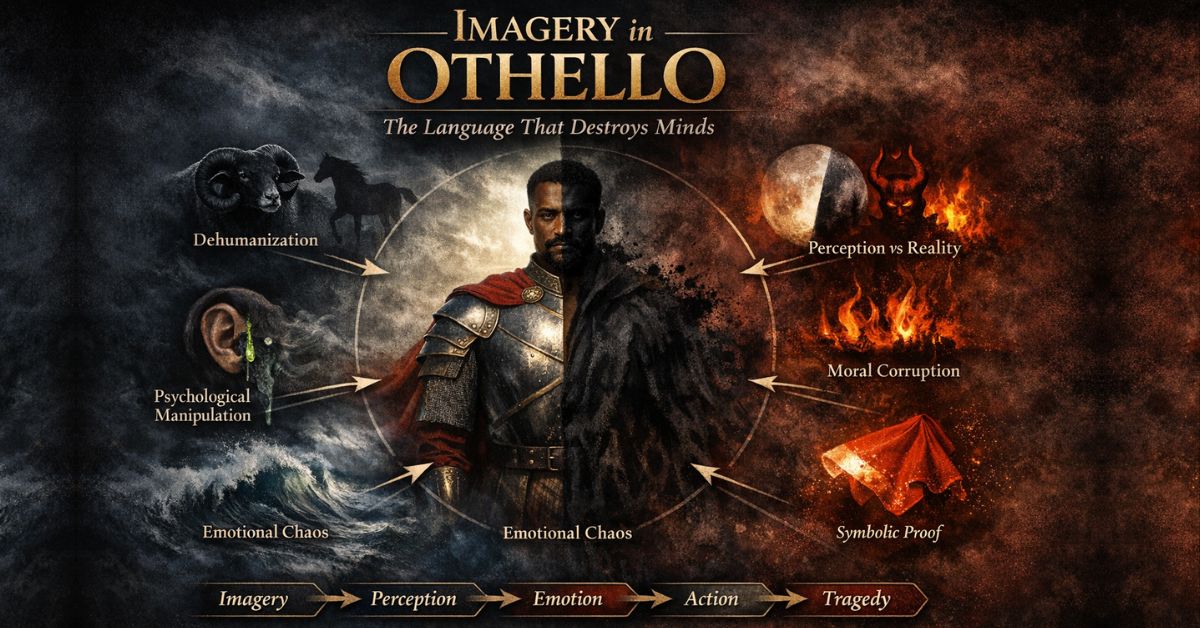
Now, here’s where my students usually lean forward: the real weapon in this play is not a sword. It’s imagery. In simple terms, the meaning of imagery in Othello is the use of vivid, sensory language to paint emotional and psychological pictures. But Shakespeare doesn’t just decorate his lines. He weaponizes them.
Think of Iago. When he says, “the green-eyed monster,” he doesn’t just describe jealousy. He makes us see it, fear it, almost feel it breathing. That’s how Shakespeare uses imagery in Othello: to manipulate not just characters, but us, the audience.
As we explore Othello imagery, watch closely. You’ll notice patterns- animal imagery that dehumanizes, light and dark imagery that questions morality, religious imagery that hints at damnation, and poison imagery that infects the mind.
What Is Imagery in Othello? (Definition & Purpose)
Imagery in Othello refers to vivid sensory language used by William Shakespeare to create mental pictures, evoke emotions, and reveal themes like jealousy, deception, and race.
Let me explain this the way I do in a live class. If I say, “Othello is jealous,” it sounds plain. But when William Shakespeare writes, “it is the green-eyed monster,” jealousy suddenly feels alive. That’s imagery.
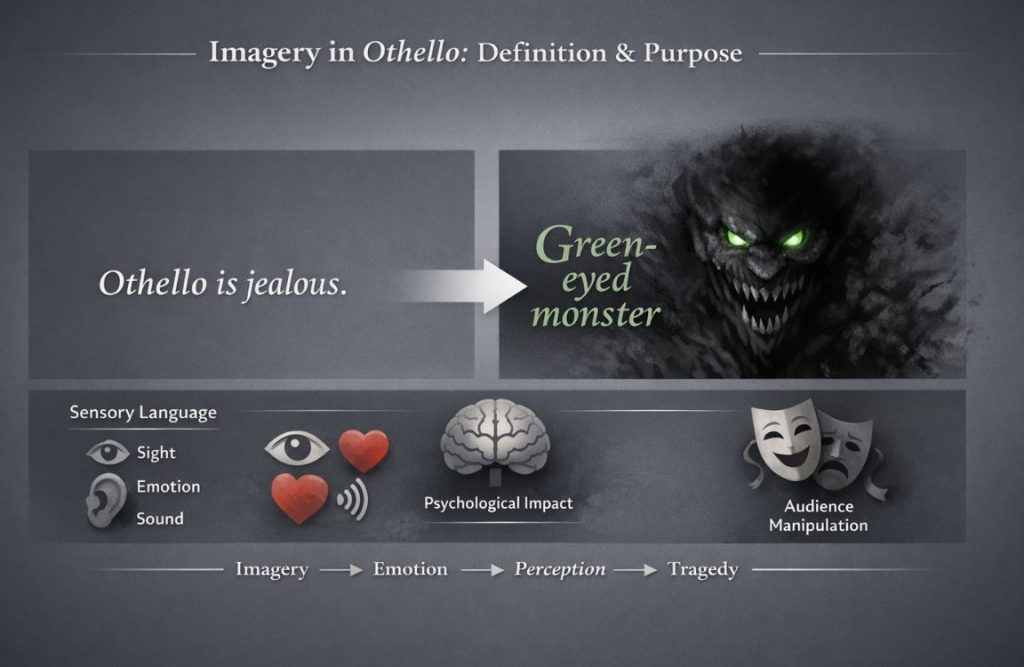
In simple terms, imagery is sensory language- appealing to sight, sound, and emotion- to create vivid mental pictures. But in Othello, it becomes far more powerful. In my Othello imagery analysis class, I often tell my students: imagery here is not decoration. It is a psychological strategy.
Shakespeare uses this literary device to build tension, shape themes like jealousy, race, and deception, and manipulate both characters and the audience through fear, unease, and dramatic irony.
Notice how animal, poison, and dark imagery gradually influence Othello’s thinking. Here’s the brilliance- while Othello is deceived, we often see the truth. That gap creates dramatic irony in Othello.
So remember: imagery in Othello doesn’t just describe events. It drives the tragedy forward, guiding how we feel, judge, and anticipate the fall.
Types of Imagery in Othello
When I teach the types of imagery in Othello, I always tell my students: Shakespeare doesn’t repeat himself. He layers meaning. Each image belongs to a pattern, and together they shape the major Othello imagery themes of jealousy, race, and moral collapse.
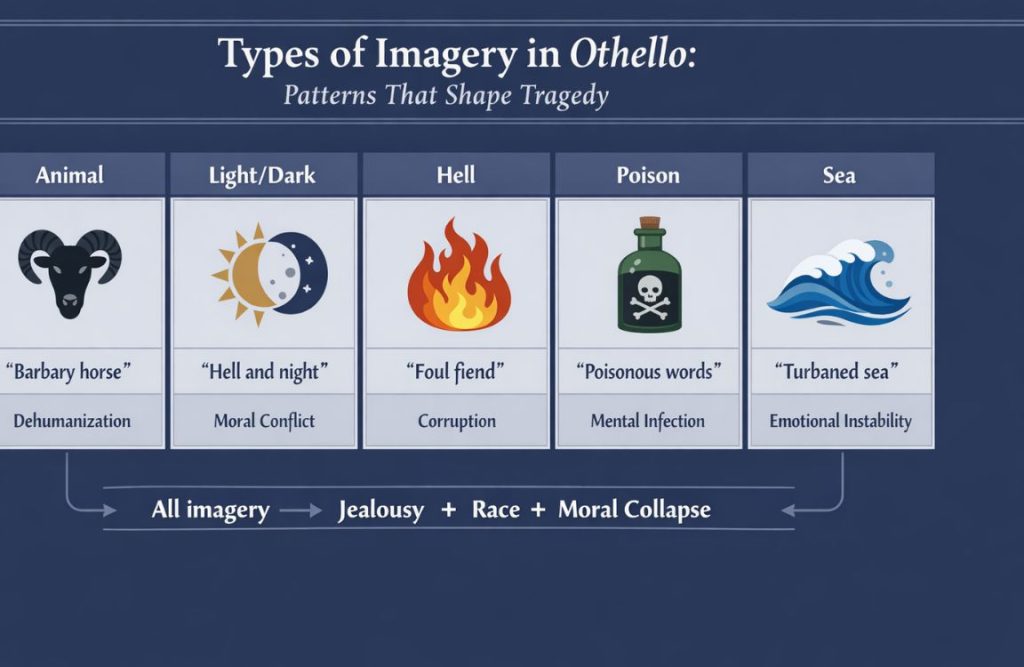
Table: Types of Imagery in Othello
Before we explore each type in detail, here’s a quick overview I share with my students:
| Type of Imagery | Key Example | Function in the Play | Thematic Impact |
| Animal Imagery | “Old black ram,” “Barbary horse,” “goats and monkeys” | Dehumanizes characters, fuels racism, and manipulates perception | Shows moral degradation and loss of humanity |
| Light & Dark Imagery | “Put out the light,” Desdemona as “fair,” Othello as “black.” | Creates contrast between appearance and reality | Explores race, morality, and internal conflict |
| Religious / Hell Imagery | “Divinity of hell” references to devils and damnation | Frames Iago as demonic and events as sinful | Suggests moral corruption and spiritual fall |
| Poison & Disease Imagery | “Pour this pestilence into his ear,” “infect,” “plague.” | Represents manipulation as a slow, invisible process | Highlights psychological decay and destructive jealousy |
| Sea Imagery | “Pontic Sea,” storm imagery | Mirrors emotional instability and loss of control | Reflects Othello’s turbulent mind and inevitable downfall |
i) Animal Imagery in Othello
Animal imagery in Othello is used by Iago to dehumanize characters, provoke racial fear, and manipulate perception by turning human relationships into bestial, instinct-driven images.
Let me take you into one of my most unsettling classroom moments. I write: “an old black ram is tupping your white ewe.” Then I pause. Silence. Exactly as William Shakespeare intended.
In animal imagery in Othello, Iago doesn’t merely insult. He strips people of humanity. He replaces identity with instinct. My students quickly see that this is not a description. It is a distortion.
Consider the “Barbary horse.” The meaning of Barbary horse imagery is not just racial. It suggests wildness, uncontrolled desire, and dangerous foreignness. Iago is not describing Othello. He is rewriting him.
But here’s the deeper pattern. These images spread. What begins as Iago’s language becomes Othello’s own: “goats and monkeys!”- a shocking sign of psychological collapse.
And notice the method: Iago never argues. He implants images. They bypass reason and strike the imagination.
So, when you analyze animal imagery in Othello, don’t just ask what is said, ask what is seen, felt, and feared. That is where manipulation truly works.
ii) Light and Dark Imagery in Othello
Light and dark imagery in Othello challenges simple moral binaries by linking race, perception, and psychology, ultimately revealing that true darkness lies in deception, not appearance.
Now, let me challenge a familiar assumption I hear in class: light is good, dark is bad. Shakespeare quietly dismantles that comfort.
In race imagery in Othello, Desdemona is aligned with light- purity, innocence- while Othello is associated with darkness. Yet this contrast quickly destabilizes. Through black and white imagery in Othello, Shakespeare exposes how perception, not truth, shapes judgment.
Here’s the twist I stress: darkness becomes psychological. As Iago manipulates him, Othello begins to internalize that darkness, even describing his mind as “begrimed.” Meanwhile, Iago- outwardly “white”- operates in moral darkness, hiding corruption behind honesty.
And then comes that haunting moment: “Put out the light.” Light no longer saves. It becomes a metaphor for destruction in Othello.
So, I advise my students to look carefully. The real darkness is never skin deep. It is crafted, planted, and believed.
iii) Religious and Hell Imagery in Othello
Religious imagery in Othello presents a conflict between heaven and hell, where Iago’s demonic manipulation turns faith into a tool of deception, leading Othello toward moral damnation.
If Iago appeared in a modern film, I remind my students, he wouldn’t carry a weapon. He’d whisper like a devil. That is how religious imagery in Othello works.
From the beginning, Iago surrounds events with sin, hell, and damnation, shaping powerful hell imagery in Othello. He never argues directly. He reframes situations as evil. Even his plots become a “divinity of hell,” masking corruption as truth.
Through demonic imagery in Othello, Iago appears almost moral while guiding others into ruin. Desdemona is cast as angelic, yet gradually reimagined as sinful.
And Othello changes. He begins to see himself as damned, even turning murder into a twisted act of justice.
By the end, there is no visible hell, yet we feel it.
That, I remind my students, is Shakespeare’s genius: he creates a psychological hell.
iv) Poison and Disease Imagery in Othello
Poison imagery in Othello shows how Iago manipulates through language, turning jealousy into a mental disease that spreads invisibly and destroys Othello from within.
Here’s a line I always dramatize in class: “I’ll pour this pestilence into his ear.” I lean in, and the room goes silent.
In poison imagery in Othello, Iago becomes less a man and more a toxin. He doesn’t strike. He infects. Through jealousy imagery in Othello, jealousy is not an emotion but a disease, slowly consuming reason.
Think about poison. It works invisibly, spreads quietly, and kills inevitably. That is Iago’s method. His words “burn like sulphur,” and Othello himself admits the change within him.
This is where disease imagery in Othello deepens the tragedy. Language like “infect,” “pestilence,” and “plague” suggests that corruption spreads uncontrollably.
I often tell my students: Iago never forces Othello to act. He lets the “poison” grow until Othello destroys himself.
So, when you analyze this imagery, don’t just see a metaphor. See method. This is manipulation at its most refined and most deadly.
v) Sea Imagery in Othello
Sea imagery in Othello reflects emotional instability and uncontrollable passion, showing how Othello’s mind shifts from calm control to irreversible chaos under Iago’s influence.
Let me end this section with an image I love to explore in class: the sea. Calm one moment, violent the next. Sound familiar?
In sea imagery in Othello, the ocean mirrors Othello’s emotional state. Early on, the sea is controlled, like his mind, disciplined and stable. But soon, storms rise, reflecting inner turmoil and the collapse of reason.
I often remind my students: Othello can command armies, but not himself. His mind becomes like the “Pontic Sea,” moving in a relentless, one-way current of vengeance.
What makes this imagery so effective is its unpredictability. Just like the ocean, Othello’s mind becomes turbulent, pulled by unseen forces, Iago’s words.
By the final acts, the sea is no longer a backdrop. It is a force of destruction. And as William Shakespeare suggests, the most dangerous storms are the ones we carry within ourselves.
Symbolic Imagery in Othello
Symbolic imagery in Othello transforms objects and metaphors into powerful forces that shape perception, turning love into suspicion and jealousy into destructive belief.
Let me take you into a moment I recreate in class. I hold up an imaginary handkerchief and ask, “Can this small object destroy a marriage?” In Othello by Shakespeare, the answer is BIG YES.
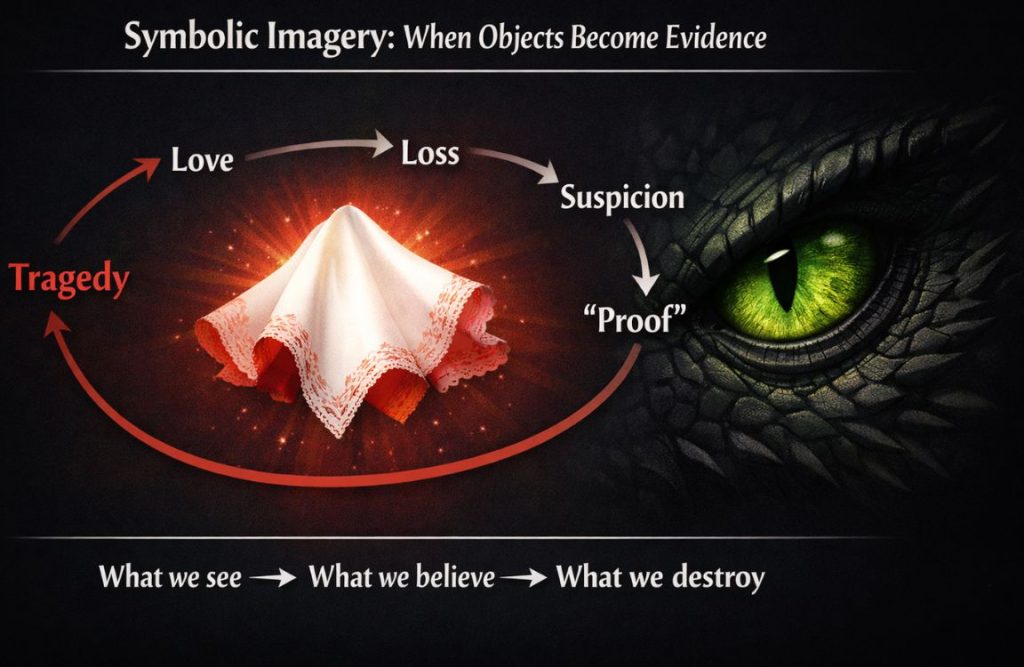
The handkerchief symbolism in Othello begins with love and trust, even carrying a sense of magical origin. Yet once lost, it becomes visual “proof” of betrayal. This is where handkerchief imagery in Othello gains force- an innocent object transforms into evidence that reshapes reality.
Then comes the “green-eyed monster.” I always tell my students this is not just a metaphor. It’s a symbol that breathes. The green-eyed monster imagery in Othello captures jealousy as something that feeds and grows.
What deepens this is how symbols work together in Othello. From the handkerchief’s embroidered detail to Desdemona’s final song, imagery becomes action.
And here’s the unsettling truth: we often believe not what is true, but what we are made to see.
Imagery in Othello Act-by-Act Analysis
When I guide students through Othello, I often say: Don’t just follow the plot. Follow the images. Each act reshapes imagery, quietly steering the tragedy forward. Let’s trace how these patterns evolve, deepening meaning and emotion.
i) Act 1: Seeds of Corruption
In Othello Act 1, imagery plants the first seeds of corruption. Iago’s crude animal and sexual imagery dehumanizes Othello before he appears, shaping perception through language. Light/dark contrasts and theft imagery further frame Desdemona as “stolen,” revealing how imagery manipulates narrative and prejudice from the start.
ii) Act 2: Calm Before the Storm
In Act 2 of Othello, I often pause and ask: Why does everything feel peaceful? Storm imagery fades into calm seas, symbolizing temporary stability. Yet diabolical and poison imagery quietly emerge as Iago hints at “pouring pestilence,” suggesting that beneath this calm, destruction is already taking root.
iii) Act 3: Turning Point
Othello Act 3 marks the breaking point. Imagery becomes invasive and psychological. The handkerchief transforms into “ocular proof,” while jealousy takes monstrous form as the “green-eyed monster.” Iago’s images replace reality, and I say to my students: This is where imagination overtakes truth.
iv) Act 4: Psychological Chaos
In Othello Act 4, imagery reflects inner collapse. Disease, infection, and decay dominate Othello’s speech, mirroring his mental disintegration. Language grows fragmented and obsessive. What began as a suggestion now controls him completely, turning imagery into a force of psychological chaos.
v) Act 5: Tragic Outcome
Finally, Act 5 brings stark finality. Light and dark imagery culminate in “put out the light,” where life itself becomes a symbol. Blood, death, and silence replace the earlier suggestion. The imagery that once hinted now confirms tragedy, completing Othello’s devastating fall.
Key Quotes of Imagery in Othello (With Analysis)
Key examples of imagery in Othello reveal how Shakespeare uses vivid language to dramatize inner conflict, showing jealousy, love, and perception as forces that shape and destroy reality.
When I teach, I often say: If you want to master Shakespeare, collect his images like clues. Let me walk you through a few unforgettable examples of imagery in Othello.
First, “Put out the light, and then put out the light.” I pause- what is the second “light”? A candle becomes a life. The shift is chilling.
Then, “O, beware, my lord, of jealousy! It is the green-eyed monster.” I suggest my students notice how jealousy becomes a creature, feeding on the mind it inhabits.
Now return to Iago’s brutal “black ram/white ewe.” The imagery shocks, reducing love to something animalistic and racialized.
And finally, “Arise, black vengeance, from the hollow hell!”- language exploding into action, emotion turning into something almost visible.
Each line shows what Shakespeare does best: imagery does not decorate. It reveals the mind in motion.
Imagery vs Symbolism in Othello
Imagery and symbolism in Othello work together, where imagery creates vivid sensory experiences and symbolism gives those images deeper, lasting meaning.
Now, here’s a question my students often ask: Is imagery the same as symbolism? Not quite, and this distinction matters.
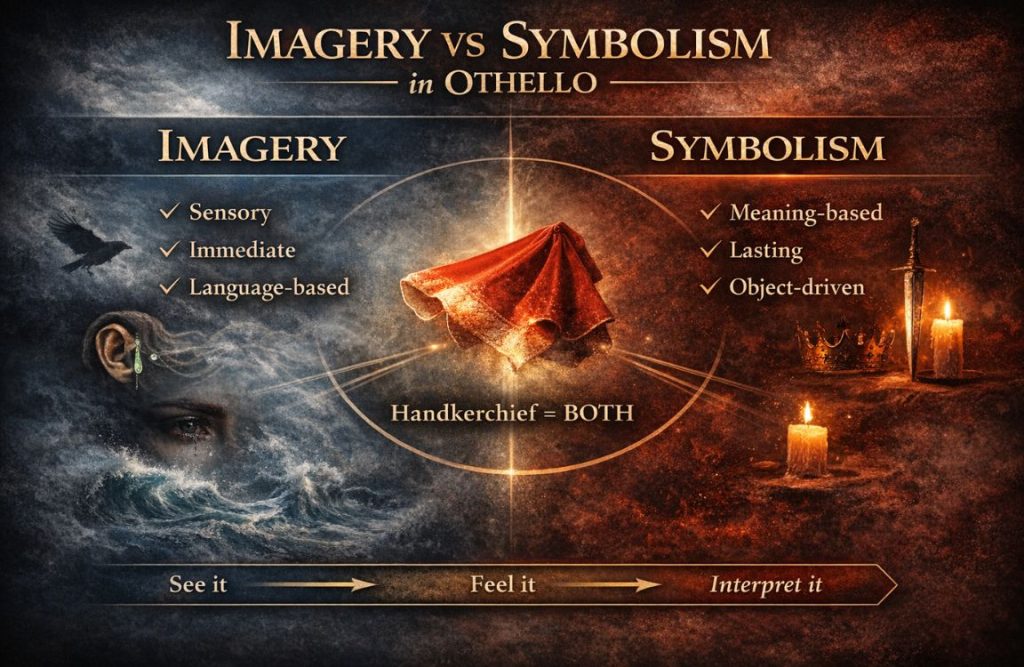
In imagery and symbolism in Othello, I tell them to think of imagery as immediate and sensory. It is language-driven, creating pictures we can almost see and feel. Symbolism, by contrast, is meaning-driven- objects like the handkerchief carry deeper ideas about love, trust, and betrayal.
This is where symbolism vs imagery in Othello becomes interesting. Imagery strikes quickly. Symbolism lingers. One shapes emotion, the other shapes interpretation.
What fascinates me is how seamlessly Shakespeare blends them. A single line can function as both- first capturing attention through sensory detail, then lingering as a symbol in our minds.
So, I always advise: don’t separate them too rigidly. Instead, ask- what do I see, and what does it stand for? That’s where real analysis begins.
Why Imagery Matters in Othello
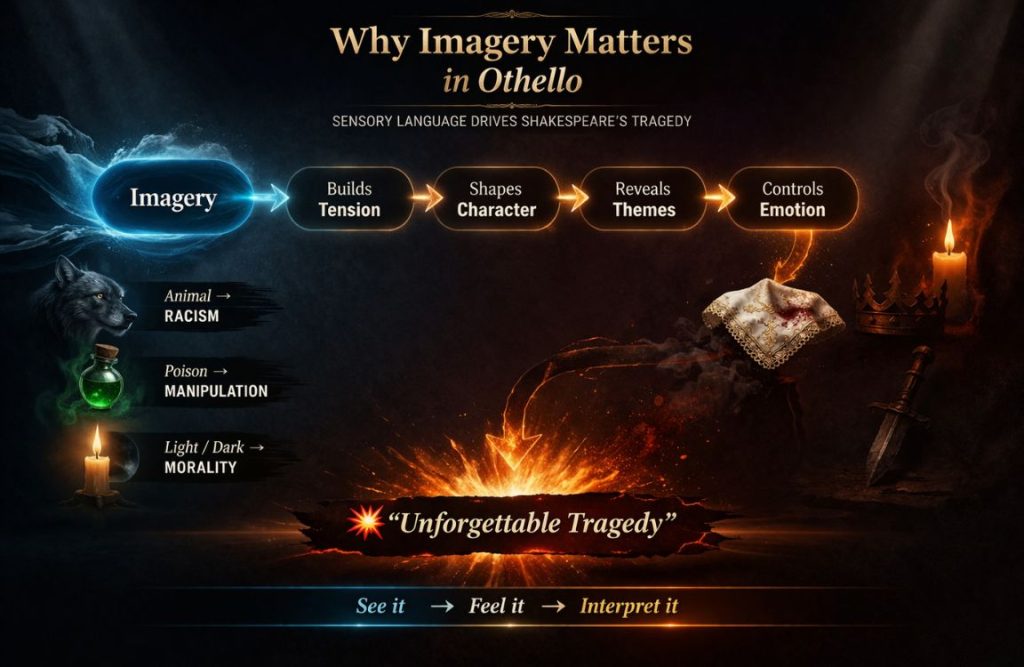
Imagery matters in Othello because it shapes atmosphere, reveals character, and drives themes like jealousy, racism, and moral corruption, making the tragedy emotionally immediate.
Let me end as I do in class- with a reflection. Imagery in Othello quietly builds tension before events erupt. Through key literary devices in Othello, imagery prepares us to feel the fall.
It also works through recurring patterns, the motifs in Othello, animal, light and dark, and diabolical images that expose prejudice, manipulation, and the poisoning of the mind.
We watch language degrade as Othello shifts from noble poetry to harsh, beastly tones under Iago’s influence. Jealousy becomes the “green-eyed monster,” vivid and devouring. These images do more than decorate; they stage experience.
We don’t just follow the plot. We see, hear, and imagine it. Without imagery, the play remains tragic; with it, the tragedy becomes unforgettable and disturbingly personal for us.
FAQs:
How does imagery influence Othello’s character development?
In my classes, I explain that imagery slowly reshapes Othello’s thinking. He begins as rational, but repeated vivid suggestions alter perception, guiding his emotions from trust to suspicion, and ultimately transforming his identity and tragic choices.
Why does Iago use animal imagery so frequently?
I often tell students that Iago chooses animal imagery because it bypasses logic and triggers instinct. By reducing characters to beasts, he distorts perception quickly, making others react emotionally rather than think critically about situations.
What role does imagery play in building suspense?
Imagery builds suspense by hinting at danger before it fully appears. I like to say it works like background music in a film- subtle signals create tension, preparing the audience emotionally for conflict and tragic consequences ahead.
Is imagery more important than symbolism in Othello?
I guide students to see that imagery and symbolism are equally important. Imagery captures attention instantly, while symbolism deepens meaning over time. Together, they create layers of understanding that make the play richer and more engaging.
How does imagery reflect themes of race and identity?
In discussion, I highlight how imagery shapes perceptions of race and identity. It influences how characters in Othello see themselves and others, often reinforcing bias, confusion, and insecurity, which ultimately contribute to misunderstanding and emotional conflict.
Conclusion:
As I wrap up this journey with my students, I often return to one simple idea: imagery is the emotional engine of Othello. Without it, the story would move, but it wouldn’t breathe. Through animal brutality, creeping poison, and shifting light and darkness, we don’t just observe tragedy. We feel it forming.
The true brilliance of imagery in Othello lies in its quiet power. It prepares us long before the final act arrives. Like a storm gathering on the horizon, we sense what’s coming, even when the characters do not.
So here’s what I always tell my students: go back. Re-read those key scenes. This time, don’t just follow the plot, follow the images. Notice how a single phrase can change everything.
Use these insights in your essays. Question what you read. And if this has sparked your curiosity, keep exploring more of William Shakespeare, because with him, there is always another layer waiting to be discovered.