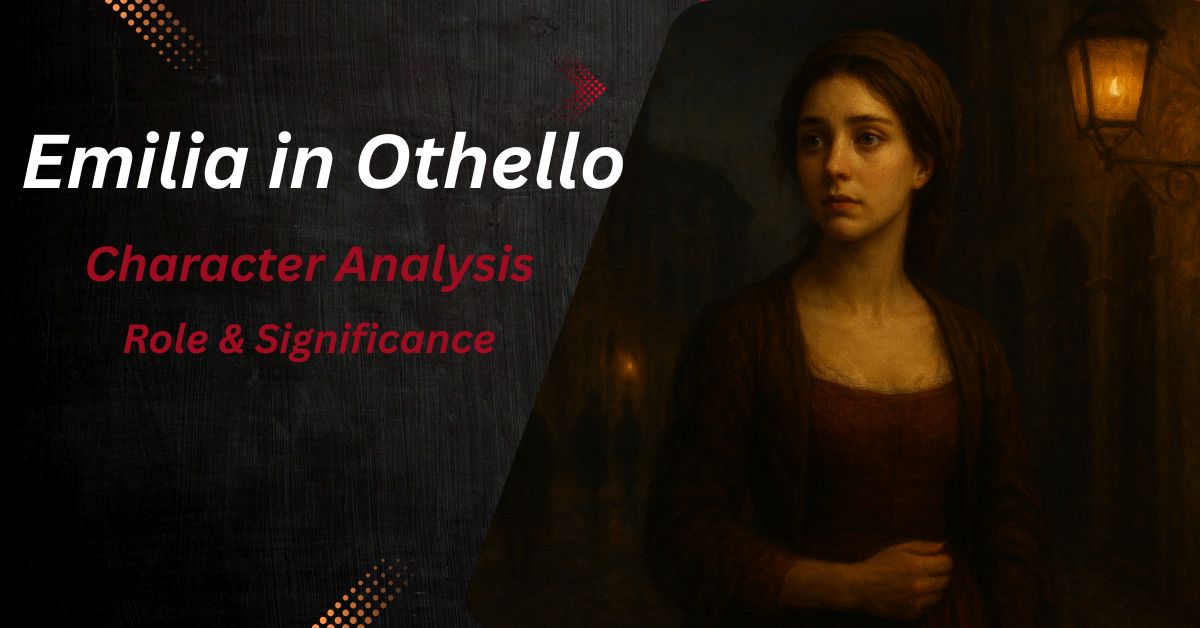
When I first introduce Emilia in Othello to my class, someone inevitably calls her “Iago’s wife,” and I can almost hear Shakespeare sigh. Emilia is far more than a marital footnote. She enters the play quietly, but she doesn’t stay quiet. By the end, she speaks with a courage that costs her everything.
In this guide, we’ll look closely at Emilia’s character, her role in the tragedy, and why her voice matters so powerfully. We’ll unpack her honesty, her loyalty to Desdemona, her bold ideas about women, and the moment she chooses truth over survival.
So, keep reading. Emilia doesn’t shout for attention, but once you notice her, Othello will never look the same again.
Who Is Emilia in Othello?
When students first meet Emilia, they expect a background figure. She isn’t dramatic, romantic, or powerful on arrival. Yet her identity quietly connects households, marriages, and social worlds that will later collide.
i) Emilia as Iago’s Wife:
In class, this detail always lands first, and often unfairly defines her. Emilia is married to Iago, a union shaped more by convenience and control than affection. Their relationship reflects a common Renaissance marriage: unequal, practical, and emotionally thin.
Emilia occupies the domestic space of a soldier’s wife, expected to obey, observe, and endure. At this stage of the play, she belongs to Iago’s household, not as a partner in schemes, but as someone living under his authority.
ii) Desdemona’s Attendant:
Alongside this marriage, Emilia serves Desdemona, acting as her companion and helper. Think of her as the woman standing just behind the heroine, fastening dresses, carrying messages, and witnessing private moments.
This role places Emilia close to Desdemona’s inner life without granting her power over it.
In lessons, I describe her as a bridge between private female spaces and the public male world- present, observant, but rarely consulted.
iii) Social Position and Marriage Context:
Emilia sits firmly in the middle of the social ladder. She isn’t noble like Desdemona, nor powerless like a servant with no voice at all. Her marriage offers protection but also restrictions.
In a society where wives are expected to be silent and loyal, Emilia’s position teaches her caution. She knows how far she’s allowed to speak- and, early on, where silence is safer.
iv) Why She’s Often Underestimated:
Students often overlook Emilia because she doesn’t demand attention. She listens more than she speaks. She stands where action happens but doesn’t steer it- at least not yet.
Like a quiet character in the back row of a classroom, she seems easy to ignore. That assumption, as we’ll see, is exactly what makes her presence so quietly dangerous to the truth.
Table of Contents
Words to Describe Emilia in Othello at a Glance
When students ask about Emilia’s personality in Othello, I ask them to pause and take her in all at once.
Let’s get Emilia in one breath before we dive in. Emilia is observant, pragmatic, and quietly brave. She begins cautious and conditioned by obedience, but grows morally awake, outspoken, and fiercely loyal. By the end, she embodies integrity- choosing truth, justice, and courage over safety and silence.

Emilia in Othello: Character Analysis
This is the moment in class when Emilia steps out of the background and onto the moral stage. Here, we stop asking who she is and start asking who she becomes, tracing a character shaped by pressure, patience, and a conscience that refuses to stay quiet.
Emilia’s Character Traits
If characters were classroom personalities, Emilia would be the student who watches everything before raising her hand- and then says something that changes the discussion.
i) Pragmatic vs. Idealistic:
Emilia doesn’t float on romantic ideals. She lives in the real world, where marriages disappoint, and people disappoint faster. She understands compromise because life has trained her to.
While others dream of perfect loyalty or perfect love, Emilia weighs consequences. Her realism isn’t cold. It’s earned. She knows how things are, not how they should be, and that grounding makes her one of the play’s most believable minds.
ii) Honest, Outspoken, Morally Awake:
What makes Emilia fascinating is that her honesty sharpens over time. When she speaks, it isn’t decorative. It’s corrective. There’s a bluntness to her words that feels almost modern, as if she’s allergic to polite lies.
In lessons, I often say Emilia talks like someone who has finally run out of patience. Her moral awareness grows until silence feels heavier than danger, and truth becomes the only thing she can carry.
iii) Contrast with Desdemona and Iago:
Put Emilia between Desdemona and Iago, and the contrast is striking. Desdemona trusts too easily. Iago doubts too eagerly. Emilia stands in the middle, skeptical but sincere.
She doesn’t idealize goodness like Desdemona, nor exploit weakness like Iago. Instead, she observes. That balance, between belief and suspicion, makes her the play’s moral measuring stick, quietly revealing how far others have fallen.
Emilia’s Moral Growth in the Play
Emilia’s journey isn’t loud or sudden. It unfolds the way real courage often does- slowly, awkwardly, and under pressure.
i) Early Silence:
At first, Emilia’s silence feels almost practical. She lives in a world where speaking costs women’s safety.
In class, I compare this to knowing the answer but not raising your hand because the room isn’t ready to hear it. Her quiet isn’t ignorance. It’s caution. She senses injustice but lacks proof, power, or permission to confront it, yet.
ii) Gradual Awareness:
As events darken, awareness replaces caution. Emilia begins to notice patterns, gaps, and consequences others ignore. Her observations sharpen, like a lens finally brought into focus. She connects actions to outcomes, words to wounds.
This is the turning point where understanding becomes responsibility. Knowing the truth now carries weight, and doing nothing starts to feel like complicity.
iii) Final Moral Awakening:
By the end, Emilia chooses truth over survival, and that choice defines her. This is the moment I pause in class, because it lands hard. Emilia speaks when silence would save her.
She exposes lies, knowing the cost. Her awakening isn’t abstract. It’s embodied, immediate, and irreversible. She doesn’t argue philosophy; she lives it.
In that final act, Emilia becomes the bravest voice in the room, proving that moral courage often arrives late- but when it does, it arrives fully.
The Role of Emilia in Othello
This is where Emilia stops being merely present and starts mattering structurally. Her actions don’t just accompany the plot. They redirect it, quietly at first, then decisively, shaping how deception travels and where truth finally breaks through.
i) How Emilia Advances the Plot:
In lessons, I describe Emilia as the character who keeps the gears turning while others argue about motives. She delivers messages, witnesses private moments, and moves between spaces no one else can access.
These movements may look small, but they connect the play’s emotional dots. Like a stagehand changing props in the dark, Emilia ensures the tragedy keeps moving- even when she doesn’t yet see the whole picture herself.
ii) The Handkerchief’s Role:
If Othello had a cursed object, this would be it. The handkerchief passes through Emilia’s hands at exactly the wrong moment. She doesn’t invent its significance, but she unknowingly becomes its courier.
I tell students to think of it as forwarding a message without reading it- harmless in intention, disastrous in effect. This single action tightens the plot’s knot, turning suspicion into something Othello believes he can see.
iii) Truth-Teller vs. Silent Observer:
What makes Emilia’s role unforgettable is how it changes. Early on, she watches more than she speaks, storing observations like unopened letters. But eventually, silence becomes impossible.
When she chooses to speak, she doesn’t soften the truth or negotiate it. She releases it all at once, like a dam breaking. In that shift, from observer to truth-teller, Emilia doesn’t just reveal lies. She reclaims the moral center of the play.
Emilia and Iago’s Relationship in Othello
When students ask me whether this marriage is about love or loyalty, I pause- because Iago and Emilia’s relationship isn’t built on affection at all. It’s built on imbalance, silence, and control, the kind that looks ordinary until it turns dangerous.
i) Power Imbalance in Marriage:
This marriage operates on hierarchy, not partnership. Iago speaks. Emilia adjusts. In the classroom, I compare it to a chessboard where one player believes the other is a pawn.
As Iago’s wife in Othello, Emilia is expected to obey without explanation, to serve without curiosity. Authority flows in one direction only, and that imbalance shapes how freely she can think, speak, or resist.
ii) Emotional Neglect:
What’s striking isn’t loud cruelty. It’s absence. Iago withholds warmth, respect, and even basic acknowledgment. Emilia lives in an emotional drought, where affection is rationed, and empathy never arrives.
Students often ask, Did Iago love Emilia?
The silence answers for him. Love requires recognition, and Emilia is largely unseen. That neglect dulls resistance, teaching her that being useful is safer than being valued.
iii) Why Emilia Obeys Iago Early On:
Early obedience isn’t weakness. It’s conditioning. Emilia has learned that survival depends on compliance.
I tell my class to imagine living where questioning feels dangerous, and silence feels practical. She follows instructions not because she trusts them, but because marriage and society have trained her to believe obedience is her role. In that space, disobedience feels like risk without reward.
iv) When and Why She Defies Him:
Defiance arrives when silence becomes unbearable. Emilia doesn’t rebel for pride. She rebels for truth. Once she realizes the human cost of obedience, loyalty collapses.
I watch students lean forward here– because this is the moment courage outweighs fear. She chooses integrity over marriage, truth over safety. And that choice, once made, cannot be undone.
Emilia and Desdemona’s Relationship in Othello
When I place these two women side by side on the board, the classroom always goes quiet. Desdemona and Emilia don’t clash loudly. They contrast softly, like candlelight beside daylight, revealing how age, experience, and love shape very different ways of seeing the world.
i) Innocence vs Experience:
Desdemona moves through life trusting that goodness protects goodness. Emilia has lived long enough to know better. I tell my students to imagine optimism as fresh paint. It shines, but it hasn’t been tested by the weather.
Emilia’s experience has chipped that shine. She understands how easily words wound and promises fail. Watching Emilia and Desdemona together feels like watching youth speak while experience listens, already predicting the cost.
ii) Ideal Love vs Realistic Marriage:
Desdemona believes love should be pure, mutual, and unwavering. Emilia treats that belief gently, like something fragile. She has learned that marriage is often a negotiation, not a fairy tale.
In class, I call Emilia the realist in the room- the one who knows love doesn’t erase power or selfishness. Their conversations expose two definitions of devotion: one built on hope, the other on survival.
iii) Loyalty Between Women:
Here’s where the contrast turns into a connection. Despite their differences, loyalty binds them. Emilia’s devotion to Desdemona isn’t performative. It’s protective. She questions, challenges, and eventually risks everything.
I watch students realize this isn’t passive loyalty. It’s active resistance. In a world that fails both women, their bond becomes a quiet rebellion and the truest relationship in the play.
Is Emilia a Feminist Character?
Every year, someone raises a careful hand and asks, “Was Emilia… feminist?” I smile, because Shakespeare never uses the word, but Emilia speaks its heartbeat. Her courage doesn’t shout slogans. It questions rules, exposes imbalance, and refuses silence when truth demands a voice.
i) Emilia’s Speech on Women and Marriage:
This moment lands like a dropped book in a quiet room. Emilia isn’t preaching. She’s responding- defending women after hearing them casually reduced and blamed. The speech grows out of frustration, not theory.
She speaks because she has listened long enough. It’s the kind of honesty that erupts when patience runs out, and politeness stops protecting anyone.
What makes the speech electric is its logic. Emilia insists women feel desire, hunger, jealousy, and hurt just as men do, and that moral expectations shouldn’t run on a double standard.
I tell students she’s holding up a mirror and daring society to look. If men stray, they’re forgiven. If women err, they’re condemned. Emilia doesn’t ask permission to say this. She states it plainly, like a truth that has waited centuries for air.
ii) Emilia’s Feminism in Context:
Here’s where I slow the class down. Emilia isn’t speaking from a modern podium. She’s speaking from a Renaissance world built to silence her. Women were expected to obey, endure, and disappear politely.
Questioning male authority wasn’t bold. It was dangerous. That’s what sharpens her words. They aren’t abstract ideas; they’re risks taken in real time.
And that’s why her voice is radical. Emilia doesn’t just complain. She reasons. She connects cause and consequence, power and behavior. She suggests that injustice teaches rebellion.
In my classroom, that realization always clicks late and hard. Emilia isn’t ahead of her time because she wants equality. She’s ahead of her time because she understands systems. She sees how inequality is taught, maintained, and justified, and she dares to say so out loud.
That’s feminism before the name.
Emilia’s Key Quotes in Othello
When I teach Emilia, I tell students she doesn’t grow louder. She grows clearer. These lines track her journey from dutiful wife to truth-teller, where loyalty is tested, courage is costly, and honesty finally refuses to whisper.
i) “I nothing but to please his fantasy.”
Early Emilia sounds like many students’ first drafts: cautious, apologetic, trimmed to fit expectations. She defines herself by service, not desire. In class, this line opens a quiet discussion about gender roles- how loyalty can slide into self-erasure. It’s not weakness; it’s conditioning, learned slowly, like handwriting.
ii) “Who would not make her husband a cuckold to make him a monarch?”
Cue the gasps. Emilia’s wit snaps awake here. She argues marriage is a partnership, not a pedestal, and fidelity isn’t blind obedience. I pause and let the room buzz. She’s not promoting betrayal. She’s exposing double standards. Truth arrives wearing humor, sharp as a pin.
iii) “Let husbands know their wives have sense like them.”
This is Emilia teaching the class. Equal intellect, equal feeling, equal appetite for dignity. I love watching students realize Shakespeare gives her the feminist mic centuries early. Loyalty, she argues, thrives on respect. Without it, marriage becomes a lecture nobody chose to attend.
iv) “The ills we do, their ills instruct us so.”
Here’s see-and-say morality, delivered with adult clarity. Emilia insists that behavior teaches behavior. Betrayal breeds betrayal; kindness multiplies. In exams, students often miss how practical this is. She’s not moralizing. She’s diagnosing cause and effect, like a seasoned teacher reading a messy group project.
v) “I will not charm my tongue; I am bound to speak.”
This is courage without armor. Emilia chooses truth over safety, voice over obedience. I tell students this is the bravest line in the play. She knows the cost and pays it anyway. Loyalty, at last, is redirected, away from a husband, toward the truth itself.
Read Also, Top 13 Emilia Quotes from Othello: In-Depth Analysis
What Happens to Emilia in Othello?
Emilia’s fate completes the tragedy’s moral arc. In the final moments, she steps fully into the role the play has been preparing her for: witness, judge, and truth-bearer. Her story ends not quietly, but decisively- proof that integrity, once awakened, refuses to retreat, even when danger stands inches away.
How Does Emilia Die in Othello?
This is the turning point where secrets collapse, and courage becomes lethal.
i) Scene Breakdown:
The final scene unfolds like a courtroom without walls. Desdemona lies dead, Othello reels in horror, and explanations tumble over one another. Emilia enters expecting clarity and finds chaos.
As fragments of the truth surface- the missing handkerchief, the lies that framed innocence. She pieces together what the audience already knows. The room tightens. This is no longer a domestic tragedy; it’s a public reckoning.
ii) Why She Refuses Silence:
In class, this is where I stop reading and look up. Emilia understands exactly what speaking will cost her. But silence, she realizes, has already cost too much. Remaining quiet would make her an accessory to injustice.
Her choice isn’t impulsive. It’s ethical. She rejects comfort, loyalty, and self-preservation in favor of something rarer in tragedy- moral clarity delivered out loud.
iii) Who Kills Her and Why:
The answer to who kills Emilia in Othello is brutal because it exposes motive as clearly as the act itself. Iago strikes and kills her not from rage, but from fear. Emilia’s words dismantle his entire construction of deceit.
When manipulation fails, violence takes its place. Her death becomes the final proof of his villainy and the price of telling the truth too clearly.
Emilia’s Last Words and Their Meaning
Emilia’s final moments reshape how we read everything that came before.
i) Loyalty to Desdemona:
Her allegiance settles firmly beside Desdemona, whose innocence she defends without hesitation. This loyalty isn’t sentimental. It’s corrective. Emilia restores a silenced woman’s reputation when it no longer benefits her to do so.
In exam terms, this is a shift from private obedience to public justice. In human terms, it’s solidarity at its bravest.
ii) Truth Spoken at the Cost of Life:
When students ask why Emilia’s last words in Othello matter, I say this: they work. They expose deception, clear Desdemona’s name, and force the truth into the open, even though Emilia won’t survive the moment. Her voice outlives her body.
The tragedy doesn’t end with silence. It ends with truth spoken too late to save lives, but not too late to matter.
FAQ:
What age is Emilia in Othello?
Shakespeare never gives a number, which is telling. Emilia reads as mature, experienced, and world-aware. In class, I describe her as emotionally older than the tragedy itself- someone shaped by marriage, observation, and hard-earned realism.
Is Emilia older than Desdemona?
Yes, and the contrast matters. Desdemona feels youthful and idealistic. Emilia carries the weight of lived experience. When I teach them together, they feel like two stages of womanhood sharing the same unjust world.
Did Iago love Emilia?
Love would require empathy, and that’s missing. Iago treats Emilia less like a partner and more like furniture- useful when needed, invisible otherwise. Students often spot this before I say a word, which tells you everything.
Is Emilia a villain in Othello?
No, but she is flawed. Emilia makes mistakes shaped by obedience and survival, not malice. I remind students that tragedy doesn’t need monsters everywhere. Sometimes, it only needs ordinary people trapped in harmful systems.
What does Emilia symbolize?
Emilia symbolizes awakening. She represents what happens when silence learns to speak. In essays, I call her the conscience of the play- arriving late, speaking boldly, and reminding us that truth often comes from the margins.
Why does Iago kill Emilia?
Because she becomes dangerous. Emilia’s honesty threatens control, reputation, and power. When I explain this, students nod: in tragedies, truth isn’t killed because it’s wrong. It’s killed because it works.
Conclusion: Why Emilia Matters in Othello
Emilia in Othello matters because she changes. In a play obsessed with fixed roles- wife, husband, soldier, villain- she evolves. She begins constrained by loyalty and ends defined by integrity. For students, that journey is the lesson.
Emilia shows how truth can grow inside ordinary people, how feminism doesn’t always roar but sometimes arrives through clarity, and how loyalty means choosing justice over comfort. Her sacrifice doesn’t undo the tragedy, but it redeems the play’s moral landscape.
When the noise fades, Emilia’s voice lingers- reminding us that speaking up may come late, but it is never meaningless.