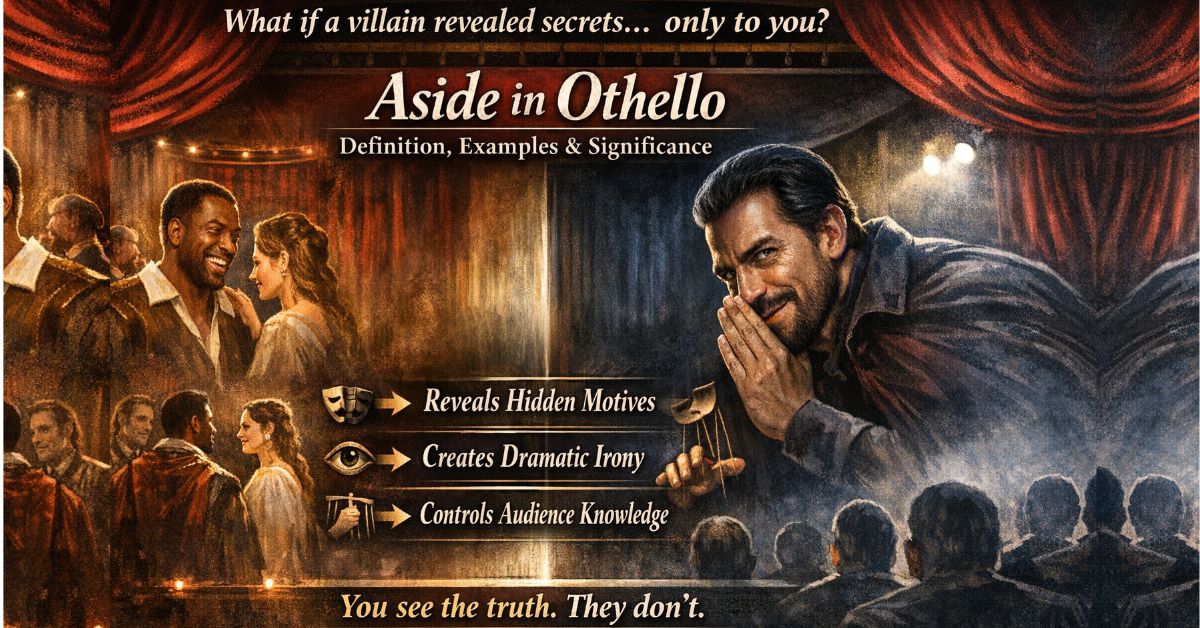
What if a villain revealed his secrets… but only to you? As I tell my students, this is the magic of an aside in Othello. In Shakespeare’s tragedy, I watch Iago operate like a magician, smiling at others while whispering truth to us.
An aside in Othello is a remark spoken to the audience, unheard by other characters. But here’s the twist: it doesn’t just reveal information; it pulls us into the conspiracy.
We become witnesses to deception, accomplices to it. That is why it matters: it creates dramatic irony and gives Iago control over both characters and the audience.
In this lesson, I’ll guide you through key examples and show how these whispered lines drive the tragedy forward.
What Is an Aside in Othello? (Definition & Meaning)
Let me give you the simplest aside definition I use in class: an aside is a brief remark a character delivers to the audience that other characters on stage cannot hear. In Othello, this device becomes a psychological weapon. Shakespeare uses aside in Othello to reveal hidden motives, create dramatic irony, and deepen tension.
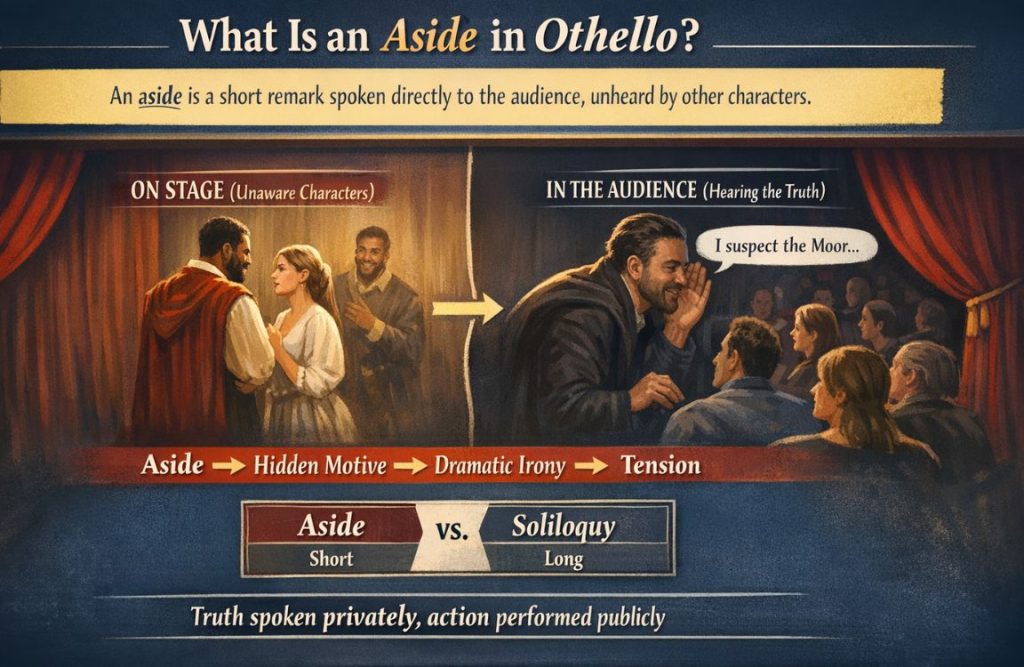
When Iago speaks aside, he splits reality into two layers- the visible and the hidden. To other characters, he is “honest Iago,” but to us, he confesses his schemes. This duality reveals the purpose of aside in drama: exposing truth beneath performance while making the audience complicit.
Asides also foreshadow action and build suspense by showing how plots unfold before they happen. Unlike soliloquies, they are short and occur within ongoing dialogue. So, an aside in Othello is not just a technique. It sharpens irony, builds trust with the audience, and intensifies tragedy in a uniquely dramatic way.
What Makes an Aside Unique in Othello
When I teach this, I tell my students: not all asides are created equal. In most plays, they simply reveal thoughts. But in Othello, Iago turns them into weapons. This is where dramatic techniques in Othello become thrillingly dangerous. Iago doesn’t just think. He performs honesty while secretly scripting destruction.
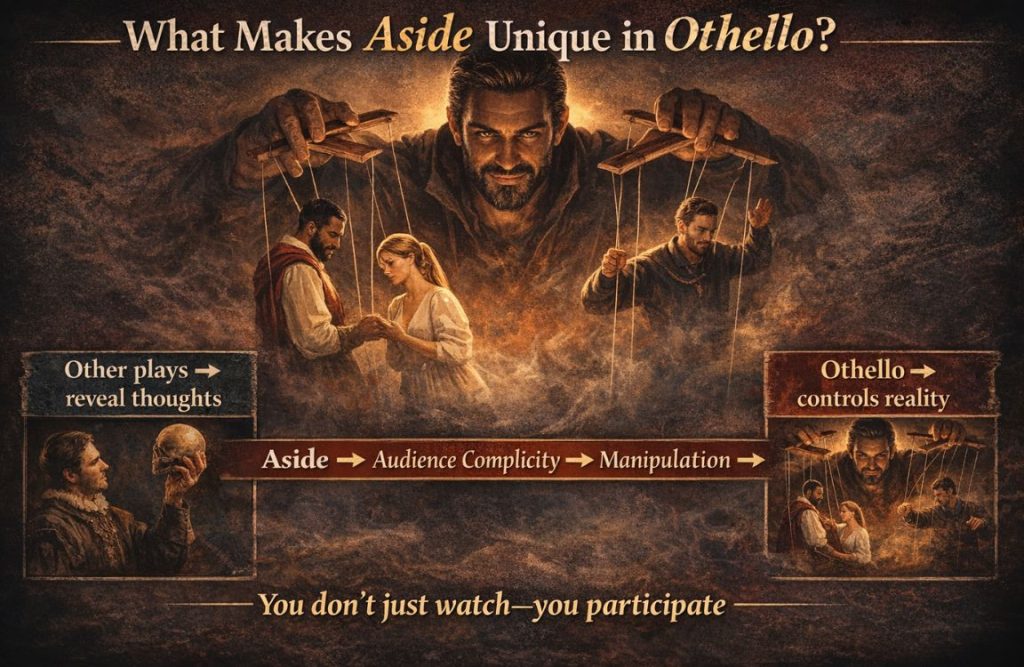
So, how does Shakespeare use the aside in Othello differently? He makes the audience complicit. We are not passive listeners. We are insiders to a crime in progress. Iago’s whispers feel like confidential briefings, and that creates an unsettling bond. You almost feel guilty knowing what others don’t.
This is psychological manipulation at its finest: Iago deceives characters, but he seduces the audience with truth.
Examples of Aside in Othello (Key Quotes Explained)
Now, let’s step into the text itself. I’ll walk you through key Iago asides, especially from Acts 1 and 3, where his manipulation begins and then explodes into full psychological control.
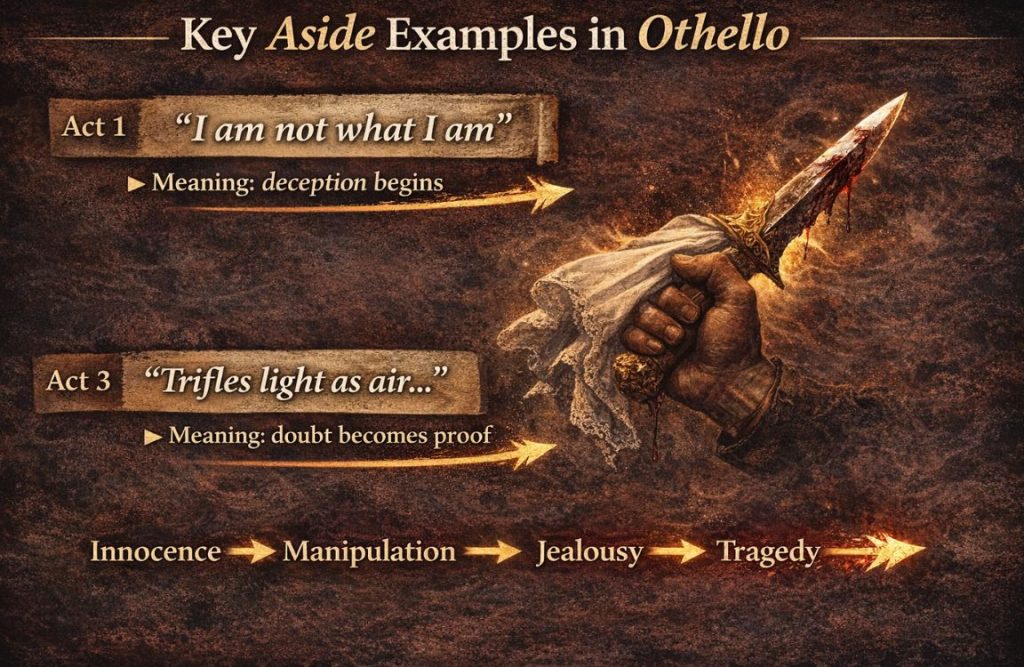
i) Iago’s Aside in Act 1 (Quote + Explanation)
One of the most striking aside examples in Othello appears in Act 1, when Iago declares, “I am not what I am.” Simple, yet it opens a trapdoor beneath the entire play. This line, along with other aside quotes in Othello like “Thus do I ever make my fool my purse,” reveals his philosophy of manipulation.
As I tell my students, it is as if Iago confesses his dishonesty directly to us, while other characters remain blind. This creates immediate dramatic irony and positions the audience as silent witnesses.
In Act 1, Iago also hints at motives- his resentment over Cassio’s promotion and suspicion of Othello. These asides do more than reveal character. They outline his strategy to exploit trust and ignite jealousy. Through them, Shakespeare exposes a two-faced villain who turns honesty into a mask, making deception the driving force of the tragedy.
ii) Iago’s Aside in Act 3 (Turning Point)
Othello Act 3 marks the true turning point, where Iago’s asides in Othello become devastatingly precise. Iago plants doubt, then quietly turns to us, revealing his method. When he says, “Ha! I like not that,” or later, “Trifles light as air… are to the jealous confirmations strong,” we see how easily suspicion is manufactured.
In class, I ask: Who is he really speaking to? Not Othello, but us. That is the essence of dramatic irony in Othello aside. Othello believes he is discovering truth, while we watch deception unfold step by step. Iago even compares his influence to poison, “Work on, my medicine, work!”, showing how calmly he orchestrates chaos. It’s fascinating!
The handkerchief becomes false proof, turning love into doubt. This moment is chilling because the audience understands everything, yet remains powerless. Through these asides, Shakespeare transforms manipulation into performance, allowing us to witness Othello’s tragic fall long before he fully realizes it himself.
Why Shakespeare Uses Asides in Othello
At this point, I ask my students a simple question: why give Iago a private microphone? Shakespeare uses asides not randomly, but deliberately- to shape tension, reveal motives, and control exactly what we know.
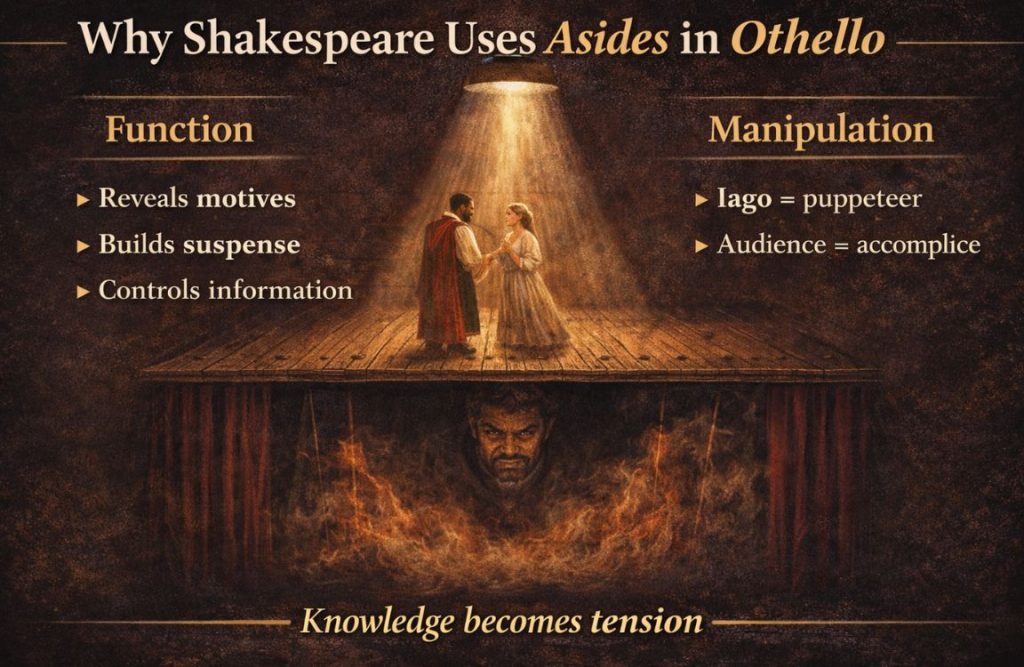
i) Function of Aside in Othello
Let me explain the function of aside in Othello the way I do in class- think of it as a spotlight revealing what others cannot see. These brief lines expose hidden motives before actions unfold, allowing us to anticipate conflict. This is why the importance of aside in Othello goes beyond style. It actively shapes the tragedy.
When Iago speaks aside, he reveals his true intentions while maintaining his “honest” image on stage. This contrast creates powerful dramatic irony, as we know the danger while others remain blind. It also builds suspense, because we watch his plans develop step by step. More importantly, asides make us uneasy participants. We become co-conspirators in his schemes.
So, Shakespeare uses asides to control information, reveal psychology, and guide our emotional response throughout the play, turning knowledge itself into tension.
ii) Aside as a Tool of Manipulation
Now here’s where it gets chilling. In Othello, the aside is not just speech. It is a control. When I introduce Iago’s manipulation quotes, I tell my students: this is not confession, this is strategy. Each aside becomes a calculated move in a psychological game where Iago acts like a puppeteer, directing others while revealing his blueprint to us.
So, how does Shakespeare use an aside in Othello to show manipulation? He creates a split reality- characters hear fragments, but we hear the full design. This builds dramatic irony and foreshadows every trap.
More dangerously, it forms an alliance with the audience. We trust Iago’s honesty with us, even as he deceives others, turning us into silent, uneasy accomplices in his manipulation.
Aside and Dramatic Irony in Othello
Now, let’s step into one of Shakespeare’s sharpest tools- dramatic irony. Here, asides become more than whispers; they turn into signals, alerting us to truths that characters tragically fail to recognize.
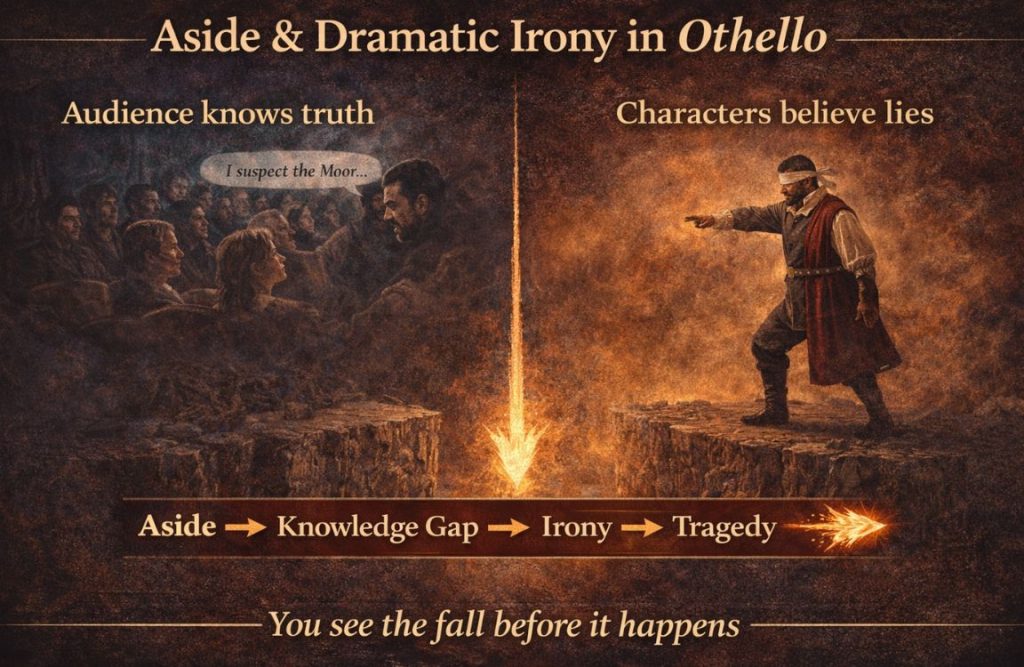
i) How Aside Creates Dramatic Irony in Othello
I often tell my students: Dramatic irony is when the audience knows something crucial that the characters do not. In dramatic irony in Othello aside, this gap becomes painfully sharp.
Asides act like secret messages delivered only to us, exposing Iago’s hidden intentions while he performs honesty on stage. We hear “I am not what I am,” even as Othello calls him “honest,” and that contrast creates powerful tension. This dual awareness lets us see illusion and reality at once.
We watch innocent actions, like Desdemona’s kindness, turn into traps before they unfold. Shakespeare uses asides to build suspense, highlight appearance versus reality, and make us uneasy witnesses, fully aware of the tragedy forming while the characters remain blind.
ii) Audience vs Characters in Othello (Hidden Truth Effect)
Here’s the moment I pause in class and ask: how does it feel to know the truth when others don’t? That tension defines dramatic irony examples in Othello.
The audience has privileged access to Iago’s schemes through asides and soliloquies, while characters continue to trust him as “honest.” This imbalance creates pity, frustration, and suspense.
We see how the handkerchief becomes false evidence, yet Othello believes it completely. It’s like watching someone walk toward a cliff. You see the danger but cannot intervene. Iago’s dual role as trusted advisor and hidden manipulator deepens this divide.
Shakespeare uses this hidden truth effect to make us complicit observers, emotionally involved in every step of the downfall, as illusion destroys reality before our eyes.
Aside vs Soliloquy vs Monologue in Othello
Now, I often see students mix these terms up. So let’s untangle them clearly. Understanding these differences is like having a map. You won’t get lost in Shakespeare’s dramatic landscape again.
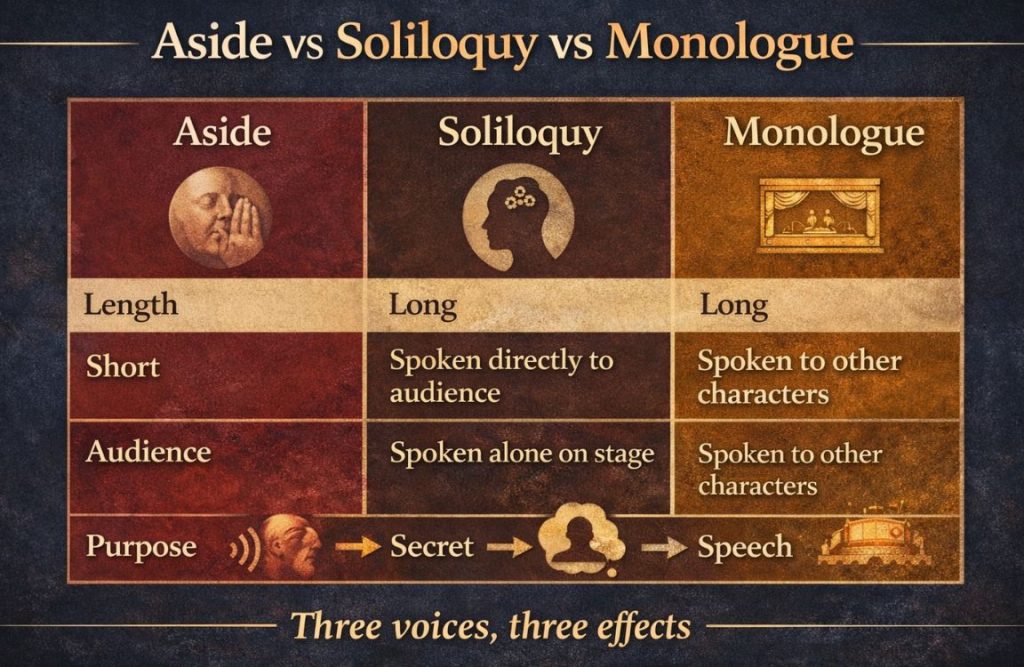
i) Aside vs Soliloquy in Othello
Here’s how I explain aside vs soliloquy in Othello in class: an aside is a whisper to the audience, while a soliloquy is a window into the soul. The difference between aside and soliloquy lies in presence and purpose.
In an aside, other characters are on stage, but the speaker briefly shares a secret with us, creating dramatic irony.
In a soliloquy, the character appears alone, thinking aloud and revealing deeper motives. Take Iago.
His asides are quick, sharp, and conspiratorial, exposing his manipulation in real time. His soliloquies, however, are longer and more reflective, uncovering his complex intentions.
Think of it this way: aside is a secret shared. Soliloquy is a mind exposed. Shakespeare uses both to control information and deepen psychological tension.
ii) Aside vs Monologue in Othello
Now let’s tackle aside vs monologue in Othello. A monologue, I tell my students, is a long speech delivered openly to other characters, meant to persuade, explain, or express emotion.
Unlike an aside, it is fully public- everyone on stage hears it. This creates a sharp contrast. An aside hides truth, revealing private intentions only to the audience, often creating dramatic irony.
A monologue in Othello, however, performs truth, shaping how characters understand events. Think of Iago’s brief, secretive asides versus Othello’s powerful speeches before others. One whispers. The other declares.
Performance-wise, an aside feels intimate and conspiratorial, while a monologue commands attention and fills the stage.
So, while both reveal character, one builds secrecy and tension, and the other builds presence, persuasion, and emotional intensity within the unfolding drama.
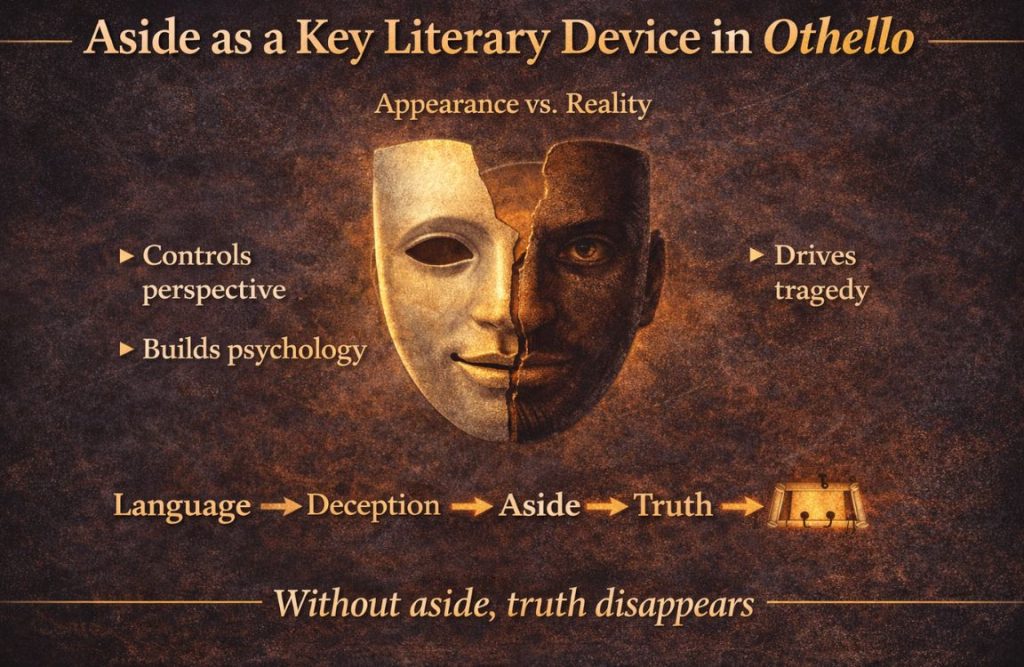
Aside as a Key Literary Device in Othello
When I step back and look at the bigger picture, I tell my students this: aside is not just a technique. It’s one of the most powerful literary devices in Othello. It works quietly, yet shapes everything.
Among the dramatic devices in Othello, the aside stands out because it connects language with structure. Shakespeare uses it to divide what is seen from what is known. That gap feeds directly into the theme of appearance versus reality.
Think about the language in Othello- polished, persuasive, often deceptive. Asides expose the truth beneath that polished surface. They reveal the cracks in the performance.
In Shakespeare’s style, nothing is accidental. The aside becomes a tool that controls perspective, guiding us through illusion toward understanding. It’s subtle, but without it, the tragedy would lose its psychological depth.
FAQs:
Why does Iago rely more on asides than soliloquies in Othello?
Iago prefers asides because they let him manipulate in real time, whispering secrets while maintaining his “honest” mask. This creates dramatic irony, shows his quick improvisation, and turns the audience into uneasy accomplices within his ongoing deception.
Do other characters use asides in Othello, or only Iago?
Yes, other characters use asides, but sparingly. Roderigo, Cassio, and Desdemona reveal private thoughts through them. Iago dominates asides, using them for manipulation, while others express innocence or concern, creating a sharp contrast with his cunning.
How would Othello change if asides were removed?
Without asides, Othello loses its dramatic heartbeat. We’d miss Iago’s plotting whispers, and the play would feel like a normal conversation, not a thrilling psychological maze. Asides are the secret tunnels of Shakespeare’s tragic architecture.
Do asides make Iago more trustworthy or more dangerous?
Far more dangerous. Iago’s asides create a false sense of honesty with the audience while revealing his manipulative control. This paradox makes him a puppet master, trapping us as complicit observers, aware of his schemes yet unable to resist.
How can you quickly identify an aside in an exam?
Look for short, secret lines, often bracketed or marked “aside.” Other characters remain onstage but ignore them. If the speaker briefly breaks from dialogue, revealing hidden thoughts directly to the audience, that’s your aside in exams.
Conclusion:
So, as I wrap up this lesson, I remind my students: the aside is not just a small dramatic trick. It is power in disguise. Through it, Shakespeare gives Iago control over truth, perception, and ultimately, fate.
What makes this so compelling is how it ties into the theme of appearance versus reality. Iago appears honest, yet his asides reveal a completely different self. That tension drives the tragedy forward.
And here’s my challenge to you: now that you understand how asides work in Othello, try spotting them in Act 1 or Act 3. Notice how they shift your perspective.
Want deeper insights? Explore our guides on imagery and symbolism in Othello, and uncover even more layers beneath Shakespeare’s words.