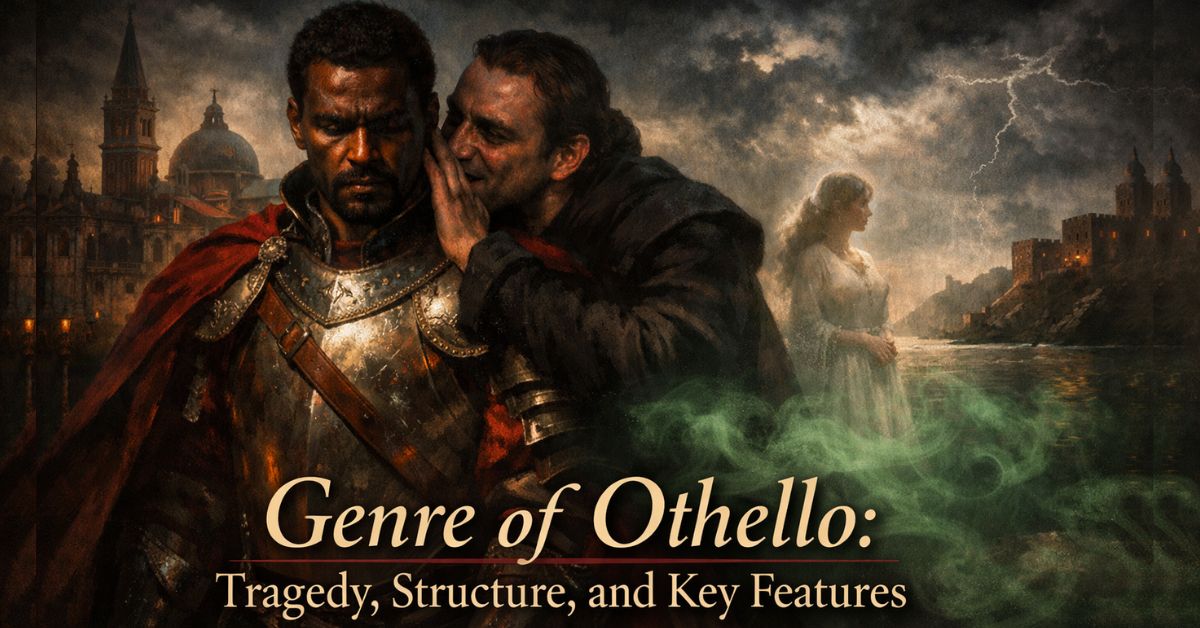
Every year, when I begin teaching the genre of Othello, I watch my students expect a simple love story. I smile and say, “Not quite.” The play, written by William Shakespeare, belongs firmly to the tradition of Shakespearean tragedy. In other words, the Othello genre is not merely romance or war drama. It is the slow collapse of a great soul.
In class, I often pause at the moment when trust begins to rot. “Notice this,” I tell them. Tragedy in Othello grows like a hidden infection: jealousy whispers, doubt spreads, and honor slowly suffocates.
So, when we discuss the genre of Othello, I remind my students that tragedy is not just death at the end. It is a tragedy unfolding slowly.
What Is the Genre of Othello?
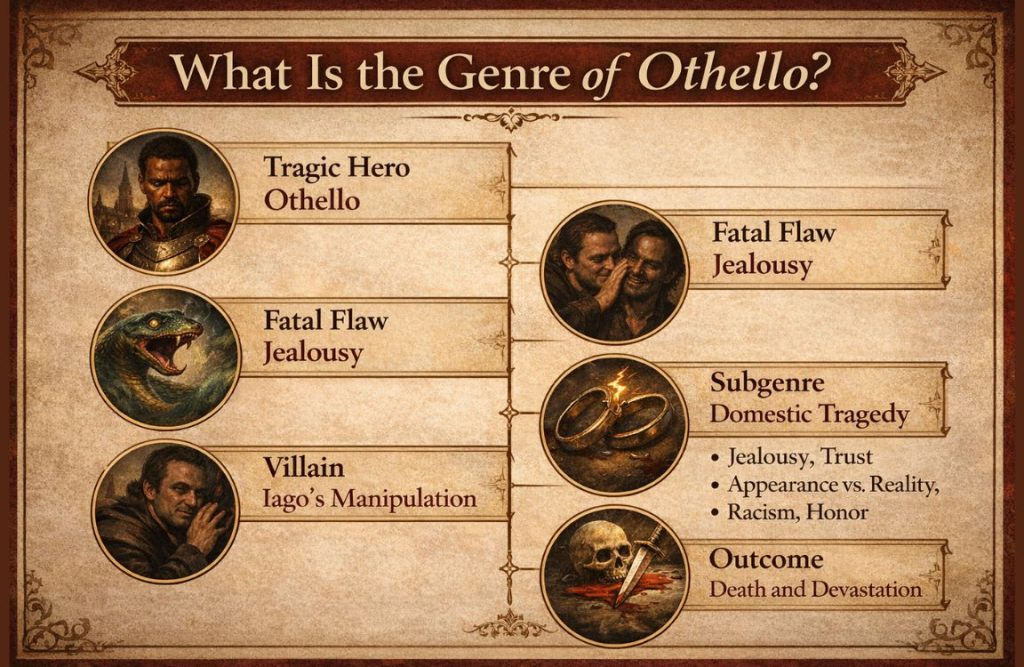
The genre of Othello is tragedy. Written by William Shakespeare, the play portrays the downfall of the noble Moorish general Othello, whose fatal flaw- jealousy- leads to manipulation, betrayal, and death.
When I introduce my students to the genre of Othello, I like to pause dramatically and say, “This isn’t a story of sword fights and battlefield glory. It’s a slow, quiet collapse inside a marriage.”
The play follows Othello, a respected Moorish general, whose vulnerability and jealous imagination become the perfect fuel for Iago’s manipulations. One stolen handkerchief, one whispered doubt, and suddenly, love turns lethal.
Some critics call it a domestic tragedy because the catastrophe happens in the home, yet it follows Shakespeare’s classic tragic structure: a noble hero, a fatal flaw, ruthless manipulation, and devastating recognition that arrives too late. Key aspects of the genre include:
- Tragic Hero: Othello, noble yet vulnerable
- Domestic Tragedy: intimate, personal destruction
- Villainy: Iago’s manipulative revenge
- Themes: jealousy, trust, appearance vs. reality, racism, and honor
- Consequence: Death and devastation
Tragedy here is not thunder and lightning. It’s a quiet, creeping poison.
When Was Othello Written & What Was Its Dramatic Context?
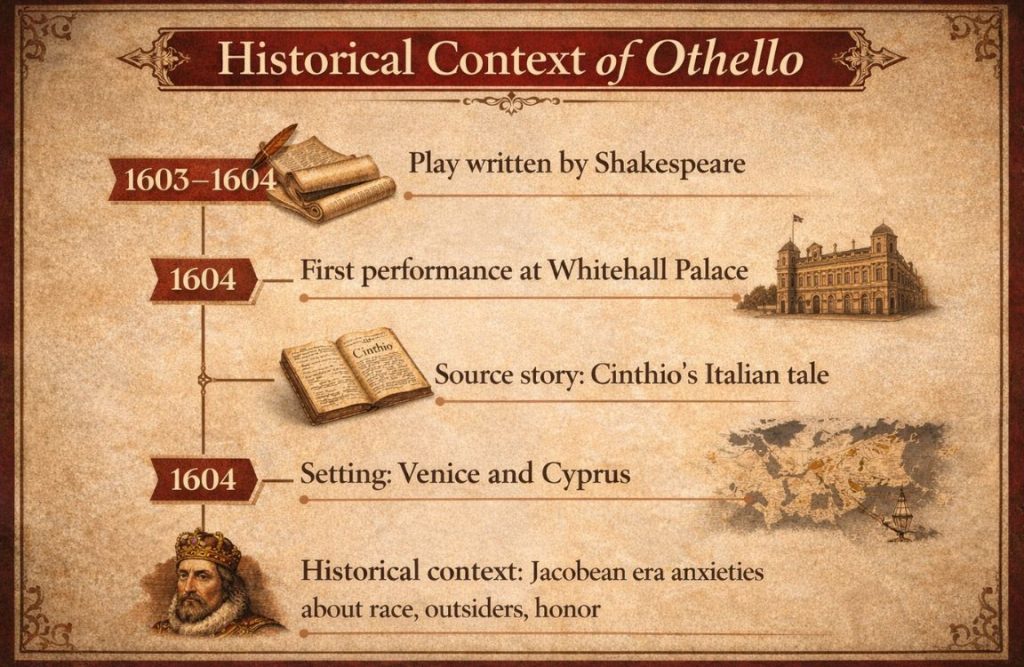
Othello was written around 1603-1604 by William Shakespeare during the early Jacobean era, shortly after the accession of James I of England. The earliest recorded performance took place on November 1, 1604, at Whitehall Palace in London.
When I explain this in class, I ask my students to imagine London’s buzzing playhouses- no cinema, no streaming, only the lively stage. Shakespeare drew on an Italian tale by Cinthio, transforming it into a powerful tragedy about jealousy, race, and trust.
Set between Venice and the military outpost of Cyprus, the play reflects early seventeenth-century anxieties about outsiders, honor, and reputation. Like many Renaissance tragedies, Othello invites audiences to watch a noble hero fall, and quietly wonder whether the same weakness could live within themselves.
Genre of Othello at a Glance
In class, I sometimes tell my students that understanding genre is like reading a play’s DNA. Once you see the pattern, everything else suddenly makes sense. So I pause, chalk in hand, and sketch this quick map on the board:
| Element | Explanation |
| Main genre | Tragedy |
| Subgenre | Domestic tragedy |
| Tragic hero | Othello |
| Tragic flaw | Jealousy |
| Structure | Aristotelian tragedy |
Then I ask them, half-smiling: What happens when a hero’s greatest strength, trust, meets the poison of jealousy? That question, I remind them, is the beating heart of Shakespeare’s tragedy.
Understanding Shakespearean Tragedy in Othello
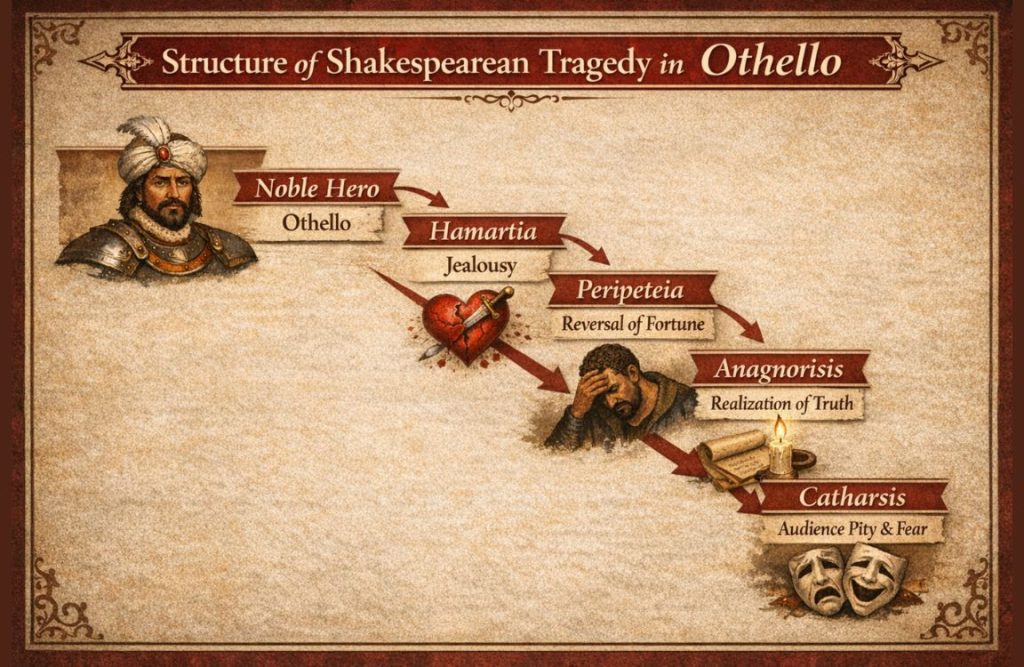
Othello by William Shakespeare is a classic example of Shakespearean tragedy in which a noble hero falls from greatness due to a fatal flaw. The play follows the tragic pattern described by Aristotle: a respected protagonist, a destructive weakness (hamartia), a dramatic reversal of fortune (peripeteia), a painful recognition (anagnorisis), and finally emotional release (catharsis).
When I begin teaching Othello, I often write a single word on the board: “Tragedy.” Then I turn to my students and ask a deceptively simple question:
“What destroys a great hero?”
Some students say villains. Others say fate. A few brave souls suggest bad luck.
Then we start reading Othello, and the class slowly realizes something unsettling: the real enemy often grows inside the hero himself.
Shakespeare’s tragedies rarely rely on monsters or supernatural curses alone. Instead, they explore something far more frightening- human weakness.
In Othello, the downfall of a respected general unfolds through jealousy, manipulation, and doubt. The tragedy does not explode suddenly. It spreads quietly, like a crack forming in a perfectly polished mirror.
To understand how this works, we need to examine the core elements of Shakespearean tragedy within the play.
i) Othello as a Tragic Hero
In classical tragedy, the protagonist is never an ordinary figure. A tragic hero must begin with greatness.
When my students first encounter Othello, they meet a man admired by Venetian society. He is a brilliant military leader, calm under pressure, dignified in speech, and deeply respected. Even the Duke of Venice trusts him with the defense of Cyprus.
In other words, Othello stands at the peak of honor and authority. But tragedy, like a patient chess player, waits for the smallest weakness.
That weakness does not appear immediately. Shakespeare lets us admire Othello first. Only later do we begin to notice the cracks beneath the armor. As a Moor living within Venetian society, Othello sometimes feels like an outsider. His confidence rests partly on the love and loyalty of those around him.
That fragile trust becomes the perfect doorway for manipulation.
Enter Iago- perhaps the most quietly dangerous villain in Shakespeare. He does not attack Othello with swords or armies. Instead, he whispers doubt.
And sometimes a whisper is more destructive than a weapon.
ii) Othello’s Hamartia: The Fatal Flaw
Aristotle used the term hamartia to describe the fatal flaw that triggers a hero’s downfall. In Othello, that flaw is jealousy, strengthened by insecurity and an intense trust in appearances.
When I discuss this moment with my students, I ask them something curious:
“Does jealousy arrive shouting?”
They usually laugh and shake their heads.
Jealousy rarely storms through the front door. Instead, it sneaks in quietly- like smoke slipping under a closed door.
At the beginning of the play, Othello appears calm and confident in his love for Desdemona. Yet Iago understands something crucial about human psychology: if you suggest doubt carefully enough, the victim will finish the suspicion himself.
That is why Iago never directly accuses Desdemona. Instead, he drops hints:
“O, beware, my lord, of jealousy:
It is the green-eyed monster which doth mock
The meat it feeds on.”
Pretending to warn Othello, Iago slowly poisons his imagination. Soon, Othello begins demanding “ocular proof.”
Ironically, by the time he seeks evidence, jealousy has already taken control.
iii) Peripeteia and Anagnorisis: The Tragic Turning Point
Every tragedy contains a moment when the hero’s fate suddenly changes direction. Aristotle called this peripeteia, or reversal of fortune.
In Othello, the reversal occurs when Othello becomes convinced that Desdemona has betrayed him. The noble general who once spoke of love with poetic tenderness begins to speak the language of suspicion and rage.
When I reach this part in class, I sometimes pause and ask students to notice how quickly admiration transforms into cruelty. Shakespeare makes the shift disturbingly believable. The hero who once trusted his wife completely now believes deception everywhere.
This tragic fall of Othello leads to the play’s most painful moment: anagnorisis, the moment of recognition.
Near the end of the play, the truth finally emerges. Iago’s deception is exposed, and Othello realizes that Desdemona was innocent all along.
For a brief moment, the fog of jealousy in Othello clears. But tragedy has a cruel rule: recognition arrives too late.
iv) Catharsis: Why the Tragedy Matters
The final element of classical tragedy is catharsis, the emotional release felt by the audience.
When Othello understands the horror of his mistake, the audience experiences two powerful emotions simultaneously- pity and fear. We pity Desdemona, whose innocence could not protect her. We fear Othello’s fate because his weakness feels disturbingly human.
In his final speech, Othello attempts to explain himself, admitting he:
“loved not wisely but too well.”
Whenever I reach this line in class, the room usually grows quiet. Students realize that this tragedy is not simply about a villain or a murderer. It is about how love itself can become dangerous when poisoned by suspicion.
And that realization is what makes Shakespearean tragedy so powerful.
The fall of Othello reminds us that the greatest battles in literature, and perhaps in life, are rarely fought on the battlefield.
They are fought inside the human heart.
Is Othello Also a Domestic Tragedy?
Yes, Othello by William Shakespeare can also be read as a domestic tragedy because the central catastrophe unfolds within the marriage of Othello and Desdemona, where jealousy, manipulation, and mistrust destroy private life.
When I discuss the genre of Othello with my students, I ask a simple question: Where does the real tragedy happen- on the battlefield or in the bedroom? The pause that follows usually reveals the answer.
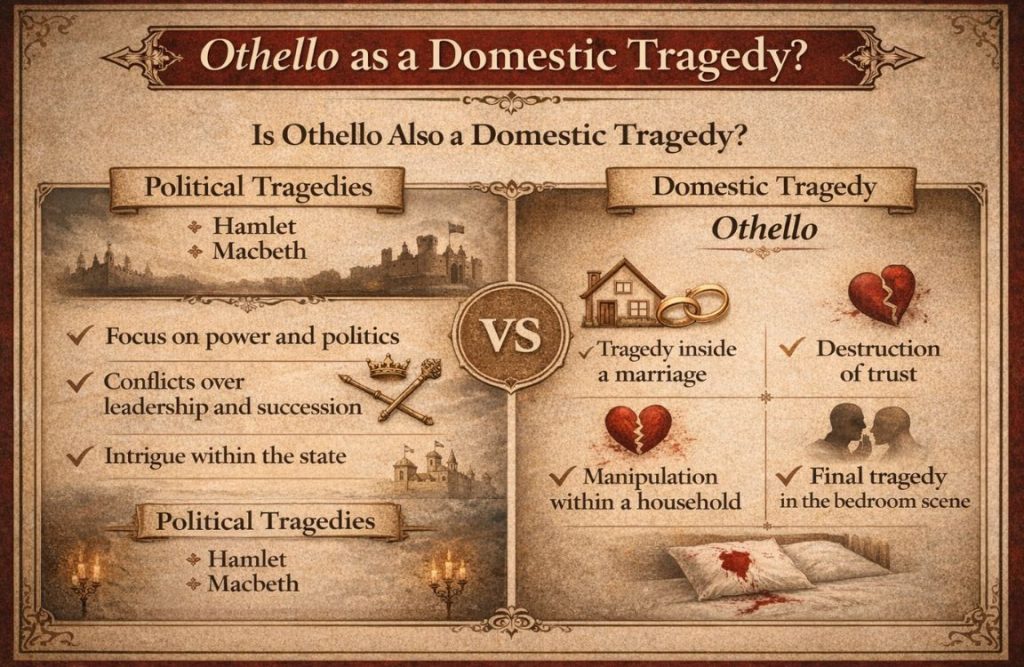
Unlike tragedies such as Hamlet or Macbeth, which revolve around kings and political power, the disaster in Othello grows inside a marriage. At the beginning, Othello and Desdemona’s relationship seems strong, almost like a house built on trust. Yet one whisper of suspicion begins loosening the bricks.
That whisper belongs to Iago. Instead of attacking the Venetian state, he attacks a household. Through jealousy, miscommunication, and manipulation, he turns private love into private torment.
By the final act, the public world fades away, and the tragedy reaches its climax in the bedroom itself. The audience realizes that the most devastating wars are sometimes fought not between nations, but within a home.
Themes That Reinforce the Tragic Genre of Othello
The major themes that reinforce the tragic genre of Othello include jealousy, deception, love, betrayal, racism, and appearance versus reality, all of which gradually destroy the relationship between Othello and Desdemona.
Whenever students ask me about the themes of Othello, I tell them to imagine the play as a fragile glass structure. Each theme forms a crack slowly spreading across its surface.
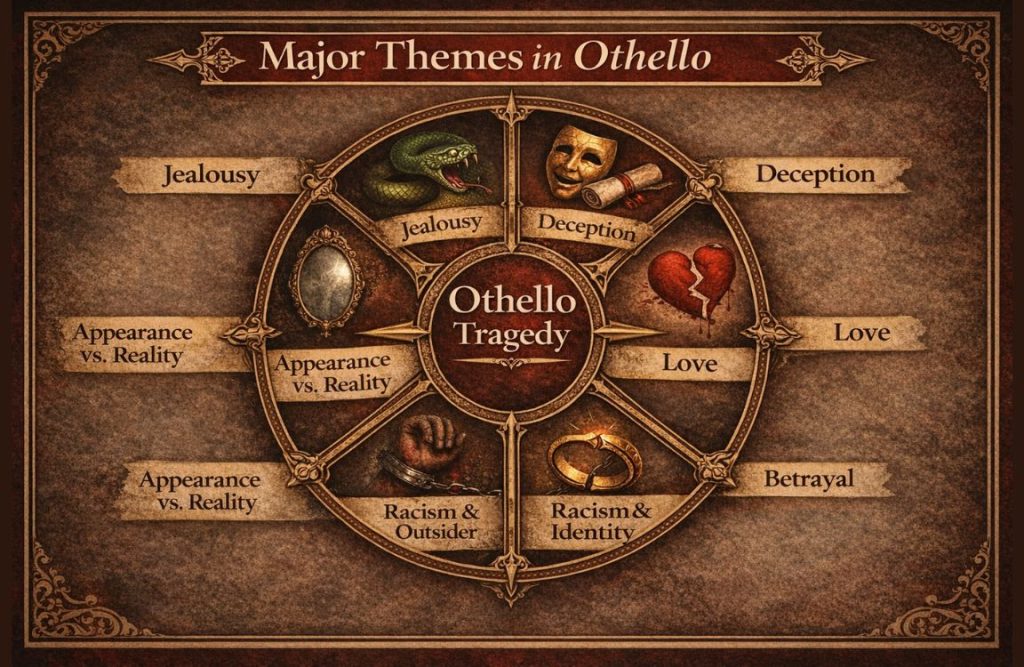
First comes jealousy. In this tragedy, jealousy behaves like a disease. When Iago warns Othello about the “green-eyed monster,” he pretends to protect him while secretly feeding him the poison.
Then we encounter deception. Iago’s genius as a villain lies in appearing trustworthy, “honest Iago.” I often tell my students that deception here works like stage magic: the audience sees the trick, but the characters do not.
Love forms another powerful theme. The relationship between Othello and Desdemona begins with genuine admiration. Yet Shakespeare asks a painful question: what happens when love is poisoned by suspicion?
Betrayal soon follows, built on the tragic confusion between appearance and reality, especially through false “ocular proof.”
Finally, racism and social insecurity quietly intensify the tragedy. Othello, as a Moor in Venetian society, struggles with outsider status, making him vulnerable to manipulation.
Together, these themes create the emotional pressure that drives Shakespeare’s tragedy toward its devastating end.
Why Shakespeare Chose Tragedy for Othello
William Shakespeare chose tragedy for Othello to explore the destructive power of jealousy, manipulation, and racism through the downfall of a noble hero whose fatal flaw leads to catastrophe.
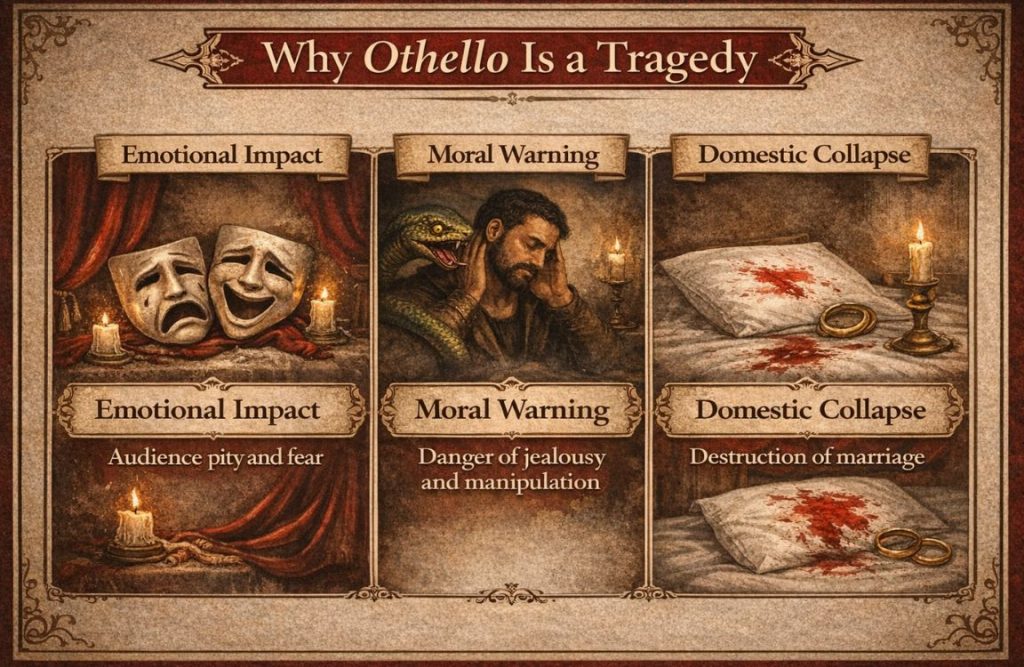
When I discuss this with students, I remind them that Shakespeare rarely chooses tragedy by accident. First, tragedy creates a powerful emotional impact. Watching Othello, a respected outsider in Venice, collapse under jealousy forces the audience to confront human weakness.
Second, tragedy delivers a moral warning about blind trust, manipulation by Iago, and the danger of acting on passion instead of truth.
Finally, the play works as a domestic tragedy, where the real catastrophe is the destruction of Othello’s marriage with Desdemona.
Like a careful chess match, Shakespeare moves the story slowly- until the hero suddenly has no escape.
FAQs:
Is Othello based on a true story?
No, Othello is not based on a true story. William Shakespeare adapted the plot from a fictional Italian tale, “Un Capitano Moro,” in Gli Hecatommithi by Giovanni Battista Giraldi (Cinthio), though scholars believe the story may have been loosely inspired by real historical events.
How is Othello different from other Shakespearean tragedies?
Unlike many tragedies by William Shakespeare that focus on political ambition or supernatural forces, Othello is an intimate domestic tragedy. Its conflict unfolds inside a marriage, driven by Iago’s psychological manipulation and human jealousy rather than kingship, warfare, or fate.
Why is jealousy such an important element in Othello?
Jealousy drives the tragedy of Othello. Through Iago’s manipulation, suspicion turns love into destructive doubt. William Shakespeare portrays jealousy as the “green-eyed monster,” revealing how fear and insecurity can distort truth and collapse trust.
What role does Iago play in shaping the tragedy of Othello?
Iago acts as the central antagonist and chief architect of the tragedy in Othello. Using deception and psychological manipulation, the seemingly “honest” Iago plants suspicion in Othello’s mind, guiding him toward jealousy, mistrust, and the catastrophic decisions that destroy his marriage.
Why does Othello still feel relevant to modern audiences?
Even centuries later, Othello remains powerful because its themes- jealousy, trust, prejudice, and manipulation- reflect enduring human struggles. William Shakespeare shows how insecurity, social “othering,” and misinformation can destroy relationships and remain painfully relevant today.
Conclusion:
The genre of Othello is primarily tragedy, but it also reflects domestic tragedy and classic Shakespearean tragedy.
When I finish teaching Othello by William Shakespeare, I tell my students something simple: this tragedy does not fall from the sky; it grows quietly inside human hearts.
The Othello genre combines heroic downfall with intimate domestic collapse. A respected general loses everything, not on the battlefield, but inside his marriage.
That is the power of tragedy in Othello. Shakespeare shows how jealousy, deception, and fragile trust can slowly turn love into destruction.