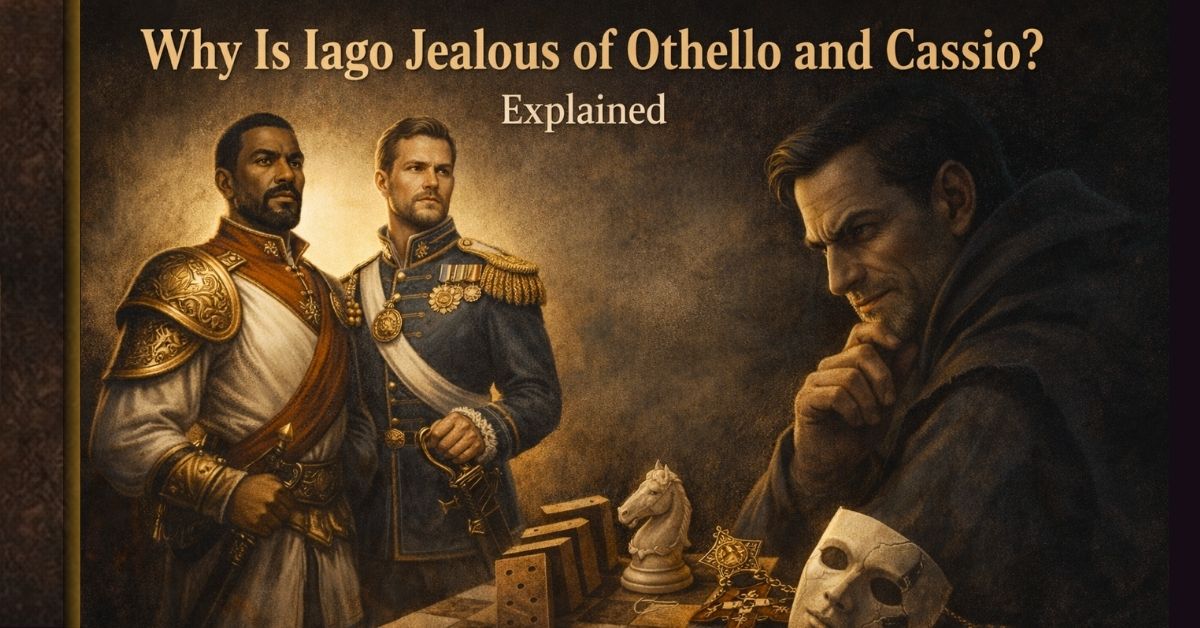
Iago doesn’t force Othello. He guides his thoughts. That’s what makes his manipulation so terrifying. As I tell my students, the most dangerous villain isn’t the one who shouts, but the one who whispers and lets you finish the sentence.
So, how does Iago manipulate Othello? He does it through psychological control, strategic language, and carefully planted “evidence” like the handkerchief.
What fascinates me is that Iago’s manipulation is never sudden. It unfolds gradually, almost invisibly, tightening like a noose. By the time we reach Act 3, Scene 3, the famous “temptation scene”, Othello isn’t being pushed anymore. He’s already falling. And here’s the chilling twist: everyone calls him “honest Iago.”
That word “honest” becomes his greatest weapon. Iago doesn’t just deceive Othello. He rewires how Othello thinks, feels, and ultimately, how he sees truth itself.
Why Does Iago Manipulate Othello?
Now, this is where I always pause in class and ask: Is Iago born evil, or does he choose it? The answer, unsettlingly, refuses to settle.
If you’re wondering why Iago manipulates Othello, the play offers several motives, but none fully satisfy.

First, there’s professional jealousy. Cassio’s promotion wounds Iago’s pride, and that resentment begins to fester. Then comes suspicion. Iago suggests, without proof, that Othello may have been involved with Emilia. Notice how even his reasoning is built on uncertainty.
But we must go deeper. When we ask why Iago is jealous of Othello, it’s not just about rank. It’s about identity. Othello is an outsider who rises above expectations, and Iago cannot bear it. His hatred becomes personal, almost irrational.
And here’s the chilling insight I share with my students: Iago doesn’t just seek revenge. He enjoys control. He manipulates others with precision, treating human emotions like tools.
So, is Iago purely evil? Perhaps not. Shakespeare makes him disturbingly human, driven by envy, suspicion, and desire for power. And that complexity is exactly what makes his manipulation so terrifying.
Table of Contents
How Does Iago Manipulate Othello Step by Step?
In this section, I’ll break down how Iago manipulates Othello step by step, revealing the techniques Iago uses to manipulate Othello, Iago’s psychological manipulation, and how Iago exploits Othello’s weaknesses with chilling precision.
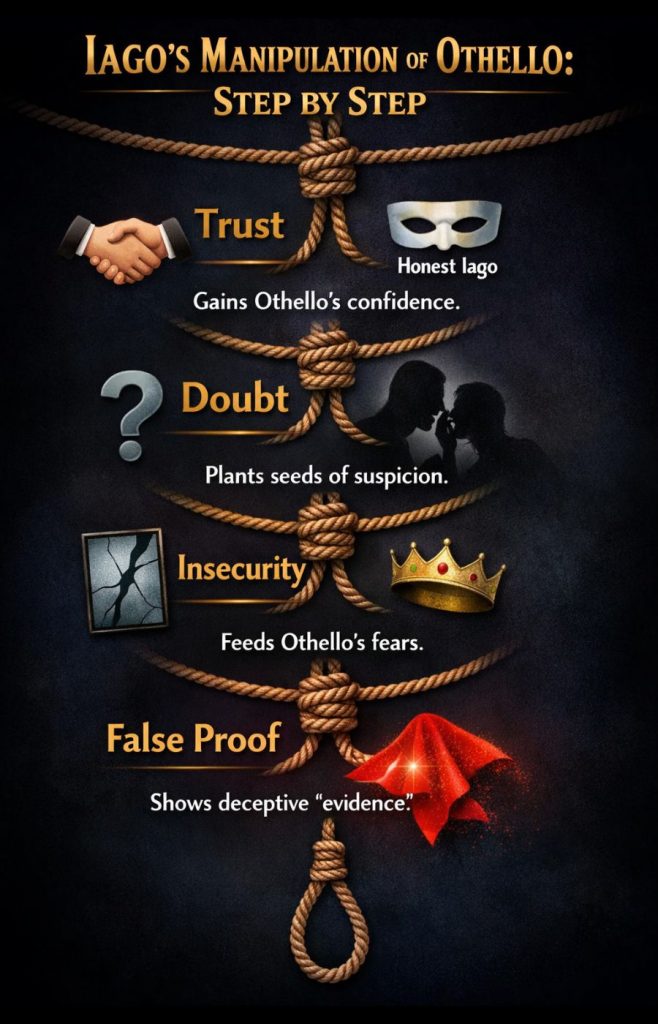
Step 1: Build Trust (“Honest Iago”)
I always tell my students: before Iago poisons Othello’s mind, he sweetens the cup. He carefully builds a reputation for honesty, so every word he later speaks sounds trustworthy.
Othello repeatedly calls him “honest Iago,” and that’s no accident. Iago earns this title through loyalty and service, creating a foundation where doubt seems impossible.
Like a puppet master, he first secures the strings because, without trust, manipulation cannot even begin.
Step 2: Plant Doubt Subtly
Here’s where Iago becomes almost artistic. He never accuses directly. He suggests. I often pause and ask students: Why does he say, ‘I like not that” Because ambiguity forces Othello to think.
Iago plants tiny seeds of suspicion, then steps back, letting Othello’s imagination do the work. Through hesitation and vague hints, he creates doubt without responsibility.
This is manipulation at its most dangerous, when Othello believes the suspicion originates within himself.
Step 3: Exploit Othello’s Insecurities
Now Iago tightens his grip. He understands Othello’s vulnerabilities: his age, outsider identity, and fear of inadequacy. Iago subtly reminds him that Desdemona once deceived her father, suggesting she could deceive again.
This is psychological precision. Iago doesn’t force belief; he reshapes perception. By exploiting insecurity, he turns love into doubt. Othello begins to internalize fear, and once insecurity becomes conviction, manipulation no longer needs reinforcement. It sustains itself.
Step 4: Provide False Proof
Finally, Iago delivers what Othello demands: “ocular proof.” But what he offers is a carefully staged illusion. The handkerchief becomes his masterstroke, planted to fabricate evidence. He even invents stories, like Cassio speaking of Desdemona in his sleep.
I always tell my students, this is where manipulation becomes irreversible. Once false proof appears real, Othello stops questioning. Iago’s role fades because Othello now completes the tragedy himself.
How Does Iago Manipulate Othello in Act 1?
Act 1 is where Iago lays the foundation of his entire scheme, though interestingly, he doesn’t manipulate Othello directly yet. This is something I always emphasize in class: the tragedy hasn’t begun. It’s being carefully prepared.
Instead, Iago carefully constructs his identity. He appears loyal and dependable, quietly building the image of “honest Iago.” At the same time, he engineers chaos behind the scenes. He provokes Brabantio using crude, racially charged language, forcing a public confrontation that unsettles Othello’s newly formed marriage.
Here’s the clever twist: Iago then steps in as Othello’s defender, warning him of danger and appearing protective. This double role, both instigator and ally, secures Othello’s trust.
Meanwhile, through Roderigo, Iago controls how events unfold, shaping perception without direct involvement.
So I tell my students: Act 1 isn’t action. It’s a strategy. Iago is arranging the chessboard, ensuring that when he finally targets Othello, trust is already firmly in place.
How Does Iago Manipulate Othello in Act 2?
If Act 1 is preparation, Act 2 is quiet execution. When students ask me how Iago manipulates Othello in Act 2, I say. He still avoids direct attack; instead, he weakens Othello’s world from the outside.
The key moment is Cassio’s downfall. Iago gets him drunk, exploiting his weakness, and orchestrates a fight that destroys Cassio’s reputation. When Othello arrives, Iago plays the “reluctant” witness, appearing fair while subtly shifting blame onto Cassio. It’s a brilliant move.
I often describe this as strategic erosion. Iago doesn’t break Othello; he removes the pillars supporting him. Without Cassio, Othello loses stability and guidance.
At the same time, Iago advises Cassio to seek Desdemona’s help, carefully setting up future suspicion by turning innocent actions into something questionable.
Nothing here is accidental. Every move strengthens Iago’s image of honesty.
So while Othello appears secure, his world is quietly being reshaped, and he remains completely unaware.
How Does Iago Manipulate Othello in Act 3
Now we arrive at the heart of the tragedy, the “temptation scene.” I tell my students, if you understand this moment, you understand the entire play. This is where we truly see how Iago manipulates Othello in Act 3, and more importantly, how Iago plants jealousy in Othello with devastating precision.
What makes this scene extraordinary is Iago’s restraint. He becomes the “reluctant accuser,” hesitating, pausing, repeating phrases like “think, my lord?” as if unwilling to speak. But this hesitation is performance. It forces Othello to demand answers, making Iago’s suggestions feel like reluctant truths rather than deliberate lies.
Here’s my favorite teaching moment: Who is doing the thinking, Iago or Othello? The answer is unsettling. Iago controls the narrative, but Othello constructs the suspicion himself. Through subtle insinuations, “I like not that” Iago turns innocent moments into imagined betrayal.
Jealousy spreads like an infection. It begins quietly, then overwhelms reason. Iago even warns Othello about jealousy, using reverse psychology to intensify it.
Then comes the turning point, “ocular proof.” Othello demands evidence, and Iago prepares the illusion of it. But by now, proof hardly matters.
This is the moment Iago takes control of Othello’s mind, not by force, but by shaping belief itself.
How Does Iago Manipulate Othello with the Handkerchief?
If Iago is an artist of manipulation, then the handkerchief is his masterpiece. When students ask me how Iago manipulates Othello with the handkerchief, I say. It’s where symbolism becomes deadly.
The handkerchief begins as a token of love, Othello’s first gift to Desdemona, rich with emotional and symbolic value. But Iago transforms it into something else entirely, false “ocular proof.” That transformation is the real trick.

Emilia, unknowingly, becomes his accomplice by giving him the handkerchief. Iago plants it in Cassio’s room, ensuring it will be discovered. Then, with chilling confidence, he fabricates a story, claiming he saw Cassio use it. Suddenly, a private symbol becomes public evidence.
Here’s the crucial insight I share with my students: Othello is already emotionally primed. The handkerchief doesn’t create jealousy. It confirms it.
And that’s the genius of Iago. He doesn’t invent reality. He reshapes it. The handkerchief proves nothing, but it feels undeniable.
In that moment, love turns into suspicion, and Othello chooses illusion over truth.
How Does Iago Use Language to Manipulate Othello?
Language is Iago’s sharpest weapon. When we ask how Iago uses language to manipulate Othello, we’re really asking how words can reshape reality.
Iago rarely speaks directly. Instead, he uses insinuations, rhetorical questions, and strategic pauses. I often tell my students that silence can be louder than speech, and Iago uses silence brilliantly. His hesitation forces Othello to imagine the worst, turning suspicion into self-generated belief.
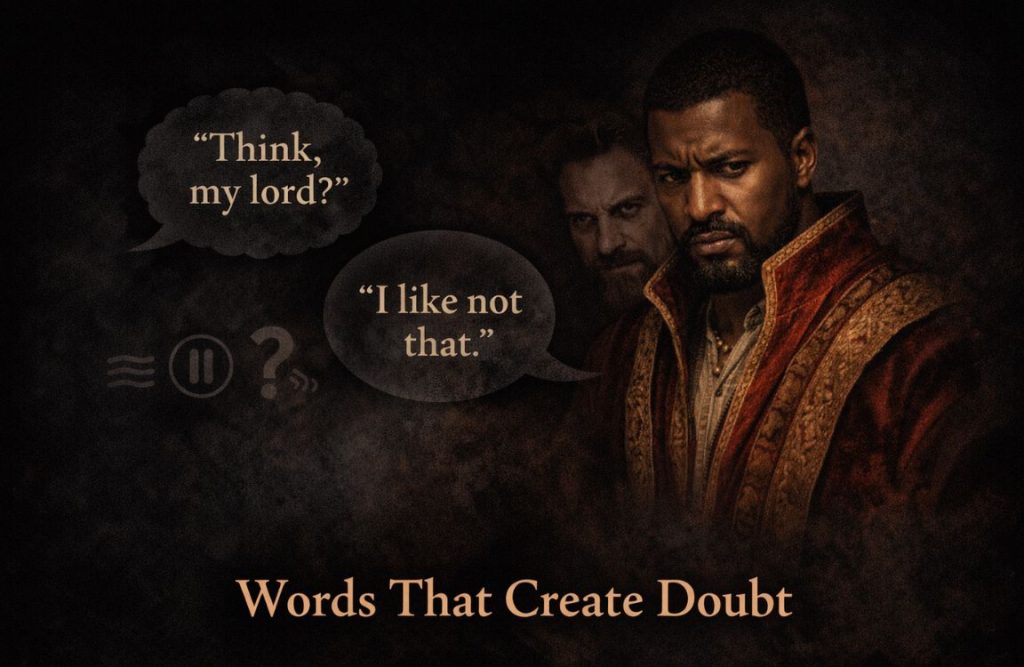
Then there’s the Iago’s honesty motif in Othello. Each time Othello calls him “honest,” the dramatic irony in Iago’s manipulation deepens. We know the truth, but Othello doesn’t.
What fascinates me most is that Iago doesn’t need elaborate lies. A hint, a pause, a carefully chosen word, that’s enough.
In the end, Iago doesn’t just speak to Othello. He teaches Othello how to doubt.
How Does Iago Manipulate Other Characters?
To truly understand Iago, we must look beyond Othello. His genius lies in consistency. He manipulates everyone, just in different ways.
When students ask how Iago manipulates Roderigo, I point to desire. Iago exploits his love for Desdemona, promising success while draining his wealth. As he admits, he makes “a fool his purse,” turning Roderigo into a willing pawn.

If we consider how Iago manipulates Cassio, the method shifts. Cassio values reputation, so Iago engineers his downfall through drink and staged conflict. Then, he advises him to seek Desdemona’s help, twisting honest intentions into future suspicion.
And how does Iago manipulate Emilia? Here, manipulation is quiet. He withholds the truth, relying on trust, so she unknowingly hands over the handkerchief.
This adaptability, I tell my students, is what makes Iago terrifying. He studies people, then reshapes their strengths into weaknesses, and uses them against themselves.
Key Quotes Showing Iago’s Manipulation
When I teach Othello, I always remind my students: sometimes a single line can reveal an entire strategy. Let’s explore a few powerful Iago manipulation quotes that uncover his method.
Take, “O, beware, my lord, of jealousy.” It sounds like advice, but it secretly plants the very emotion it warns against. This is one of the most striking manipulation quotes in Othello because it disguises harm as wisdom.
Then we have, “Men should be what they seem.” I often pause here because no one violates this principle more than Iago himself. It strengthens his “honest” image while deepening the audience’s awareness of his deceit.
But perhaps the most revealing line is, “I am not what I am.” Here, Iago openly declares his deceptive nature, inviting the audience into his secret.
These quotes show us that Iago doesn’t rely on force. He uses language, irony, and simplicity to guide others toward their own destruction.
How Does Iago Manipulate Othello Essay Answer
If I were writing an essay on how Iago manipulates Othello in an exam, I’d keep it sharp and focused.
Iago manipulates Othello through psychological control, strategic suggestion, and false evidence. He first builds trust as “honest Iago,” then subtly plants doubt about Desdemona’s loyalty. By exploiting Othello’s insecurities, he deepens suspicion without direct accusation. Finally, he uses the handkerchief as false proof, convincing Othello of Desdemona’s betrayal. This manipulation is gradual and calculated, allowing Othello to believe the ideas are his own. Ultimately, Iago’s success lies in controlling Othello’s thoughts, leading him to tragic and irreversible actions.
FAQs:
Is Iago aware of how powerful his manipulation is?
Yes, Iago is fully aware of his power. He carefully plans each step, observing reactions and adjusting tactics. His control is deliberate, almost experimental, as he watches others respond to his influence.
Could Othello have resisted Iago’s manipulation?
Possibly, but it’s difficult. Othello’s trust in Iago and his personal insecurities make him vulnerable. Shakespeare suggests tragedy arises not from weakness alone, but from a combination of trust, pressure, and emotional intensity.
What role does trust play in Iago’s manipulation?
Trust is the foundation of Iago’s strategy. Without Othello’s belief in his honesty, none of the manipulation would work. Trust allows lies to appear truthful and makes suspicion feel justified rather than imposed.
Is Iago a realistic manipulator or purely evil?
Iago feels disturbingly realistic. His motives are mixed, unclear, and human. Rather than a simple villain, he reflects how ordinary emotions, jealousy, pride, and resentment can evolve into calculated cruelty when left unchecked.
How does Shakespeare make the audience see Iago’s manipulation?
Shakespeare uses dramatic irony. The audience knows Iago’s intentions while other characters do not. This creates tension, as we watch manipulation unfold step by step, fully aware of the truth behind each action.
Conclusion:
So, how does Iago manipulate Othello? As I tell my students, it’s never just one method. It’s psychological, strategic, and deeply symbolic. Iago’s manipulation of Othello works because it blends suggestion, emotion, and illusion so seamlessly that truth becomes unrecognizable.
But here’s the real tragedy: it all begins with trust. Othello doesn’t fall because he is foolish. He falls because he believes. And that misplaced trust is what makes the manipulation in Othello so painfully human.
If this intrigued you, explore more Othello analysis, and don’t miss our detailed breakdown of why Iago is jealous of Othello and Cassio.